
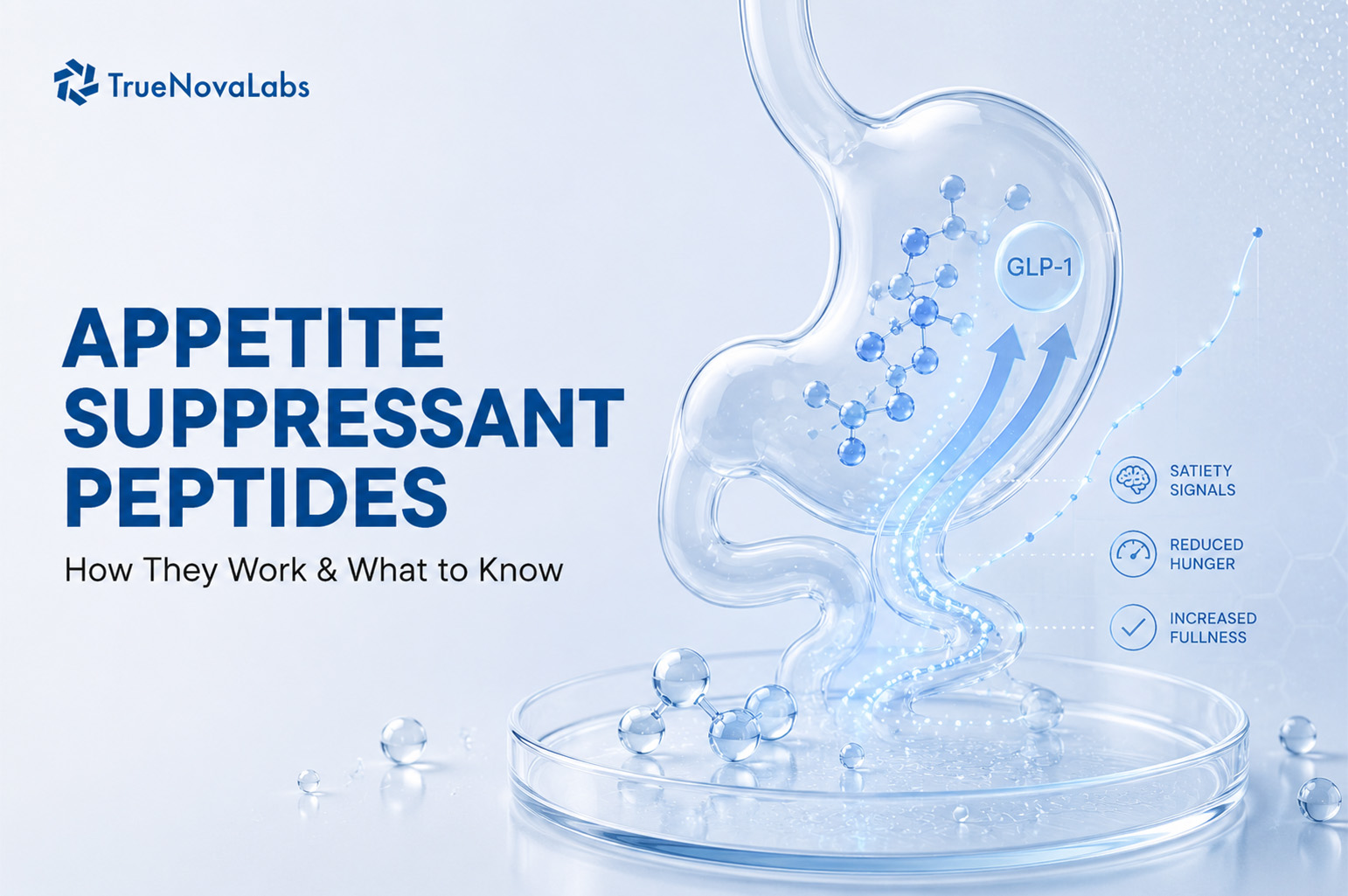
The growing interest in appetite suppressant peptides reflects a shift in how researchers approach weight management. Instead of focusing solely on calorie burn, modern metabolic research looks at how the body regulates hunger, satiety, and energy intake over time.
Appetite is not just a behavioral issue—it is controlled by complex signaling systems involving the brain, digestive system, and hormones. Peptides that influence these systems are being studied for how they may reshape hunger signals rather than override them.
In Canada, many peptides discussed in this space are supplied strictly for laboratory and educational purposes only, not as consumer products. Understanding this context is essential when interpreting their role.
👉 Looking for research-grade peptides with verified purity and transparent sourcing? Explore the collection here SHOP ALL COMPOUNDS
This guide explains how appetite suppressant peptides work, which compounds are commonly studied, and what current research suggests about their potential and limitations.
How Appetite Suppressant Peptides Work
Appetite suppressant peptides are studied for how they interact with biological signaling pathways that regulate hunger and fullness.
Rather than acting as stimulants, many of these peptides influence:
- satiety signaling in the brain
- digestive system feedback loops
- hormone-driven appetite responses
Key pathways often discussed include:
- GLP-1 (glucagon-like peptide-1)
- GIP (glucose-dependent insulinotropic polypeptide)
- amylin-related signaling
These systems help determine:
- when hunger is triggered
- how strong cravings feel
- how quickly fullness is reached
What makes this approach different is that it targets internal regulation, not just temporary suppression.

Popular Peptides Used for Appetite Control
Several peptides are frequently discussed in research because of their connection to appetite-related pathways.
Semaglutide is widely studied for its effect on GLP-1 receptors, particularly in relation to satiety and reduced food intake. Tirzepatide expands on this by combining GLP-1 and GIP pathway activity, allowing researchers to explore more complex metabolic signaling.
Cagrilintide is another compound of interest, often studied for its interaction with amylin pathways and its role in fullness perception.
These peptides are not identical. Each influences different aspects of appetite regulation, which is why their research profiles vary.
Appetite suppressant peptides explained. Learn how they regulate hunger, cravings, and energy intake—explore Tirzepatide
Appetite suppressant peptides explained. Learn how they regulate hunger, cravings, and energy intake—explore Semaglutide 5mg
Effects on Hunger and Cravings
One of the most important areas of study is how these peptides influence subjective hunger experience.
Instead of eliminating hunger completely, they are often associated with:
- reduced intensity of hunger signals
- earlier onset of satiety
- changes in food-related decision-making
This shift can influence how much energy is consumed over time.
Cravings may also change—not necessarily disappearing, but becoming less dominant in decision-making processes.
These effects are subtle but significant, as they impact behavioral patterns rather than isolated moments.
Potential Benefits for Weight Management
From a research perspective, appetite suppressant peptides are often associated with:
- more consistent eating patterns
- reduced variability in energy intake
- improved satiety signaling
These changes may contribute to gradual shifts in energy balance, which is a key factor in weight-related outcomes.
However, it is important to understand that these peptides are not standalone solutions. Their effects are studied within the context of broader systems involving:
- metabolism
- hormonal balance
- lifestyle factors
Results are typically:
- gradual
- dependent on context
- influenced by multiple variables
Risks and Side Effects
Because appetite suppressant peptides interact with hormonal and digestive systems, some research observations include:
- digestive-related responses
- changes in appetite patterns
- temporary adjustments in energy levels
However, many risks are not directly tied to the peptide mechanism, but to:
- purity and quality
- improper storage
- contamination during preparation
- inconsistent sourcing
Peptides are sensitive compounds, and degradation can alter their behavior significantly.
In Canada, substances are regulated based on classification and intended use by organizations such as Health Canada, reinforcing the importance of proper context.
👉 For consistent research outcomes, explore peptides backed by verified testing here SHOP ALL COMPOUNDS

Lifestyle Factors That Influence Results
One of the most important points in appetite-related research is that peptides do not act in isolation.
Their effects are influenced by:
- dietary patterns
- sleep quality
- stress levels
- activity levels
For example, poor sleep or high stress may affect hunger signaling independently of any peptide interaction.
This is why research focuses on systems, not single variables.
Understanding how peptides interact with lifestyle factors is essential for interpreting results accurately.
Learn how appetite suppressant peptides may influence hunger, cravings, and satiety in research—explore related weight loss peptide insights at Peptides for Weight Loss: Benefits, Mechanisms & What to Expect
FAQ
What are appetite suppressant peptides?
They are peptides studied for how they influence hunger, satiety, and energy intake through biological signaling pathways.
Do they completely eliminate hunger?
No. They are associated with modifying hunger signals rather than removing them entirely.
How do they differ from traditional appetite suppressants?
Traditional suppressants often rely on stimulation, while peptides are studied for regulatory signaling effects.
Are these peptides approved in Canada?
Many are classified as research peptides and are not approved therapeutic products unless regulated under pharmaceutical frameworks.
Why is peptide quality important?
Purity and proper handling affect stability and consistency in research outcomes.
Conclusion
The study of appetite suppressant peptides represents a shift toward understanding how the body regulates hunger at a deeper level.
Rather than forcing short-term changes, these compounds are explored for how they influence:
- satiety signaling
- appetite regulation
- energy intake behavior
- metabolic balance
Their effects are gradual and depend on a wide range of factors, including biological variability and lifestyle context.
For researchers in Canada, reliable outcomes depend on:
- high-quality sourcing
- proper storage and handling
- understanding of biological systems
- realistic expectations
Explore Research-Grade Peptides
If you’re looking for peptides supported by verified purity, transparent sourcing, and consistent quality standards, explore the full collection here SHOP ALL COMPOUNDS
Disclaimer:
This content is provided by True Nova Labs for educational and research purposes only. It is not intended to diagnose, treat, cure, or prevent any disease, nor to provide medical or legal advice.




3 Comments
Nicole Evans
Really interesting article and very easy to understand. I liked how you explained the way appetite suppressant peptides may influence hunger signals instead of just focusing on weight loss results alone. The balanced approach made the information feel much more credible.
Jason Murphy
Great breakdown of a topic that’s getting a lot more attention lately. The section discussing appetite regulation and metabolism was especially helpful because many articles online oversimplify it. I’d love to read a follow-up comparing different peptide options in more detail.
Lauren Phillips
Very informative and practical overall. I appreciate that the article mentioned realistic expectations and individual response differences instead of making exaggerated claims. That makes the content feel much more trustworthy and professional.