
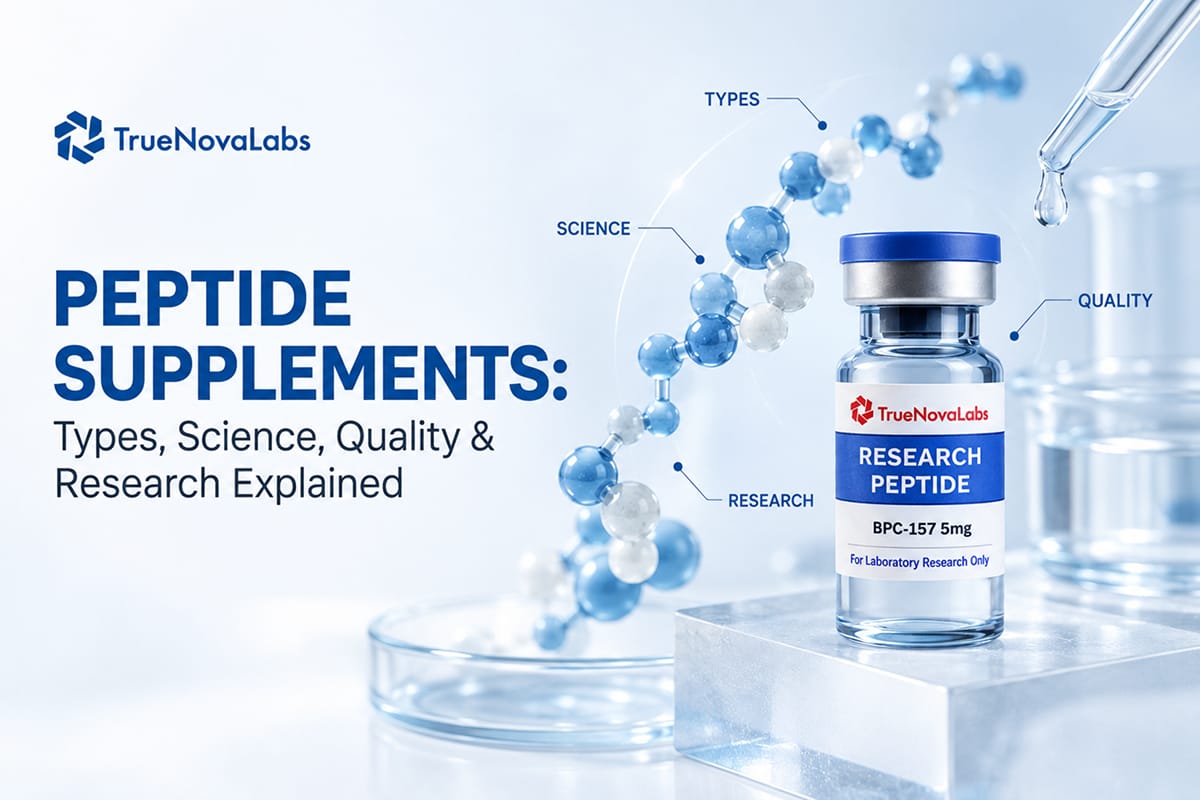
Peptide supplements now appear across nutrition, wellness, and scientific research. However, the term covers very different products, from collagen peptides and protein hydrolysates to laboratory-made compounds used in research. Therefore, readers need to understand the category before they compare claims, evidence, or quality.
Peptides consist of short chains of amino acids connected through peptide bonds. Although amino acids form the basic units, sequence, size, structure, stability, and formulation can change how a peptide behaves. As a result, researchers do not treat all peptide products as interchangeable.
👉 Explore research-focused peptide resources and learn more about current peptide science at True Nova Labs
This guide explains the main types of peptide supplements, how they differ from amino acids, how manufacturers formulate them, what current research shows, and which quality factors matter in Canada.
What Are Peptide Supplements?
Peptide supplements generally contain short chains of amino acids rather than only free amino acids or intact proteins. For example, collagen peptide powders contain smaller fragments that come from larger collagen proteins.
However, the phrase “peptide supplements” can create confusion. Nutritional peptides, food-derived bioactive peptides, and synthetic research peptides serve different purposes. In addition, Canadian regulators may place them in different categories depending on ingredients, intended use, dosage form, route of administration, and product claims.
For natural health products, Health Canada uses a product-licensing system. Therefore, authorized products in this category carry a Natural Product Number, or NPN. Prescription drugs follow a different pathway.
So, the word “peptide” describes a molecular structure rather than one single product category.
👉 Learn more about performance and recovery peptides at SHOP ALL COMPOUNDS
What Types of Peptide Supplements Exist?
Researchers and consumers encounter several common peptide categories.
| Type | Typical Source | Main Research Interest |
|---|---|---|
| Collagen peptides | Hydrolyzed collagen | Skin, connective tissue, nutrition |
| Protein hydrolysates | Milk, whey, soy, egg, or plants | Digestion and nutrient absorption |
| Food-derived bioactive peptides | Hydrolysis or fermentation | Cellular and physiological signaling |
| Short nutritional peptides | Selected amino-acid sequences | Absorption and metabolism |
| Synthetic research peptides | Laboratory synthesis | Specific molecular pathways |
Collagen Peptides
Collagen peptides remain one of the best-known forms of peptide supplements. Manufacturers break larger collagen proteins into smaller fragments, which changes their molecular-size profile and often improves solubility.
Researchers have examined collagen peptides in studies involving skin, connective tissue, joint-related outcomes, and protein nutrition. However, source material, dose, molecular-weight distribution, and study design can influence results.
Food-Derived Bioactive Peptides
Food proteins can release short peptide sequences during digestion, fermentation, or enzymatic processing. Moreover, some sequences show biological activity in laboratory models.
Scientists study whether these peptides influence signaling pathways, enzyme activity, or other physiological processes. Nevertheless, laboratory activity alone does not prove a meaningful effect in humans.
Synthetic Research Peptides
Laboratories can synthesize peptides with specific sequences for controlled experiments. Therefore, researchers can study targeted pathways with greater molecular precision.
However, synthetic research peptides should not automatically fall under the same category as conventional nutritional supplements.
How Are Peptide Supplements Different From Individual Amino Acids?
Amino acids act as individual building blocks, while peptides connect several amino acids in a specific order.
Amino acids = individual units
Peptides = organized amino-acid sequences
This organization matters because cells may recognize a peptide sequence differently from the same amino acids consumed separately.
Digestion also changes the picture. After oral intake, peptides encounter stomach acid, digestive enzymes, intestinal enzymes, mucus, and transport systems. Consequently, some peptides break into smaller fragments, while others may remain intact long enough for absorption.
Researchers therefore examine molecular size, sequence, gastrointestinal stability, transport mechanisms, and surrounding nutrients. Because these variables differ between products, scientists cannot assume that every peptide supplement has the same bioavailability.
How Are Peptide-Based Products Formulated?
Formulation depends on the product category.
For nutritional peptide products, manufacturers often start with a protein source and use controlled enzymatic hydrolysis. Next, they filter, purify, concentrate, dry, and package the material.
The process may include:
- Protein extraction
- Enzymatic hydrolysis
- Filtration and purification
- Concentration and drying
- Packaging and quality checks
However, small manufacturing changes can alter the final peptide profile. For instance, different enzymes may create different peptide sizes and sequences.
Synthetic research peptides require tighter identity control. Therefore, laboratories may use chromatography and mass spectrometry to assess molecular identity, purity, molecular mass, and potential impurities.
Storage also affects quality. Heat, moisture, light, oxidation, and unsuitable pH conditions can damage peptide-containing materials. Consequently, researchers should review storage guidance alongside composition and purity data.
👉 Explore the science behind supplement ingredients, research methods, and quality evaluation in Supplements: Science, Ingredients, Research & Quality Standards Explained.
What Does Current Research Say About Peptide Supplements?
Research findings depend heavily on the peptide category.
Collagen peptides have received substantial attention in human studies. Researchers have explored skin-related outcomes, connective-tissue markers, joint-related measures, and nutritional applications. Meanwhile, scientists continue to study food-derived peptides for digestion, absorption, and biological activity.
However, evidence quality varies. Two studies may use different sources, molecular-weight profiles, daily amounts, study durations, or participant groups. Therefore, researchers should avoid applying findings from one formulation to every product with a similar name.
Bioavailability also remains important. A peptide may show activity in a laboratory assay, yet digestion may reduce that activity before the molecule reaches a relevant biological target.
As a result, strong research asks two questions: Can the peptide influence a pathway, and can it reach that pathway under realistic conditions?
What Factors Influence Peptide Supplement Quality?
Quality can vary even when two products look similar on the label. Therefore, researchers should evaluate several factors together.
| Quality Factor | Why It Matters |
|---|---|
| Raw material source | Influences composition and contamination risk |
| Peptide identity | Confirms the intended compound or sequence |
| Purity | Helps identify unwanted materials |
| Molecular-weight profile | Can affect digestion and absorption |
| Manufacturing controls | Improve batch consistency |
| Analytical testing | Supports identity and composition claims |
| Storage conditions | Help protect stability |
| Batch documentation | Supports research reproducibility |
For research materials, documentation becomes especially important. Researchers may review batch numbers, purity data, analytical reports, storage guidance, and manufacturing information before selecting a compound.
👉 Learn more about performance and recovery peptides at SHOP ALL COMPOUNDS
Key Research Limitations to Consider
Peptide research continues to expand. However, several limitations still shape the evidence.
Bioavailability Can Differ
Oral peptides may break down during digestion. Therefore, a strong laboratory result does not automatically predict the same outcome after oral consumption.
Formulations Are Not Interchangeable
Different raw materials and manufacturing methods can create different peptide profiles. Consequently, researchers should not transfer results from one formulation directly to another.
Human Evidence Remains Uneven
Some peptide supplements have controlled human studies, while other claims rely mainly on cell or animal research. Therefore, each product requires its own evidence review.
Mechanisms Do Not Prove Outcomes
A plausible pathway can support a research hypothesis. However, it does not prove a meaningful human outcome on its own.
Canadian Regulation Depends on Product Type
In Canada, natural health products and prescription drugs follow different regulatory pathways. Therefore, nutritional peptide supplements and synthetic research peptides should not be treated as one category.
👉 MORE:
FAQ About Peptide Supplements
What are peptide supplements made from?
Many products come from collagen, milk, whey, soy, egg, or plant proteins. Manufacturers may use hydrolysis to create smaller peptide fragments. In addition, laboratories can synthesize defined peptide sequences for research.
Are peptide supplements the same as protein powder?
No. Protein powders usually contain larger proteins, while peptide products may contain smaller fragments created from those proteins.
Are peptides the same as amino acids?
No. Amino acids exist as individual units, while peptides connect multiple amino acids in a specific sequence.
Are peptide supplements absorbed intact?
Not always. Some peptides break down during digestion. Meanwhile, others may remain stable enough for partial or intact absorption.
What determines peptide supplement quality?
Researchers should consider source material, identity, purity, manufacturing controls, analytical testing, storage conditions, and batch documentation.
Are research peptides dietary supplements in Canada?
Not automatically. Canadian classification depends on factors such as intended use, formulation, claims, and route of administration.
Conclusion
Peptide supplements include several distinct product types, from collagen peptides and protein hydrolysates to food-derived and synthetic research peptides. Because each category differs in composition and intended use, readers should evaluate products based on their formulation, evidence, quality controls, and research purpose.
Current research continues to expand, but important limitations remain. Bioavailability can vary, formulations are not interchangeable, and human evidence may still lag behind laboratory findings. Therefore, product-specific research provides a stronger basis for evaluation than broad claims about peptides as a whole.
For Canadian audiences, regulatory classification also matters because nutritional products and synthetic research compounds may follow different requirements. True Nova Labs focuses on research-oriented peptide education, analytical testing, compound information, and quality documentation to support more informed research decisions.d information, and quality documentation to help readers assess peptide science more clearly.
👉 Explore educational resources and research-focused peptide information at TrueNovaLabs.
Disclaimer:
This content is provided by True Nova Labs for educational and research purposes only. It is not intended to diagnose, treat, cure, or prevent any disease, nor to provide medical or legal advice.



3 Comments
Olivia Sterling
I found the discussion around peptide supplements useful, especially because the terminology can sometimes be confusing. Clarifying the differences between commercially marketed supplements and compounds studied in laboratory research provides important context for readers.
Benjamin Prescott
The article raises an important point about evaluating peptide-related products based on evidence rather than marketing claims. I also appreciate the emphasis on understanding ingredients, product quality, and the limitations of available research.
Rachel Beaumont
I liked the practical perspective on peptide supplements and the importance of understanding what the available evidence actually supports. This is especially useful for distinguishing general supplement discussions from the more controlled research conducted on specific peptide compounds.