
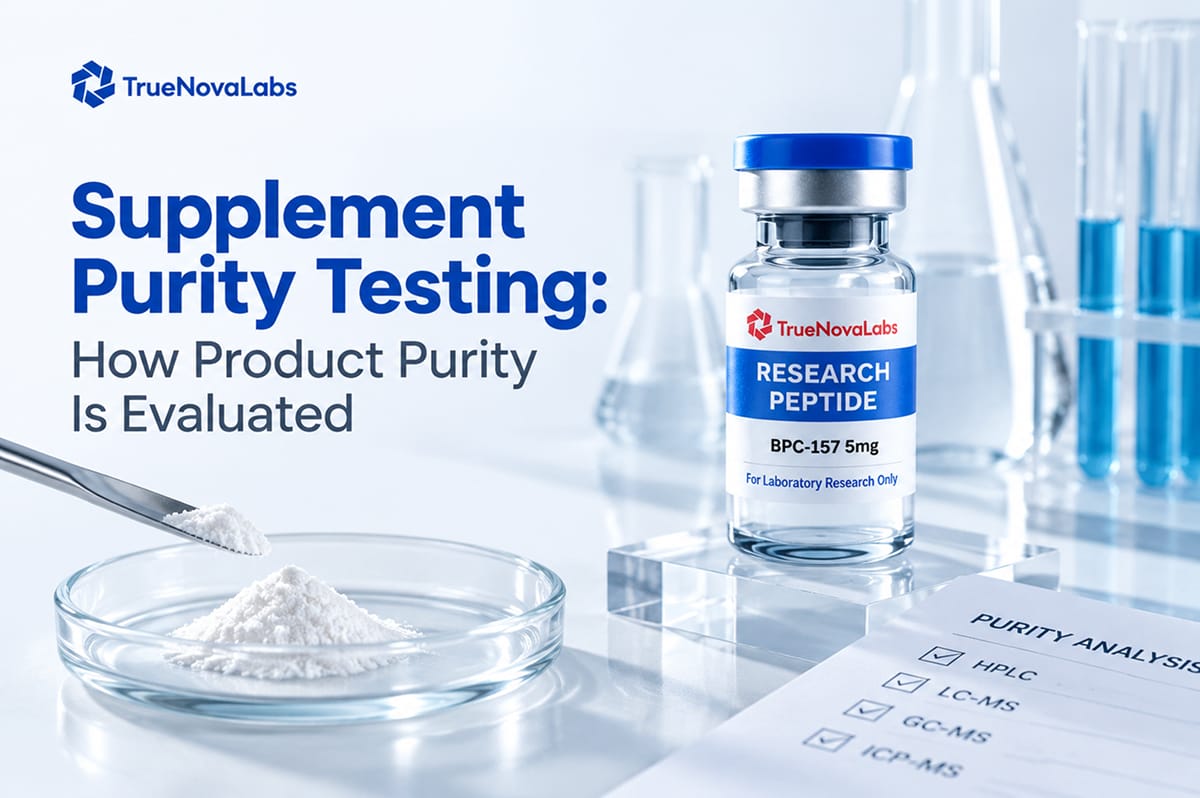
Supplement purity testing plays an important role in understanding the composition, consistency, and reliability of ingredients used in research and product development. As the supplement industry continues to expand in Canada and globally, researchers increasingly rely on analytical methods to evaluate ingredient characteristics beyond basic product labels.
However, ingredient labels alone do not always provide complete information about a material’s composition. Therefore, researchers examine purity levels, potential impurities, and analytical profiles to determine whether a sample matches expected specifications.
Currently, laboratories use advanced techniques such as High-Performance Liquid Chromatography (HPLC), mass spectrometry, and chromatography to analyze ingredient composition. These methods help researchers compare samples, evaluate consistency, and better interpret scientific data.
In Canada, supplement-related products are evaluated based on factors such as classification, intended use, ingredients, and product claims. As a result, transparent testing practices remain important for researchers who evaluate supplement-related compounds.
👉 Explore research-focused peptide resources and learn more about current peptide science at True Nova Labs
This guide explains how supplement purity testing works, what purity means in analytical evaluation, which methods laboratories use, and how researchers interpret purity data.
What Is Supplement Purity Testing?
Supplement purity testing is a laboratory process that evaluates the composition of an ingredient sample and determines the amount of the intended compound present.
Unlike basic ingredient identification, purity testing examines the complete profile of a sample. Researchers use this process to identify unwanted substances and understand whether a material meets expected quality specifications.
Generally, supplement purity testing focuses on several key areas:
| Testing Area | Purpose |
|---|---|
| Target compound percentage | Measures the amount of intended ingredient present |
| Impurity profile | Identifies unwanted substances within the sample |
| Batch consistency | Compares characteristics between production batches |
| Analytical profile | Provides detailed composition information |
For example, researchers studying peptide-related compounds analyze purity profiles to confirm whether samples contain expected structures with minimal unwanted components.
Furthermore, purity testing allows researchers to understand the exact materials used during experiments. Therefore, it supports more accurate interpretation of scientific findings.
👉 Learn more about performance and recovery peptides at SHOP ALL COMPOUNDS
What Does Purity Mean in Analytical Testing?
Specifically, in analytical testing, purity refers to the proportion of the target compound compared with other substances detected within a sample.
However, purity represents only one part of ingredient evaluation. Researchers also consider identity, potency, stability, and documentation to create a broader understanding of quality.
| Measurement | Purpose |
|---|---|
| Purity | Measures the amount of target compound present |
| Identity | Confirms the specific compound being analyzed |
| Potency | Determines active ingredient concentration |
For instance, a sample may demonstrate a high purity percentage, but researchers still need identity testing to verify that the material matches the expected compound.
Additionally, testing conditions, analytical methods, and sample preparation can influence results. Therefore, researchers must understand the testing process before interpreting purity data.
👉 Learn how researchers identify and evaluate active ingredients in Supplement Ingredients Research: How Active Ingredients Are Studied.
What Types of Impurities Can Testing Detect?
Supplement purity testing can identify different categories of unwanted substances depending on the ingredient and analytical method.
For this reason, common impurity types include:
| Impurity Type | Description |
|---|---|
| Related compounds | Similar substances created during synthesis or processing |
| Residual materials | Remaining substances from manufacturing procedures |
| Degradation products | Compounds formed when ingredients change over time |
| External contaminants | Unwanted substances introduced during handling |
For peptide research, impurity analysis is especially important because small molecular differences may influence experimental interpretation.
Similarly, other supplement ingredients may require specific testing approaches based on their chemical structure and production methods.
Moreover, impurity detection provides researchers with additional information about whether a sample meets expected research specifications.
How Is Supplement Purity Measured?
Researchers measure supplement purity by using analytical techniques that separate, identify, and quantify different components within a sample.
The selected method depends on the ingredient type and the information researchers need to obtain.
| Method | Purpose |
|---|---|
| Chromatography | Separates different compounds within a sample |
| HPLC | Evaluates purity profiles and compound separation |
| Mass spectrometry | Examines molecular characteristics |
| Spectroscopy | Studies chemical properties |
For example, HPLC helps researchers separate compounds and compare the target ingredient with other components found within a sample.
Meanwhile, mass spectrometry provides additional molecular information and supports compound analysis.
Together, these methods create a more complete understanding of ingredient composition.
What Analytical Methods Are Commonly Used?
Additionally, researchers use several analytical techniques to evaluate supplement purity. Each method provides different information about ingredient characteristics.
High-Performance Liquid Chromatography (HPLC)
HPLC is one of the most common analytical methods used for purity evaluation.
Specifically, researchers use HPLC to:
- separate chemical components
- measure purity profiles
- compare samples
- evaluate batch consistency
For peptide-related research, HPLC helps researchers determine whether a sample demonstrates the expected analytical profile.
Mass Spectrometry
Mass spectrometry examines molecules based on their mass-to-charge ratio.
In addition, researchers use this method to:
- analyze molecular characteristics
- support compound identification
- detect specific components
Furthermore, laboratories may combine HPLC and mass spectrometry because each technique provides different analytical information.
Therefore, multiple testing approaches often create a more complete evaluation of ingredient quality.
👉 Explore the science behind supplement ingredients, research methods, and quality evaluation in Supplements: Science, Ingredients, Research & Quality Standards Explained.
Purity vs Identity vs Potency
Purity, identity, and potency describe different aspects of ingredient evaluation. Understanding these differences helps researchers interpret laboratory results more effectively.
| Category | Main Question | Research Purpose |
|---|---|---|
| Purity | How much target compound exists? | Evaluates composition |
| Identity | Is this the expected compound? | Confirms authenticity |
| Potency | How much active material is present? | Measures concentration |
Generally, identity testing confirms that researchers analyze the correct compound.
Meanwhile, purity testing examines the proportion of the intended material and identifies other substances.
Finally, potency testing measures the concentration of active ingredients.
Together, these measurements provide a broader understanding of ingredient characteristics and support more accurate research evaluation.
What Are the Limitations of Purity Results?
Although supplement purity testing provides valuable information, researchers must understand that purity results represent only one part of ingredient evaluation.
However, a purity percentage does not explain every characteristic of a material. For example, it does not directly describe stability, storage conditions, or performance under different research environments.
Additionally, results may vary depending on:
| Factor | Impact |
|---|---|
| Analytical method | Different methods provide different measurements |
| Sample preparation | Can influence testing accuracy |
| Laboratory procedures | May affect interpretation |
| Testing conditions | Can influence analytical results |
Therefore, researchers should avoid evaluating ingredient quality based only on purity results.
Instead, they should review purity data together with identity, potency, documentation, and other analytical information.
👉 Learn more about performance and recovery peptides at SHOP ALL COMPOUNDS
How to Interpret Purity Testing Data
Interpreting purity testing data requires understanding both the result and the analytical process behind it.
For this reason, researchers commonly review several important factors:
| Data Point | Importance |
|---|---|
| Purity percentage | Shows target compound proportion |
| Testing method | Explains how results were generated |
| Batch information | Identifies tested material |
| Documentation | Provides testing context |
For example, a purity result may show the percentage of a target compound. However, researchers still need identity analysis to confirm that the compound matches the expected ingredient.
Furthermore, combining multiple sources of information allows researchers to create a more complete evaluation of ingredient quality.
👉 Explore how researchers evaluate purity, identity, potency, and verification in Supplement Quality & Testing: Purity, Identity, Potency & Verification.
FAQ About Supplement Purity Testing
What is supplement purity testing?
Supplement purity testing is a laboratory process that evaluates ingredient composition and identifies substances within a sample.
Why is supplement purity testing important?
It helps researchers understand ingredient consistency, evaluate composition, and identify potential impurities that may affect research interpretation.
What is the difference between purity and identity testing?
Purity testing measures the amount of target compound present, while identity testing confirms the specific compound being analyzed.
What methods are used for supplement purity testing?
Researchers commonly use HPLC, chromatography, mass spectrometry, and spectroscopy to evaluate ingredient composition.
Does high purity mean an ingredient is fully verified?
No. Purity provides important information, but researchers also review identity, potency, stability, and documentation.
Why do researchers use multiple testing methods?
Different methods provide different types of information. Therefore, combining analytical approaches creates a more complete quality assessment.
How does HPLC support purity testing?
HPLC separates and analyzes compounds, helping researchers evaluate purity profiles and ingredient consistency.
Conclusion
Supplement purity testing provides important information about ingredient composition, consistency, and analytical characteristics.
Rather than relying only on product labels, researchers evaluate purity together with identity, potency, testing methods, and documentation.
Furthermore, analytical techniques such as HPLC and mass spectrometry allow researchers to better understand ingredient profiles and identify potential impurities.
For Canadian researchers and organizations, transparent purity testing information supports more accurate evaluation of supplement-related compounds.
Ultimately, understanding supplement purity testing helps readers better interpret scientific data and recognize the importance of analytical verification.
👉 Explore educational resources and research-focused peptide information at TrueNovaLabs.
Disclaimer:
This content is provided by True Nova Labs for educational and research purposes only. It is not intended to diagnose, treat, cure, or prevent any disease, nor to provide medical or legal advice.



3 Comments
Marcus Hartwell
The discussion of supplement purity testing is useful for understanding why analytical verification matters when evaluating different ingredients. I particularly liked the focus on identifying impurities and confirming the consistency of the material being tested.
Emma Rutherford
I appreciate the emphasis on laboratory testing rather than relying solely on product claims. Understanding how purity is assessed and what analytical data can reveal gives researchers a clearer way to evaluate the quality of a sample.
Caleb Hartwell
This is a helpful overview of why purity testing is an important part of supplement research. Clear analytical results can make it easier to compare samples and identify potential differences in composition or quality.