
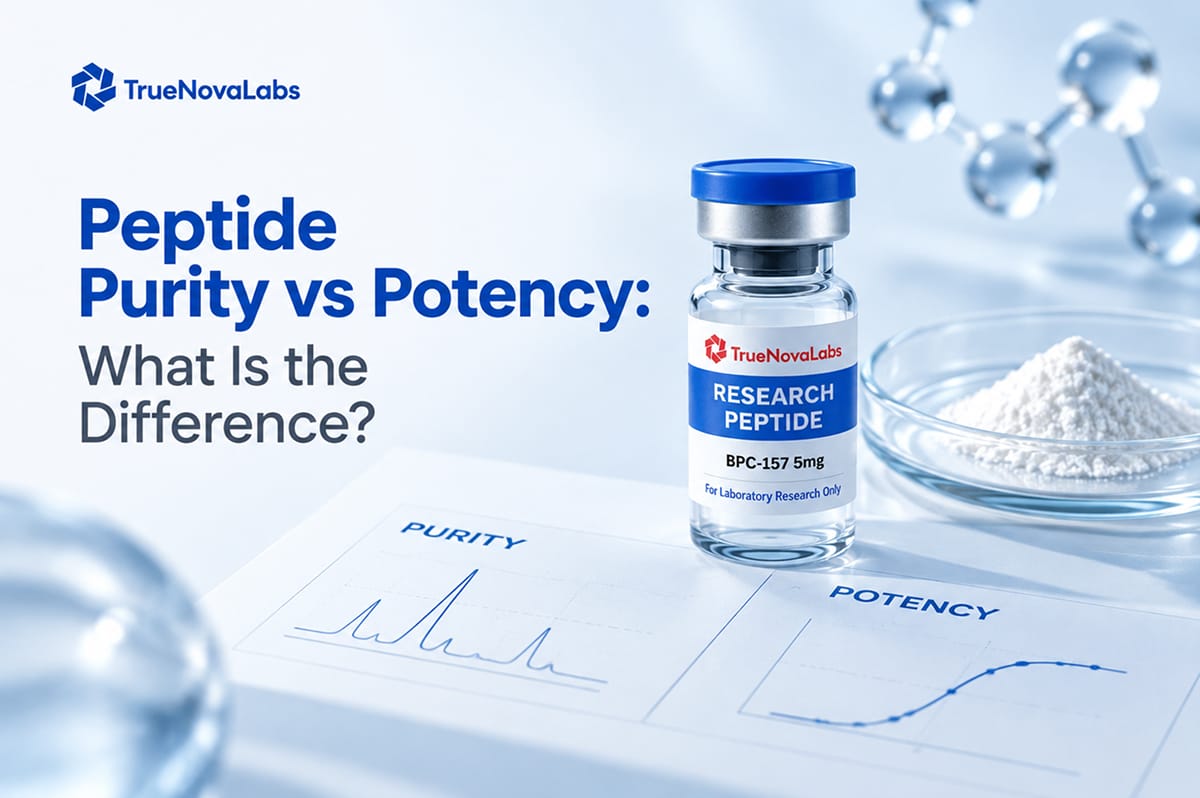
Peptide research requires accurate evaluation of ingredient characteristics to help researchers understand the materials used in scientific studies. Among the key factors in peptide analysis, purity and potency are two important measurements. Although these terms are often discussed together, they describe different aspects of peptide evaluation.
As peptide research continues to expand in Canada and worldwide, laboratories use advanced analytical methods to examine peptide characteristics. However, many discussions focus only on purity while overlooking the importance of potency. Therefore, understanding peptide purity vs potency helps researchers interpret analytical results more accurately.
👉 Explore research-focused peptide resources and learn more about current peptide science at True Nova Labs
Furthermore, methods such as High-Performance Liquid Chromatography (HPLC) and mass spectrometry allow researchers to evaluate peptide composition, concentration, and characteristics more effectively. This guide explains the differences between peptide purity and potency, how researchers measure them, and why both factors matter in peptide research.
What Is Peptide Purity?
Peptide purity refers to the percentage of the intended peptide compared with other substances detected within a sample.
Generally, purity analysis answers the question:
“How much of the sample consists of the target peptide?”
During peptide production and analysis, a sample may contain different components, including the intended peptide, related compounds, residual materials, or degradation products.
| Component | Description |
|---|---|
| Target peptide | The intended peptide compound being analyzed |
| Related compounds | Similar peptide fragments or production by-products |
| Residual materials | Remaining substances from processing procedures |
| Degradation products | Compounds formed when peptides change over time |
For example, researchers studying peptide compounds may evaluate purity to determine whether a sample contains the expected peptide structure with minimal unwanted components.
However, a purity percentage only describes the composition of the sample. It does not automatically explain concentration, stability, or measurable characteristics of the peptide.
Therefore, researchers usually evaluate purity together with other analytical information to gain a more complete understanding.
👉 Learn more about performance and recovery peptides at SHOP ALL COMPOUNDS
What Is Peptide Potency?
In contrast, peptide potency refers to the measurable concentration or characteristics of a peptide under defined testing conditions.
While purity examines what exists inside a sample, potency focuses on the amount or measurable properties of the target peptide.
Specifically, researchers may evaluate potency through factors such as:
| Potency Factor | Research Consideration |
|---|---|
| Peptide concentration | Determines the amount of target peptide present |
| Quantitative analysis | Measures specific peptide levels |
| Analytical response | Reviews testing results from laboratory methods |
| Sample comparison | Evaluates consistency between samples |
For instance, two peptide samples may demonstrate similar purity levels but produce different potency results because their concentrations or analytical characteristics may differ.
Additionally, potency evaluation depends on the peptide type, testing method, and research objectives. As a result, researchers interpret potency data within the context of the analytical process used.
Peptide Purity vs Potency: Key Differences
Although peptide purity and potency are closely related, they answer different research questions.
| Category | Peptide Purity | Peptide Potency |
|---|---|---|
| Main Focus | Sample composition | Peptide concentration or measurable characteristics |
| Main Question | What percentage of the sample is the target peptide? | How much measurable peptide is present? |
| Evaluation Purpose | Identifies composition and impurities | Evaluates concentration or analytical performance |
| Common Methods | HPLC, mass spectrometry | Quantitative and analytical evaluation methods |
In simple terms, purity evaluates the quality of composition, while potency evaluates the amount or measurable characteristics of the peptide.
Furthermore, a purity result alone does not provide a complete picture of peptide quality. Similarly, potency data without purity analysis may not show whether unwanted compounds exist.
Therefore, researchers consider both measurements together when evaluating peptide samples.
Does High Peptide Purity Mean High Potency?
High peptide purity does not always mean high potency.
Although a high purity percentage indicates that a sample contains a large proportion of the intended peptide, potency depends on additional factors.
For example, two samples may both demonstrate high purity, but one sample may contain a different concentration of the target peptide. Consequently, their potency measurements may not be identical.
Moreover, peptide structure, analytical conditions, and sample characteristics can influence potency evaluation.
Because of this, researchers typically consider several evaluation factors:
| Evaluation Factor | Purpose |
|---|---|
| Purity testing | Examines sample composition |
| Identity testing | Confirms peptide structure |
| Potency evaluation | Measures concentration or characteristics |
| Stability analysis | Reviews consistency over time |
Ultimately, high purity provides valuable information, but it should not be considered the only indicator of peptide quality.
👉 Explore the science behind supplement ingredients, research methods, and quality evaluation in Supplements: Science, Ingredients, Research & Quality Standards Explained.
How Is Peptide Purity Measured?
Researchers measure peptide purity using analytical techniques that separate and identify different components within a sample.
Among these methods, High-Performance Liquid Chromatography (HPLC) is one of the most commonly used approaches for peptide purity evaluation.
High-Performance Liquid Chromatography (HPLC)
HPLC allows researchers to separate compounds within a sample and analyze their individual characteristics.
Specifically, researchers use HPLC to:
- evaluate peptide purity profiles
- separate target compounds from related substances
- compare analytical patterns between samples
- review batch consistency
For example, HPLC analysis can show the proportion of the target peptide compared with other detected components.
Additionally, researchers may combine HPLC results with other analytical methods to improve the accuracy of peptide evaluation.
👉 Explore how researchers evaluate ingredient purity, impurities, and analytical testing methods in Supplement Purity Testing: How Product Purity Is Evaluated.
How Can Peptide Potency Be Evaluated?
Peptide potency evaluation focuses on measuring the amount or measurable characteristics of the target peptide.
Unlike purity testing, which mainly examines composition, potency evaluation focuses on quantitative information.
For this purpose, researchers may evaluate potency through:
| Method | Purpose |
|---|---|
| Quantitative analysis | Measures peptide concentration |
| Comparative testing | Compares characteristics between samples |
| Analytical assays | Evaluates measurable peptide properties |
| Laboratory measurements | Provides research data under controlled conditions |
However, potency results require careful interpretation because different analytical approaches may measure different characteristics.
For this reason, researchers consider testing methods, sample conditions, and analytical objectives when reviewing potency information.
Furthermore, potency evaluation works alongside purity testing rather than replacing it.
Where Do HPLC and Mass Spectrometry Fit?
Furthermore, HPLC and mass spectrometry are two important analytical techniques used in peptide research.
HPLC primarily helps researchers evaluate peptide separation and purity profiles. Meanwhile, mass spectrometry provides information about molecular characteristics and supports peptide identification.
| Analytical Method | Main Purpose |
|---|---|
| HPLC | Evaluates separation and purity profile |
| Mass spectrometry | Examines molecular characteristics and identity |
For example, researchers may use HPLC to examine the composition of a peptide sample. Then, mass spectrometry can provide additional molecular information about the analyzed compound.
Moreover, combining multiple analytical techniques allows researchers to create a more detailed evaluation of peptide characteristics.
Therefore, HPLC and mass spectrometry often work together in advanced peptide research.
👉 Learn more about performance and recovery peptides at SHOP ALL COMPOUNDS
Why the Distinction Matters in Peptide Research
Understanding the difference between peptide purity and potency helps researchers interpret laboratory data more accurately.
Purity provides information about:
- sample composition
- potential impurities
- peptide consistency
Meanwhile, potency provides information about:
- peptide concentration
- measurable characteristics
- analytical performance
However, neither factor provides a complete evaluation by itself.
Instead, researchers typically consider:
| Evaluation Area | Importance |
|---|---|
| Purity | Understands sample composition |
| Identity | Confirms peptide characteristics |
| Potency | Evaluates measurable peptide properties |
| Testing methods | Explains how results are generated |
| Documentation | Provides analytical context |
In Canada and other research environments, transparent analytical evaluation helps researchers compare peptide materials more effectively.
As a result, understanding peptide purity vs potency allows researchers to interpret scientific information with greater accuracy and clarity.
👉 Explore how researchers evaluate purity, identity, potency, and verification in Supplement Quality & Testing: Purity, Identity, Potency & Verification.
FAQ About Peptide Purity vs Potency
What is peptide purity?
Peptide purity refers to the percentage of the intended peptide compared with other substances detected within a sample.
What is peptide potency?
Peptide potency refers to the measurable concentration or characteristics of a peptide under specific testing conditions.
Is peptide purity the same as potency?
No. Purity evaluates sample composition, while potency evaluates concentration and measurable peptide characteristics.
Does high peptide purity mean high potency?
Not always. A peptide sample can demonstrate high purity while requiring additional evaluation to understand potency.
How is peptide purity measured?
Researchers commonly use analytical methods such as HPLC, chromatography, and mass spectrometry to evaluate peptide composition.
How is peptide potency evaluated?
Researchers evaluate potency through quantitative analysis, analytical testing, and comparison methods depending on the research objectives.
Why are HPLC and mass spectrometry important?
These methods provide information about peptide composition, molecular characteristics, and analytical profiles.
Why should researchers evaluate both purity and potency?
Evaluating both factors provides a more complete understanding of peptide characteristics and supports more accurate research interpretation.
Conclusion
Peptide purity and potency represent two different but connected aspects of peptide evaluation.
Purity focuses on the composition of a sample and the presence of unwanted substances, while potency focuses on measurable concentration and peptide characteristics.
Furthermore, analytical techniques such as HPLC and mass spectrometry help researchers evaluate these factors more effectively.
By understanding peptide purity vs potency, researchers can better interpret analytical data and develop a clearer understanding of peptide characteristics in scientific research.
👉 Explore educational resources and research-focused peptide information at TrueNovaLabs.
Disclaimer:
This content is provided by True Nova Labs for educational and research purposes only. It is not intended to diagnose, treat, cure, or prevent any disease, nor to provide medical or legal advice.



3 Comments
Daniel Hartwell
The distinction between peptide purity and potency is an important one, especially when evaluating research materials. I found it useful that the article explains why a high purity result does not necessarily provide the same information as a potency or activity measurement.
Sophie Rutherford
I appreciate the focus on analytical testing and the different questions each type of measurement can answer. Understanding purity, identity, and biological activity as separate parameters gives a much clearer framework for evaluating peptide research materials.
Marcus Beaumont
This is a useful overview of why purity and potency should not be treated as interchangeable terms. Looking at the analytical methods and limitations behind each measurement makes the topic much easier to understand from a research perspective.