
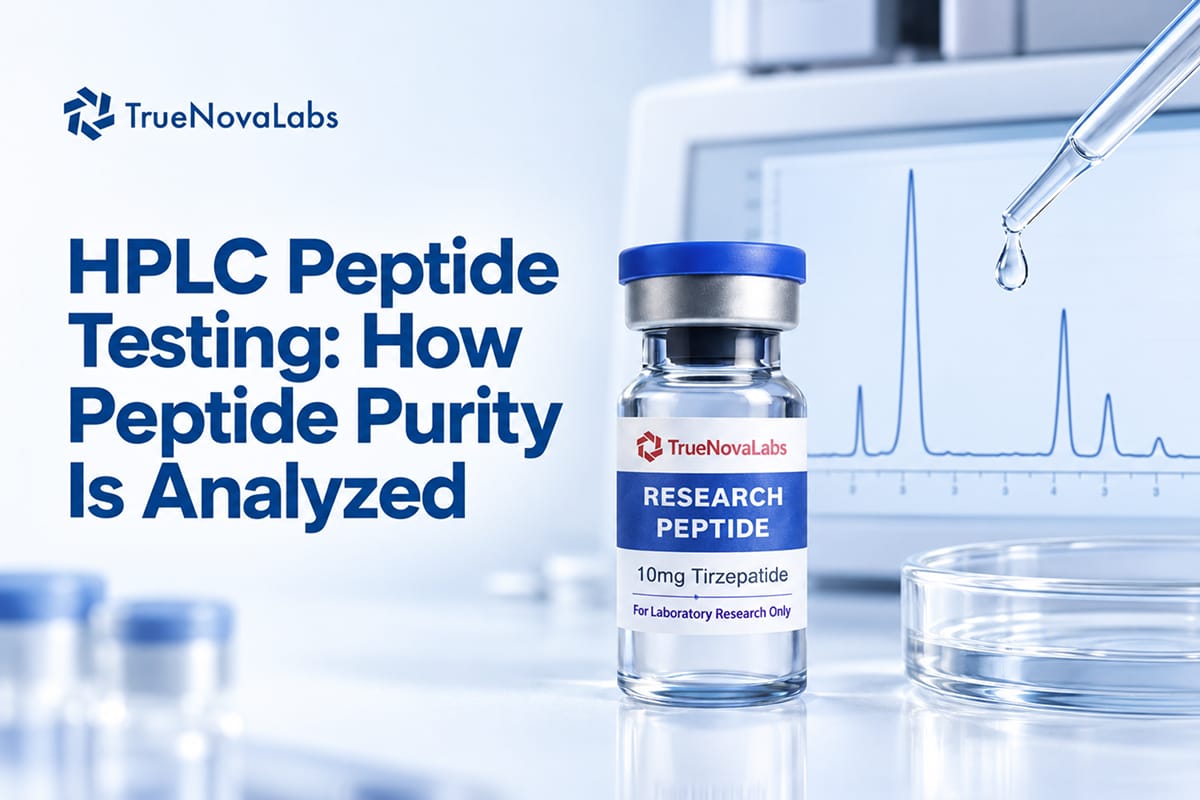
However, an HPLC result is more than a single purity percentage. In addition, researchers consider the analytical method, retention time, peak pattern, and testing conditions. Therefore, understanding HPLC helps researchers interpret peptide testing data and Certificates of Analysis (COAs) more accurately.
👉 Explore research-focused peptide resources and learn more about current peptide science at True Nova Labs
However, an HPLC result is more than a single purity percentage. Researchers also consider the analytical method, retention time, peak pattern, and testing conditions. Therefore, understanding HPLC helps researchers interpret peptide testing data and Certificates of Analysis (COAs) more accurately.
What Is HPLC Peptide Testing?
HPLC peptide testing uses High-Performance Liquid Chromatography to separate and analyze components within a peptide sample.
During testing, a prepared sample passes through a specialized column. As a result, different components interact with the column differently and travel through the system at different rates. The instrument then records these differences as a chromatogram.
For peptide research, HPLC can provide information about:
- Peptide purity
- Related compounds
- Degradation products
- Retention characteristics
- Chromatographic profiles
Importantly, HPLC results depend on the analytical method used. Therefore, researchers should consider the testing conditions when interpreting the data.
👉 Learn more about peptide quality evaluation in Supplement Quality & Testing: Purity, Identity, Potency & Verification.
How Does HPLC Separate Peptide Components?
HPLC separation depends on interactions between the sample, stationary phase, and mobile phase.
The process can be summarized as:
Sample → Injection → Column → Separation → Detection → Chromatogram
As components move through the column, their different interactions cause separation. Consequently, they reach the detector at different times.
| Factor | Role in Separation |
|---|---|
| Column chemistry | Influences component separation |
| Mobile phase | Affects compound movement |
| Flow rate | Controls movement through the system |
| Temperature | Can influence separation |
| Gradient conditions | Changes separation conditions |
Because these factors influence the chromatogram, researchers should consider the analytical method when reviewing results.
👉 Learn more about performance and recovery peptides at SHOP ALL COMPOUNDS
How Is Peptide Purity Estimated From an HPLC Chromatogram?
An HPLC chromatogram displays detector response against retention time. The peaks represent components detected by the analytical system.
When an appropriate area-based method applies, researchers can estimate purity by comparing the target peak area with the total relevant peak area:
Purity (%) ≈ Target Peak Area ÷ Total Relevant Peak Area × 100
However, this calculation represents an analytical estimate under specific conditions. It does not prove that every possible impurity has been detected.
For example, some substances may produce weak detector responses, while components with similar retention behavior may overlap. Therefore, researchers should interpret the purity value alongside the analytical method and supporting data.
What Do Peaks and Retention Times Represent?
Peaks and retention times provide important information about an HPLC analysis.
What Does an HPLC Peak Represent?
An HPLC peak generally represents a detectable component reaching the detector after separation.
Peak area can provide quantitative information under appropriate conditions. Meanwhile, additional peaks may indicate related compounds, degradation products, or other detectable components.
However, an additional peak does not automatically identify a specific substance. Researchers may need additional analytical information to determine its identity.
What Does Retention Time Represent?
Retention time is the time required for a component to pass through the chromatographic system.
Researchers can compare a sample peak with an appropriate reference under the same conditions. This comparison can support identification when the method provides sufficient specificity.
Nevertheless, retention time alone does not establish complete molecular identity.
👉 Explore the science behind supplement ingredients, research methods, and quality evaluation in Supplements: Science, Ingredients, Research & Quality Standards Explained.
What Can HPLC Detect in a Peptide Sample?
HPLC can detect components that the selected method can separate and measure.
Depending on the method, researchers may observe the target peptide, related compounds, degradation products, or other detectable substances.
| HPLC Finding | Possible Information |
|---|---|
| Main peak | Target peptide or principal component |
| Additional peak | Other detectable component |
| Multiple peaks | Several separated components |
| Retention time | Chromatographic behavior |
| Peak area | Detector response |
| Different profile | Potential difference between samples |
Furthermore, researchers can compare chromatograms from different production batches. For example, two batches may show similar main peaks but different secondary peaks.
However, HPLC cannot detect every substance under every analytical condition. Therefore, an apparently simple chromatogram does not prove that no other components are present.
What Are the Limitations of HPLC Testing?
HPLC provides useful analytical information, but researchers should understand its limitations.
First, the method can only separate and detect components within the capabilities of the selected system. Consequently, substances with similar chromatographic behavior may be difficult to distinguish.
Second, co-elution can occur when two components reach the detector at similar times. They may then appear as one peak.
Third, different substances can produce different detector responses. Therefore, peak area does not automatically represent the exact amount of every component without appropriate calibration.
Finally, HPLC does not inherently provide complete molecular identification. Additional testing may be necessary when researchers need molecular confirmation.
HPLC vs Mass Spectrometry for Peptide Analysis
Researchers can gain different analytical insights by using HPLC and mass spectrometry.
| Feature | HPLC | Mass Spectrometry |
|---|---|---|
| Main purpose | Separation and chromatographic analysis | Molecular characterization |
| Primary output | Chromatogram | Mass spectrum |
| Retention time | Important | Not the primary measurement |
| Purity analysis | Commonly used | Can provide supporting information |
| Molecular mass | Limited information | Strong capability |
| Identification | Can support identification | Provides molecular information |
HPLC is useful for examining how components separate within a sample. Meanwhile, mass spectrometry provides molecular information that can support identification and characterization.
For example, researchers may separate components using HPLC and then examine selected components with mass spectrometry.
Therefore, the two techniques can complement each other when researchers need both chromatographic and molecular information.
👉 Learn more about performance and recovery peptides at SHOP ALL COMPOUNDS
How to Interpret HPLC Results on a Peptide COA
A Certificate of Analysis may report an HPLC purity value, but researchers should also examine the supporting information.
First, check the batch or lot number to confirm that the result corresponds to the material being evaluated.
Next, review the analytical method and testing conditions. In addition, these details help explain how the result was generated.
Then, compare the reported result with the stated specification. A purity percentage without its method or specification provides limited context.
Finally, review other analytical results included on the COA.
| COA Detail | What to Check |
|---|---|
| Batch number | Does it match the material? |
| HPLC result | What value was reported? |
| Test method | How was the result generated? |
| Specification | What criterion was applied? |
| Testing date | When was testing performed? |
| Laboratory | Who performed the analysis? |
| Additional testing | Are other methods reported? |
Furthermore, comparing COAs from different batches can help researchers identify changes in analytical characteristics.
Ultimately, an HPLC result should be interpreted as part of a broader analytical record rather than as a standalone measure of peptide quality.
👉 Explore how researchers evaluate purity, identity, potency, and verification in Supplement Quality & Testing: Purity, Identity, Potency & Verification.
FAQ About HPLC Peptide Testing
What is HPLC peptide testing?
HPLC peptide testing uses High-Performance Liquid Chromatography to separate and analyze components within a peptide sample.
What does HPLC measure in peptide testing?
HPLC can provide information about chromatographic separation, retention times, peak profiles, and purity estimates under specific analytical conditions.
Does HPLC prove peptide identity?
HPLC can support identity assessment when researchers compare chromatographic characteristics with an appropriate reference. However, additional analytical methods may provide further molecular information.
What does an HPLC peak represent?
An HPLC peak generally represents a detectable component that has passed through the chromatographic system. Additional peaks may indicate other detectable components.
Does a high HPLC purity percentage guarantee peptide quality?
No. Researchers should also consider the analytical method, detection capabilities, specifications, and supporting test results.
Can HPLC detect every impurity?
No. HPLC detects components that the selected method can separate and measure. Some substances may remain undetected or overlap with other components.
Why is retention time important?
Retention time helps researchers compare the chromatographic behavior of a sample component with a reference under the same analytical conditions.
Is HPLC better than mass spectrometry?
The techniques serve different purposes. HPLC focuses on separation and chromatographic analysis, while mass spectrometry provides molecular information. Therefore, researchers may use either or both depending on the analytical objective.
Conclusion
HPLC peptide testing provides useful information about the composition and chromatographic behavior of peptide samples. By separating detectable components, HPLC helps researchers examine purity profiles, retention times, and differences between samples.
However, a reported HPLC purity percentage should not be interpreted alone. In addition, the analytical method, detection conditions, specifications, and testing context all influence how the result should be understood.
Furthermore, mass spectrometry can complement HPLC by providing molecular information that chromatography alone may not establish. Together, these approaches can provide a broader view of peptide characteristics.
Ultimately, understanding HPLC peptide testing helps researchers interpret analytical reports more carefully and understand what a reported purity result actually represents.
👉 Explore educational resources and research-focused peptide information at TrueNovaLabs.
Disclaimer:
This content is provided by True Nova Labs for educational and research purposes only. It is not intended to diagnose, treat, cure, or prevent any disease, nor to provide medical or legal advice.



3 Comments
Lucas Hartwell
The explanation of HPLC peptide testing is quite useful, especially for understanding how chromatographic analysis can help assess peptide purity. I also liked the focus on interpreting analytical results rather than relying only on product descriptions.
Olivia Rutherford
I found the discussion of HPLC particularly helpful for understanding how researchers can evaluate peptide samples analytically. Looking at chromatographic profiles and related data provides useful information when assessing sample consistency and purity.
Marcus Caldwell
This is a useful introduction to the role of HPLC in peptide testing. I appreciate the emphasis on analytical verification because purity results are much more meaningful when the testing method and underlying data are clearly documented.