
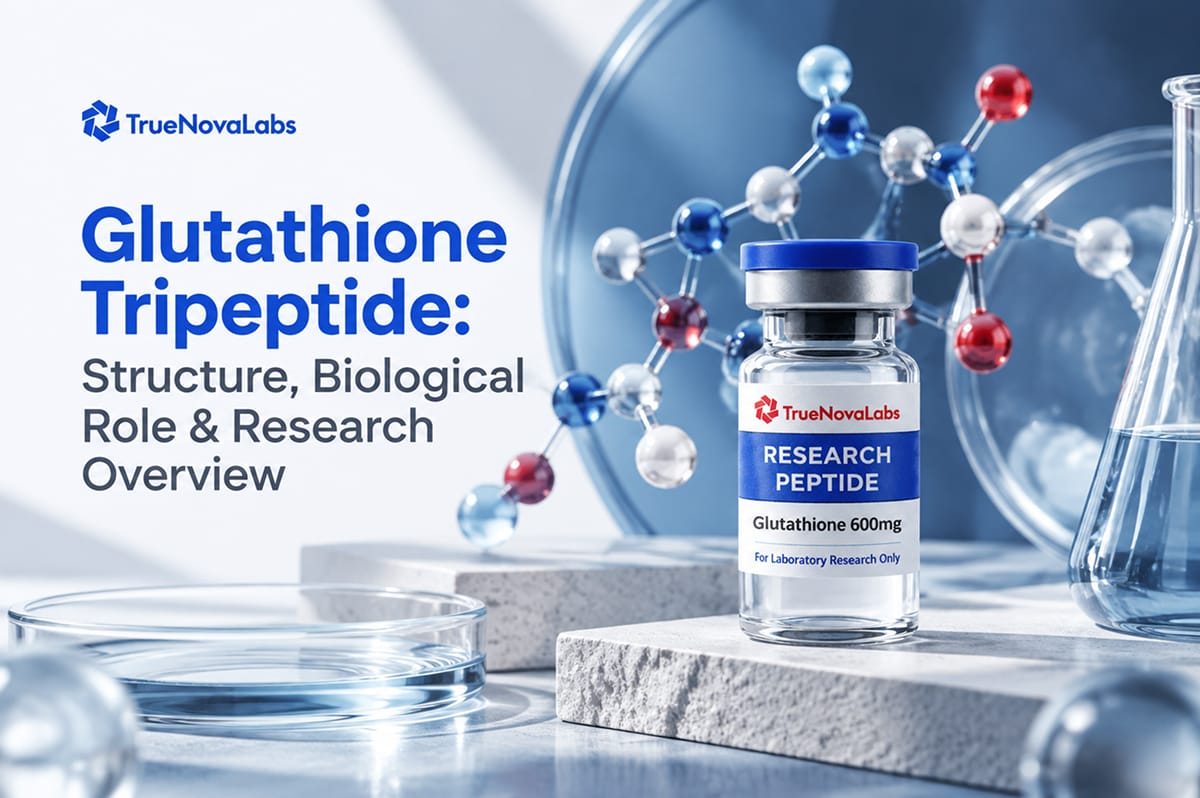
Glutathione tripeptide is one of the most studied small peptides in biochemical and molecular research. Currently, scientists investigate this naturally occurring molecule because of its involvement in cellular redox processes, molecular interactions, and biological regulation pathways.
In particular, glutathione provides researchers with an important model for studying how peptide structures influence biological systems. Compared with longer peptides, glutathione has a simple three-amino-acid structure. However, this small molecular structure allows it to participate in complex cellular processes.
👉 Explore research-focused peptide resources and learn more about current peptide science at True Nova Labs
Furthermore, glutathione research continues expanding across molecular biology, biochemistry, and cellular science. Therefore, understanding its structure, synthesis, measurement methods, and biological role provides valuable insight into peptide science and modern laboratory research.
What Is the Glutathione Tripeptide?
In general, glutathione is a naturally occurring tripeptide composed of three amino acids. More specifically, researchers study this molecule because its unique structure allows it to participate in cellular processes related to redox regulation.
From a structural perspective, glutathione exists mainly in two forms:
| Form | Description |
|---|---|
| Reduced glutathione (GSH) | The active form that participates in redox reactions |
| Oxidized glutathione (GSSG) | The form created when glutathione interacts with reactive molecules |
In particular, scientists focus on glutathione because it functions as part of cellular antioxidant systems. Additionally, researchers examine how glutathione participates in maintaining the balance between oxidizing and reducing molecules within biological environments.
Beyond cellular research, glutathione studies extend across multiple scientific fields, including molecular biology, biochemistry, and biochemical analysis.
Despite its small molecular structure, glutathione remains a valuable research molecule because of its significant biological importance.
👉 Learn more about performance and recovery peptides at SHOP ALL COMPOUNDS
Which Amino Acids Make Up Glutathione?
Structurally, glutathione contains three specific amino acids:
| Amino Acid | Role Within Glutathione |
|---|---|
| Glutamic acid | Provides the first component of the peptide structure |
| Cysteine | Contains the thiol group involved in redox activity |
| Glycine | Completes the tripeptide structure |
Together, these amino acids create the unique characteristics of glutathione. In particular, the cysteine component contributes to glutathione’s ability to participate in redox reactions.
More specifically, the connection between glutamic acid and cysteine differs from typical peptide bonds. This unusual structure contributes to glutathione’s stability and influences how researchers analyze its molecular properties.
For this reason, scientists examine both the amino acid composition and molecular arrangement when studying glutathione characteristics.
Why Is Glutathione Classified as a Tripeptide?
In general, glutathione is classified as a tripeptide because it contains three amino acid units connected through peptide bonds.
Peptides are commonly categorized according to the number of amino acids they contain:
| Peptide Classification | Number of Amino Acids |
|---|---|
| Dipeptide | Two amino acids |
| Tripeptide | Three amino acids |
| Oligopeptide | Several amino acids |
| Polypeptide | Longer amino acid chains |
Interestingly, glutathione has a unique feature that separates it from many other tripeptides. More specifically, glutathione contains a gamma-glutamyl bond between glutamic acid and cysteine instead of a standard peptide connection.
Because of this unique structure, researchers can better examine glutathione stability, molecular activity, and biological interactions.
Furthermore, understanding peptide classification allows scientists to compare glutathione with other naturally occurring and synthetic peptides used in laboratory research.
How Is Glutathione Synthesized in Biological Systems?
Within biological systems, cells synthesize glutathione through a two-step enzymatic process involving three amino acids: glutamate, cysteine, and glycine.
Initially, cells combine glutamate and cysteine to form gamma-glutamylcysteine. Afterward, glycine attaches to this molecule to produce glutathione.
The synthesis pathway includes:
| Step | Process |
|---|---|
| Step 1 | Formation of gamma-glutamylcysteine from glutamate and cysteine |
| Step 2 | Addition of glycine to produce glutathione |
During this process, researchers examine enzyme activity, amino acid availability, and cellular conditions that influence glutathione production.
Additionally, scientists study glutathione synthesis because it provides insight into how cells regulate important biochemical pathways.
For this reason, laboratory research often focuses on understanding factors that affect glutathione metabolism and cellular availability.
👉 Explore the science behind supplement ingredients, research methods, and quality evaluation in Supplements: Science, Ingredients, Research & Quality Standards Explained.
What Role Does Glutathione Play in Cellular Redox Processes?
More importantly, glutathione plays an important role in cellular redox processes by participating in reactions that maintain molecular balance.
In particular, researchers study glutathione because the cysteine component contains a reactive sulfur group. As a result, this feature allows glutathione to interact with certain molecules involved in oxidation and reduction reactions.
Key research areas include:
| Research Area | Description |
|---|---|
| Oxidative balance | Studies how cells regulate reactive molecules |
| Redox signalling | Examines communication through oxidation-related pathways |
| Cellular defence mechanisms | Investigates molecular protection processes |
| Enzyme interactions | Studies glutathione-related biochemical reactions |
Additionally, researchers examine the relationship between reduced glutathione (GSH) and oxidized glutathione (GSSG). The ratio between these forms provides information about cellular redox conditions.
Nevertheless, glutathione activity depends on biological context, experimental conditions, and research methods. Therefore, scientists evaluate glutathione through controlled laboratory studies.
How Is Glutathione Studied in Laboratory Research?
To better understand this molecule, researchers study glutathione using various analytical techniques to evaluate its structure, concentration, and biological interactions.
For instance, common research approaches include:
| Research Method | Purpose |
|---|---|
| Chromatographic analysis | Measures glutathione separation and concentration |
| Mass spectrometry | Identifies molecular characteristics |
| Enzyme-based assays | Evaluates biochemical activity |
| Spectrophotometric methods | Measures molecular changes through light absorption |
At the beginning of laboratory analysis, researchers examine glutathione samples to determine molecular characteristics. Following this analysis, scientists evaluate how glutathione behaves under different experimental conditions.
Furthermore, combining multiple analytical methods provides a more complete understanding of glutathione properties.
Ultimately, laboratory research allows scientists to examine both the chemical structure and biological relevance of this tripeptide.
How Do Researchers Measure Glutathione?
Currently, researchers use different methods to measure glutathione levels and analyze its molecular properties.
However, the selected method depends on the research objective, sample type, and required accuracy.
| Measurement Method | Information Provided |
|---|---|
| HPLC analysis | Separates and quantifies glutathione components |
| Mass spectrometry | Provides molecular identification information |
| Enzyme recycling assays | Measures glutathione concentration |
| Spectroscopic methods | Detects chemical changes |
For example, HPLC allows researchers to separate glutathione-related compounds within a sample. In comparison, mass spectrometry provides detailed molecular information about peptide identity.
Furthermore, researchers may compare reduced and oxidized glutathione levels to better understand redox conditions.
Therefore, selecting the appropriate analytical method is essential for obtaining accurate research data.
👉 Learn more about performance and recovery peptides at SHOP ALL COMPOUNDS
What Are the Limitations of Current Glutathione Research?
Despite extensive research, scientists continue to face challenges when interpreting glutathione experimental results.
For example, one major limitation involves differences between research conditions and biological environments.
Other challenges include:
| Limitation | Explanation |
|---|---|
| Sample differences | Biological samples may vary between studies |
| Measurement methods | Different techniques may produce different results |
| Biological complexity | Multiple pathways influence glutathione activity |
| Research models | Laboratory models may not represent every biological condition |
Furthermore, biological samples may vary between studies, which can influence research interpretation.
Similarly, different analytical techniques may produce different results depending on experimental design.
Additionally, laboratory models may not represent every biological condition. Therefore, scientists continue improving analytical methods and research models to better understand glutathione mechanisms.
👉 Learn more about peptide mechanisms, molecular interactions, and current research approaches in Peptide Science: Structure, Signalling & Modern Research Explained.
FAQ About Glutathione Tripeptide
What is glutathione tripeptide?
Glutathione tripeptide is a naturally occurring peptide composed of glutamic acid, cysteine, and glycine. Specifically, researchers study it because of its role in cellular redox processes and molecular interactions.
Why is glutathione called a tripeptide?
Glutathione is classified as a tripeptide because it contains three amino acids connected through peptide bonds.
Which amino acids form glutathione?
Glutathione consists of glutamic acid, cysteine, and glycine. Together, these amino acids create its unique molecular structure.
How do researchers study glutathione?
To achieve accurate analysis, researchers study glutathione through analytical methods such as HPLC, mass spectrometry, enzyme-based assays, and spectroscopic techniques.
What is the difference between GSH and GSSG?
GSH represents reduced glutathione, while GSSG represents oxidized glutathione formed during redox reactions.
Why is glutathione important in peptide research?
Glutathione provides researchers with a useful model for studying peptide structure, molecular interactions, and cellular biochemical processes.
Conclusion
Overall, glutathione tripeptide remains an important research molecule because of its unique structure and involvement in cellular redox processes.
Through these studies, researchers continue expanding their understanding of this naturally occurring peptide, including its amino acid composition, synthesis pathways, analytical methods, and biological interactions.
Nevertheless, glutathione research requires careful interpretation because biological systems are complex and experimental conditions can influence results.
Ultimately, studying glutathione provides valuable insights into peptide science, molecular biology, and the mechanisms that regulate cellular environments.
👉 Explore educational resources and research-focused peptide information at TrueNovaLabs.
Disclaimer:
This content is provided by True Nova Labs for educational and research purposes only. It is not intended to diagnose, treat, cure, or prevent any disease, nor to provide medical or legal advice.





3 Comments
Nathan Hartwell
The explanation of glutathione as a tripeptide is a useful introduction to its role in cellular biology. I particularly liked the focus on its molecular structure and how researchers study its involvement in redox-related processes.
Amelia Beaumont
I found the discussion of glutathione’s biological functions particularly interesting. Understanding how this tripeptide participates in cellular redox pathways provides useful context for interpreting the research surrounding it.
Gregory Rutherford
This is a helpful overview of glutathione from a research perspective. I appreciate the emphasis on its biochemical role and the importance of understanding the underlying mechanisms when evaluating findings related to this tripeptide.