
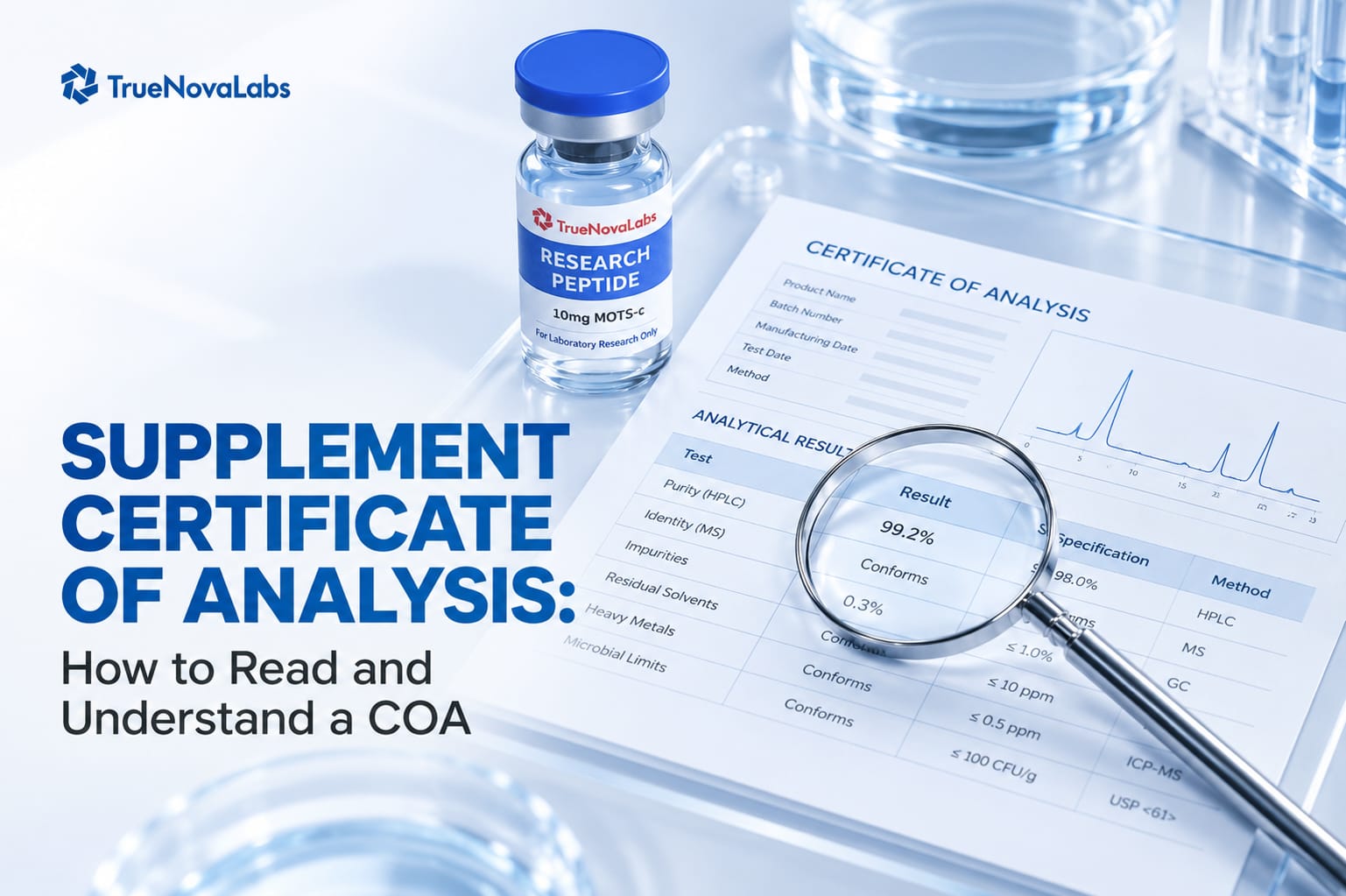
A Supplement Certificate of Analysis (COA) is a laboratory document that reports testing results for a specific supplement, ingredient, or production batch. For researchers and quality-focused buyers, a COA can provide useful information about identity, purity, testing methods, and whether a product meets defined specifications.
However, reading a COA requires more than checking a single purity percentage. The batch number, analytical method, acceptance criteria, and reported result all provide important context. In Canada, this approach is particularly relevant to natural health products (NHPs), where quality specifications can address characteristics such as identity, quantity, purity, and potency.
👉 Explore research-focused peptide resources and learn more about current peptide science at True Nova Labs
Understanding these elements makes it easier to distinguish meaningful laboratory documentation from a document that provides limited information.
What Is a Supplement Certificate of Analysis?
More specifically, a Supplement Certificate of Analysis records analytical testing performed on a specific product or batch. In this way, the document connects the tested material with laboratory results and applicable quality specifications.
For example, a typical COA may include:
- Product or ingredient name
- Batch or lot number
- Testing date
- Analytical methods
- Acceptance criteria
- Test results
- Laboratory or approval information
Most importantly, the report should clearly identify what the laboratory tested and whether the results met the stated specifications.
A COA therefore works as part of a broader quality-control process. It should not, by itself, be treated as a guarantee of every aspect of product quality.
👉 Learn more about performance and recovery peptides at SHOP ALL COMPOUNDS
What Information Is Included in a Supplement COA?
In practice, COA formats differ between laboratories and manufacturers. Nevertheless, several fields provide particularly useful information when reviewing a report.
| COA Element | What It Shows |
|---|---|
| Product name | Identifies the tested material |
| Batch or lot number | Links results to a specific production batch |
| Testing date | Shows when the analysis occurred |
| Test method | Identifies how the laboratory performed the analysis |
| Acceptance criteria | Defines the required specification |
| Result | Reports the measured or reported value |
| Laboratory information | Identifies the testing or review source |
Start with the product name and batch number. Then, compare those details with the product being evaluated.
The batch number is especially important because a COA from a different production lot may not demonstrate the characteristics of the current batch.
How to Verify Ingredient Identity on a COA
Identity testing determines whether the tested material corresponds to the expected ingredient. Depending on the compound, laboratories may use chromatography, spectroscopy, mass spectrometry, or other analytical techniques.
When reviewing an identity result, check:
- The ingredient name
- The batch or lot number
- The analytical method
- The reported result
- The acceptance criteria
A matching ingredient name alone does not demonstrate analytical identity. Instead, the testing method and result provide the scientific basis for the identification.
Furthermore, identity and purity represent different quality characteristics. Identity testing asks whether the expected substance is present, while purity testing examines the amount of the target material or the presence of other components.
Therefore, researchers should evaluate both results rather than using a purity percentage as proof of identity.
How to Interpret Purity and Testing Results
In many cases, purity is the most visible result on a COA. However, researchers should interpret the percentage alongside its analytical method and acceptance criterion.
For example:
| Test | Result | Acceptance Criteria |
|---|---|---|
| Identity | Conforms | Meets specification |
| Purity | 98.7% | ≥98.0% |
| Appearance | Conforms | Meets specification |
| Microbial testing | Pass | Within limits |
In this example, the 98.7% result becomes meaningful because the report establishes a minimum specification of 98.0%.
At the same time, a purity result does not necessarily describe every aspect of product quality. Depending on the product, additional testing may address identity, contaminants, microbial characteristics, stability, or other specifications.
For this reason, avoid judging a COA solely by its highest numerical value. Instead, review the complete set of tests and determine whether the reported results satisfy the applicable criteria.
Understanding Laboratory Testing Methods
The analytical method explains how a laboratory obtained a particular result. Consequently, understanding the method helps clarify what a COA actually demonstrates.
For this reason, different methods serve different purposes:
| Testing Method | Common Application |
|---|---|
| HPLC | Separation and quantitative analysis |
| UPLC | High-resolution chromatographic analysis |
| Mass spectrometry | Molecular characterization |
| Spectroscopy | Chemical composition or structural analysis |
| Microbiological testing | Assessment of microbial characteristics |
For example, HPLC can separate and analyze components within a sample, while mass spectrometry can provide information about molecular characteristics.
However, the presence of a sophisticated testing method does not automatically establish overall product quality. Researchers should also examine the method’s purpose, acceptance criteria, and reported result.
In Canada, Health Canada’s NHP quality framework emphasizes suitable testing methods and defined specifications as components of quality evaluation.
Why Batch-Level Testing Matters
In particular, batch-level testing connects laboratory results to a specific production lot. This connection allows researchers to determine whether the documented analysis applies to the material they are evaluating.
For example, a COA that identifies the same batch number as the product provides stronger traceability than a generic report without batch information.
For example, batch-specific documentation can support:
- Product traceability
- Testing records
- Quality review
- Specification verification
- Production documentation
In the Canadian NHP framework, manufacturers and quality personnel use specifications and testing as part of the process for determining whether products meet established requirements.
Therefore, a generic COA can provide useful information about testing practices, but a batch-specific report offers more relevant evidence about a particular production lot.
👉 Learn more about performance and recovery peptides at SHOP ALL COMPOUNDS
How COAs Support Supplement Quality Verification
Overall, a COA provides analytical evidence that can support supplement quality verification. However, researchers should consider it alongside the broader quality system.
In addition, relevant documentation may include:
- Product specifications
- Batch records
- Manufacturing controls
- Laboratory procedures
- Storage requirements
- Quality assurance records
Furthermore, the COA should clearly connect the tested sample with its reported results. The document should also identify the relevant analytical methods and acceptance criteria.
For Canadian natural health products, quality evaluation may involve several specifications depending on the product. These can include identity, quantity, purity, potency, and other applicable characteristics.
As a result, the usefulness of a COA depends on both its analytical results and the quality of the documentation surrounding those results.
👉 Explore the science behind supplement ingredients, research methods, and quality evaluation in Supplements: Science, Ingredients, Research & Quality Standards Explained.
FAQ About Supplement Certificates of Analysis
What does a supplement COA show?
A COA records laboratory testing information for a particular product or batch. Depending on the product, it may include identity, purity, potency, testing methods, acceptance criteria, and results.
Why is the batch number important?
The batch number connects laboratory results to a specific production lot. Therefore, it helps determine whether the report applies to the product being evaluated.
Does a high purity percentage prove product quality?
No. Purity represents only one quality characteristic. Researchers should also consider identity, testing methods, acceptance criteria, contaminants, and other applicable specifications.
What should I check first on a COA?
First, check the product name and batch number. Then review the analytical methods, acceptance criteria, reported results, and laboratory information.
Is HPLC enough to verify a supplement?
Not necessarily. HPLC can provide valuable information about chemical separation and analysis, but additional testing may be necessary depending on the product and its specifications.
Can a COA guarantee product quality?
No. A COA provides analytical evidence, but it does not independently guarantee every aspect of quality. Manufacturing controls, sampling, storage, testing procedures, and quality systems also matter.
Conclusion
A Supplement Certificate of Analysis provides valuable information about the identity, composition, and tested characteristics of a specific product or batch. However, the most useful way to read a COA is to evaluate the entire report rather than focusing on a single purity number.
Start with the product and batch information. Next, examine the analytical methods, acceptance criteria, and reported results. Finally, consider how the COA fits within the manufacturer’s broader quality-control system.
For researchers evaluating supplements in Canada, this approach provides a practical framework for understanding laboratory documentation. Ultimately, a well-interpreted COA should help answer three basic questions: What was tested? How was it tested? Did the results meet the relevant specifications?
👉 Explore educational resources and research-focused peptide information at TrueNovaLabs.
Disclaimer:
This content is provided by True Nova Labs for educational and research purposes only. It is not intended to diagnose, treat, cure, or prevent any disease, nor to provide medical or legal advice.



3 Comments
Victor Whitmore
This article explains the purpose of a Certificate of Analysis in a clear and practical way. I especially liked the point that reviewing testing results can provide more useful information about a supplement’s identity, purity, and quality than relying on the product label alone.
Isabelle Prescott
I found the breakdown of what to look for in a supplement CoA particularly useful. Details such as testing methods, batch information, and reported results are important when evaluating the quality and consistency of a product.
Nathaniel Caldwell
The discussion of Certificates of Analysis highlights why third-party testing documentation can be valuable when researching supplements. I appreciate the emphasis on checking actual analytical results rather than making assumptions based only on marketing descriptions.