
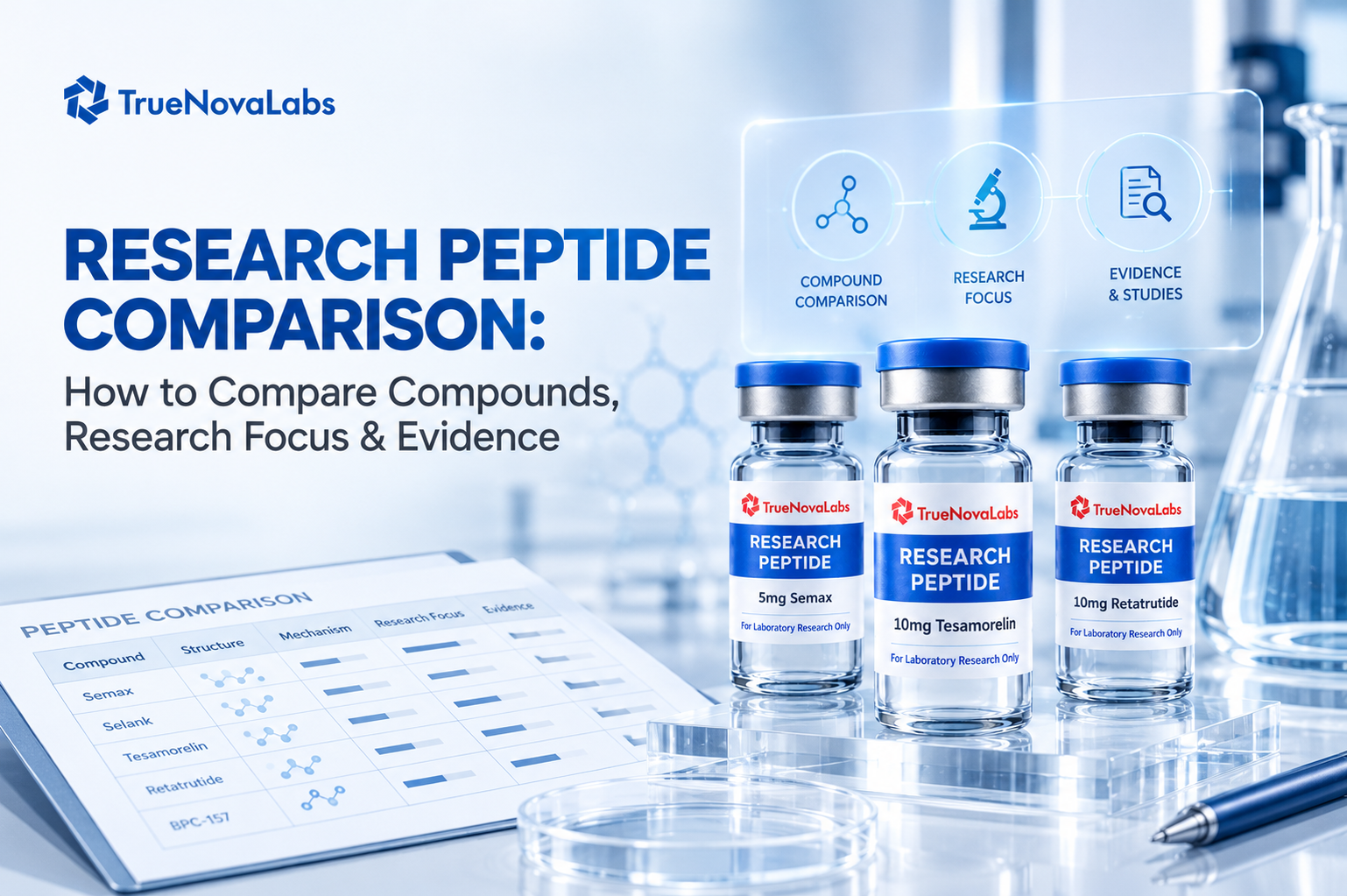
A reliable research peptide comparison should go beyond product descriptions. Instead, researchers need to examine molecular structure, biological targets, mechanisms, experimental models, evidence quality, and analytical data.
👉 Explore research-focused peptide resources and learn more about current peptide science at True Nova Labs
Although two peptides may appear in the same research category, their biological roles and evidence can differ substantially. In Canada, this scientific assessment should also remain separate from the regulatory status of a specific product.
What Makes Research Peptide Comparison Different From General Peptide Comparison?
General peptide comparisons may focus on broad characteristics such as research area, formulation, or product format. By contrast, research peptide comparison requires a more scientific approach because investigators need to understand what each compound can contribute to a defined experimental question.
First, researchers should confirm molecular identity. Next, they can examine sequence, structure, targets, mechanisms, and research applications. After that, they should evaluate the strength and limitations of the available evidence.
A practical comparison can include:
- Molecular identity and sequence
- Peptide length and modifications
- Biological targets and pathways
- Research applications
- Experimental models
- Pharmacokinetic characteristics
- Analytical and quality data
- Evidence limitations
Moreover, the research question should guide the comparison rather than a general claim about which peptide is better. For example, a compound studied mainly for receptor signalling may not be directly comparable with one investigated primarily for mitochondrial biology.
👉 Learn more about performance and recovery peptides at SHOP ALL COMPOUNDS

How Are Research Peptides Compared by Structure and Mechanism?
Structure provides an important starting point because amino acid sequence, peptide length, chemical modifications, and molecular configuration can influence biological behaviour. However, structural similarity alone does not prove equivalent activity.
Researchers should also identify the main target or pathway. Some peptides interact with membrane receptors, while others influence intracellular signalling, proteins, enzymes, or mitochondrial structures. Consequently, two compounds can appear in the same research field while operating through different mechanisms.
| Factor | What to Compare |
|---|---|
| Sequence | Are the amino acid sequences related? |
| Length | How many amino acids are present? |
| Modifications | Does either compound contain chemical changes? |
| Target | Which receptor, protein, or structure is involved? |
| Pathway | Which biological signalling process is studied? |
| Stability | Could structural differences affect stability? |
Furthermore, structure-activity research can help explain how sequence changes affect binding or biological activity. For this reason, researchers should identify the exact peptide form before comparing findings from different studies.
How Do Research Applications and Experimental Models Differ Between Peptides?
Researchers should compare applications according to the question each study addresses. Common areas include metabolic signalling, receptor pharmacology, growth hormone research, neurological research, mitochondrial biology, cellular stress, and tissue research.
However, the same category can contain very different evidence profiles. One peptide may have extensive cell-based research, while another may have animal or human studies. Therefore, researchers should record the experimental model alongside the application.
| Experimental Model | Main Research Value |
|---|---|
| In vitro | Cellular activity and molecular pathways |
| Ex vivo | Responses in isolated tissues or samples |
| Animal | Whole-organism biological responses |
| Human observational | Associations and biological measurements |
| Clinical trial | Controlled human outcomes |
Importantly, these models are not interchangeable. A cellular result can clarify a mechanism, whereas a clinical trial addresses different questions. As a result, comparisons become more meaningful when each finding stays connected to its study design.
Similarly, researchers should consider the endpoint being measured. A change in a biomarker, receptor signal, or cellular response does not necessarily demonstrate a broader functional outcome.
How Should Preclinical and Clinical Evidence Be Compared?
Evidence quality is central to research peptide comparison. Researchers should not simply count publications or assume that more studies automatically mean stronger evidence. Instead, they should examine the design and relevance of each study.
Key factors include:
- Study design
- Sample size
- Experimental model
- Control or comparator
- Primary endpoints
- Study duration
- Reproducibility
- Study limitations
Preclinical research can provide valuable information about mechanisms and biological responses. Nevertheless, researchers should not automatically translate those findings into human outcomes. Likewise, clinical evidence can provide more direct information about human populations, but its interpretation still depends on population characteristics, endpoints, study design, and statistical strength.
For example, a measurable molecular change may not correspond to a meaningful functional outcome. Conversely, an observed human association may not establish a mechanism. Therefore, researchers should assess both evidence strength and relevance to the research question.
In practice, a useful evidence hierarchy is not simply about placing one study type above another. Rather, researchers should ask whether the study directly answers the question they are investigating.
How Do Purity, Identity and Analytical Data Support Research Peptide Comparison?
A meaningful comparison depends on knowing what compound an experiment actually contains. Therefore, identity and analytical characterization are important when evaluating research peptides.
Researchers can review:
- Peptide identity
- Purity measurement
- Molecular mass
- Chromatographic profile
- Batch or lot information
- Analytical methods
- Certificate of Analysis, when available
- Storage and stability information
HPLC can provide information about purity and related impurities, while mass spectrometry can support molecular-mass and identity assessment. However, one analytical result does not necessarily describe every aspect of product quality.
Moreover, batch information supports reproducibility. If researchers compare different lots, variations in identity, purity, formulation, or handling may influence experimental results. Consequently, consistent analytical documentation can strengthen interpretation and help researchers investigate unexpected findings.
👉 Learn more about performance and recovery peptides at SHOP ALL COMPOUNDS
What Should Canadian Researchers Consider When Comparing Research Peptides?
Canadian researchers should keep scientific evaluation separate from regulatory classification. Health Canada regulates different product categories under different frameworks. In particular, injectable peptide drugs are regulated as prescription drugs in Canada. Therefore, a research label or scientific publication should not be interpreted as authorization for human use.
For laboratory research, researchers should focus on:
- Confirmed molecular identity
- Available purity and analytical information
- Defined research purpose
- Appropriate experimental model
- Relevant scientific evidence
- Applicable Canadian requirements
In addition, a published study describes the conditions investigated in that study. It does not automatically establish that every commercial product containing the same compound has identical characteristics or regulatory status.
For Canadian researchers, this distinction is particularly important when comparing products marketed online. Consequently, scientific evidence, product documentation, and regulatory status should remain separate parts of the evaluation.
👉 Learn how researchers compare peptide structure, mechanisms, and evidence in Peptide Comparisons: Understanding Differences Between Research Compounds.
FAQs About Research Peptide Comparison
What is research peptide comparison?
Research peptide comparison is a structured process for evaluating peptides by molecular identity, structure, mechanisms, applications, evidence, and analytical characteristics.
Why is molecular structure important?
Structure can influence target interaction, stability, biological activity, and pharmacokinetic behaviour. Therefore, structural information helps explain differences between related compounds.
Can two peptides have similar research applications but different mechanisms?
Yes. Two compounds may appear in the same research field while acting through different receptors or signalling pathways. Consequently, researchers should compare both mechanisms and applications.
Is clinical evidence always stronger than preclinical evidence?
Not necessarily for every research question. Preclinical studies can provide detailed mechanistic information, while clinical studies address human outcomes. Therefore, researchers should consider study quality and relevance rather than study type alone.
Why does purity matter?
Impurities, degradation products, or incorrect identity can affect experimental results. As a result, purity and identity data can support reproducibility and interpretation.
Is a Certificate of Analysis enough?
A Certificate of Analysis can provide useful batch-specific information, but researchers should also consider the analytical methods, specifications, identity confirmation, and other documentation available.
What should Canadian researchers check?
They should review molecular identity, analytical information, intended research use, product documentation, and applicable Canadian requirements.
Conclusion
A strong research peptide comparison evaluates more than similarities in product names or research categories. Instead, researchers should examine molecular structure, biological mechanisms, experimental applications, evidence quality, and analytical documentation together.
Moreover, in-vitro, animal, observational, and clinical studies answer different questions, so findings from one model should not automatically transfer to another. Finally, clear identity and analytical information can support more reproducible research.
For Canadian researchers, regulatory considerations should also remain distinct from scientific evidence. Ultimately, a structured comparison helps researchers assess related compounds more objectively and select products that align with their specific laboratory research questions.
Researchers seeking laboratory-focused compounds can also review TrueNovaLabs research products according to available identity, purity, and analytical information.
👉 Explore educational resources and research-focused peptide information at TrueNovaLabs.
Disclaimer:
This content is provided by True Nova Labs for educational and research purposes only. It is not intended to diagnose, treat, cure, or prevent any disease, nor to provide medical or legal advice.




3 Comments
Jason Reed
This guide provides a useful framework for comparing research peptides based on their individual characteristics. I especially appreciate the focus on molecular structure and biological mechanisms, as these details help explain why different peptides should be evaluated in their specific research contexts.
Melissa Grant
I found this comparison approach helpful for organising information about different peptide compounds. Looking at their mechanisms, available evidence, and research limitations together makes it easier to understand the differences without drawing conclusions beyond what the data supports.
Peter Lawson
A helpful starting point for readers exploring research peptides. I like the emphasis on comparing compounds according to their specific properties rather than assuming that peptides with similar research interests necessarily have the same mechanisms or evidence base.