
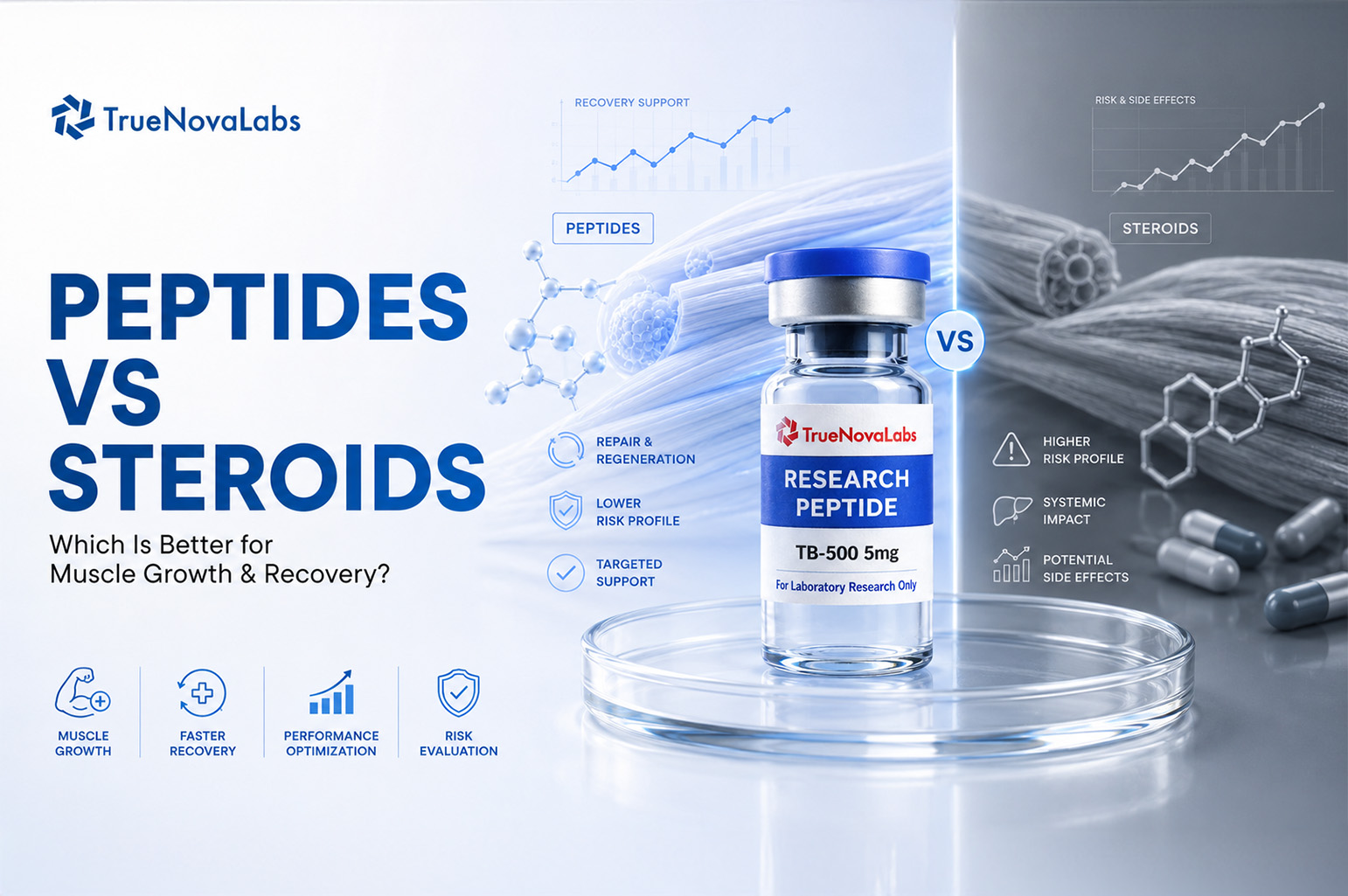
The comparison between peptides vs steroids is one of the most debated topics in performance and muscle growth discussions. While both are associated with changes in muscle development and recovery, they operate through fundamentally different biological mechanisms.
Understanding these differences is essential—not just for evaluating results, but for understanding how the body responds to hormonal signaling, recovery, and long-term adaptation.
In Canada, these categories are also treated differently from a regulatory standpoint. Anabolic steroids are controlled substances, while many peptides are classified as research compounds intended for laboratory use only, depending on their context.
👉 Looking for research-grade peptides with verified purity and transparent sourcing? Explore available options here SHOP ALL COMPOUNDS
This guide breaks down how steroids and peptides work, how they compare in muscle growth and recovery, and what current research suggests about their risks and limitations.
How Steroids Work for Muscle Growth
Steroids, particularly anabolic-androgenic steroids (AAS), are synthetic compounds designed to mimic testosterone, a key hormone involved in muscle growth.
They work by:
- directly increasing protein synthesis
- enhancing nitrogen retention in muscle tissue
- accelerating muscle repair and growth
Because steroids act directly on androgen receptors, they can produce rapid and noticeable changes in muscle mass and strength.
However, this direct hormonal manipulation also affects multiple systems beyond muscle tissue, including:
- endocrine balance
- cardiovascular function
- liver health
This broad impact is what contributes to both their effectiveness and their risk profile.

How Muscle Growth Peptides Differ
Peptides take a very different approach.
Rather than directly forcing muscle growth, peptides are studied for how they influence:
- growth hormone (GH) signaling
- IGF-1 pathways
- recovery and repair processes
- cellular communication
This means peptides are not typically associated with immediate muscle gain. Instead, they are explored for how they may support the conditions required for muscle adaptation over time.
For example, peptides such as CJC-1295 and Ipamorelin are studied for how they influence endogenous GH release, while compounds like BPC-157 are associated with tissue repair models.
The key difference is this:
- Steroids → direct hormonal override
- Peptides → indirect signaling support
Muscle Gains and Performance Comparison
From a performance standpoint, steroids and peptides differ significantly in both speed and mechanism.
Steroids are often associated with:
- rapid increases in muscle mass
- noticeable strength gains
- accelerated physical changes
Peptides, by contrast, are more commonly linked to:
- improved recovery efficiency
- consistent training adaptation
- long-term support for muscle development
However, peptides do not replace:
- progressive training
- proper nutrition
- recovery cycles
Their role is more subtle and dependent on consistency over time.
Recovery and Long-Term Effects
Recovery is one of the most important distinctions between these two categories.
Steroids may accelerate recovery in the short term by enhancing protein synthesis, but they can also disrupt natural hormonal balance, which may lead to long-term complications.
Peptides are studied for how they may support:
- tissue repair
- recovery cycles
- hormonal signaling consistency
Because they interact with natural pathways rather than overriding them, peptides are often explored for their potential role in long-term adaptation, rather than short-term performance spikes.
Risks, Side Effects & Safety Concerns
Both peptides and steroids carry risks, but the nature of those risks differs.
Steroids are associated with well-documented concerns, including:
- hormonal suppression
- cardiovascular strain
- liver-related issues
- long-term endocrine disruption
Peptides, on the other hand, are more often associated with risks related to:
- purity and quality
- contamination during preparation
- improper storage
- inconsistent sourcing
Because peptides are sensitive molecules, degradation can affect both their stability and behavior.
In Canada, substances are regulated based on classification and intended use by organizations such as Health Canada, reinforcing the importance of proper context.
👉 To ensure consistent research outcomes, explore peptides backed by verified testing here SHOP ALL COMPOUNDS
Which Option Aligns With Different Fitness Goals?
The question of which is “better” depends entirely on the objective.
If the focus is on:
- rapid muscle growth
- immediate performance changes
then steroids are often associated with those outcomes—but with significant trade-offs.
If the focus is on:
- recovery support
- long-term adaptation
- hormonal signaling research
then peptides are more aligned with that approach.
Rather than competing solutions, these categories represent different philosophies of muscle development.
Peptides vs steroids explained. Compare muscle growth, recovery, risks, and long-term effects—read more in our guide: Peptides for Muscle Growth: Benefits, Performance & What to Expect
FAQ – Peptides vs Steroids
What is the main difference between peptides and steroids?
Steroids directly increase muscle growth through hormonal manipulation, while peptides influence signaling pathways that support recovery and adaptation.
Do peptides build muscle like steroids?
No. Peptides are studied for indirect support through recovery and hormonal signaling, not direct muscle growth.
Are steroids more effective?
They may produce faster results, but they also carry higher risks and broader systemic effects.
Are peptides safer than steroids?
They involve different risk profiles, often related to quality and handling rather than direct hormonal disruption.
Are these substances legal in Canada?
Regulation depends on classification. Steroids are controlled substances, while many peptides are classified as research compounds unless approved under pharmaceutical frameworks.
Conclusion
The comparison of peptides vs steroids highlights two fundamentally different approaches to muscle growth.
Steroids focus on direct hormonal manipulation and rapid results, while peptides are studied for how they support natural signaling, recovery, and long-term adaptation.
Understanding this distinction is key to making informed decisions and avoiding unrealistic expectations.
For researchers in Canada, reliable outcomes depend on:
- understanding biological mechanisms
- sourcing high-quality peptides
- maintaining proper storage and handling
- interpreting results within the correct context
Explore Research-Grade Peptides
If you’re looking for peptides supported by verified purity, transparent sourcing, and consistent quality standards, explore the full collection here SHOP ALL COMPOUNDS
Disclaimer:
This content is provided by True Nova Labs for educational and research purposes only. It is not intended to diagnose, treat, cure, or prevent any disease, nor to provide medical or legal advice.



3 Comments
Derek Sullivan
Really interesting comparison between peptides and steroids for muscle growth and recovery. I liked that the article focused on how differently they interact with recovery, hormonal signaling, and long-term adaptation instead of oversimplifying the topic. The balanced discussion around risks and expectations was especially helpful.
Olivia Grant
Great read overall. A lot of content online tends to present peptides and steroids as if they produce the same type of results, so I appreciated the explanation about recovery support versus direct anabolic effects. It definitely gave a more realistic perspective on muscle development.
Connor Blake
Very informative and easy to follow. I appreciate that the article discussed long-term health considerations and realistic expectations instead of only focusing on short-term performance improvements. The comparison felt much more balanced and trustworthy because of that.