

The concept of muscle growth peptide cycles is often discussed in research focused on recovery, hormonal signaling, and long-term adaptation. However, unlike traditional performance approaches, peptide “cycles” are not simply about timing usage—they are about understanding how biological systems respond over time.
Peptides associated with muscle growth are typically studied for how they influence growth hormone pathways, tissue repair, and recovery cycles, rather than directly increasing muscle mass.
In Canada, most peptides referenced in this context are supplied strictly for laboratory and educational purposes only, not as approved performance-enhancing products.
👉 Looking for research-grade peptides with verified purity and transparent sourcing? Explore available options here SHOP ALL COMPOUNDS
This guide explores how researchers typically discuss peptide cycles, how they structure them, and which factors influence outcomes.
What a Peptide Cycle Typically Looks Like
In research contexts, a “cycle” refers to a structured observation period during which a peptide is studied under controlled conditions, followed by a rest phase.
This structure exists because biological systems—especially those involving growth hormone (GH) signaling—operate in rhythms and feedback loops.
A typical cycle is not defined only by duration, but by:
- consistency of exposure
- stability of conditions
- controlled observation of responses
The purpose of cycling is to:
- observe how signaling pathways respond over time
- monitor adaptation patterns
- reduce the risk of overstimulation of hormonal systems
Rest periods are just as important as active phases, as they allow the system to return to baseline and maintain sensitivity.
Popular Muscle Growth Peptides Used in Cycles
Researchers commonly discuss several peptides in relation to muscle growth cycles, with each peptide playing a different role in signaling.
Researchers often associate CJC-1295 with growth hormone–releasing hormone (GHRH) pathways, where it may support sustained GH signaling.
Ipamorelin is studied as a GH secretagogue, triggering GH release in a more selective and pulsatile manner.
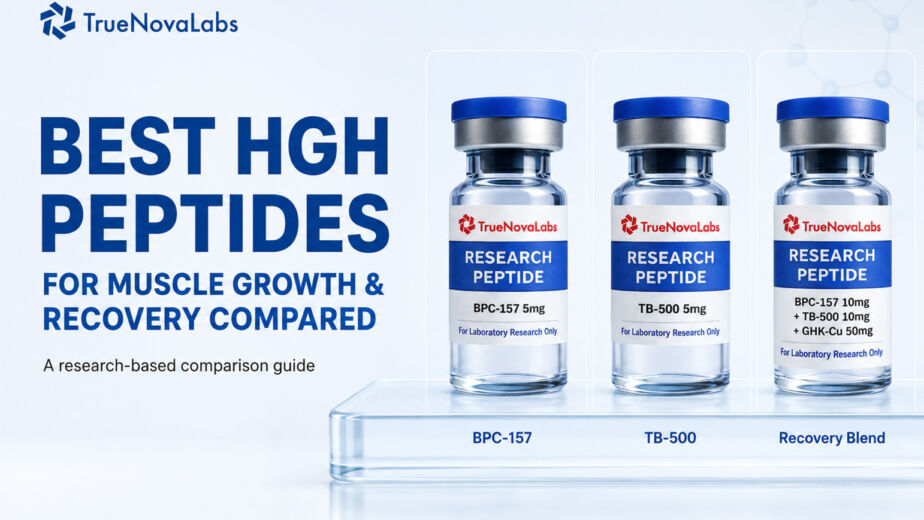
BPC-157 is frequently explored in tissue repair models, particularly in relation to muscle and tendon recovery.
TB-500 is studied for its role in cell migration and repair mechanisms, which are important for recovery cycles.
These peptides are not interchangeable. Some are focused on hormonal signaling, while others are associated with repair and recovery processes.
Bulking vs Lean Muscle Cycles
In research discussions, peptide cycles are sometimes categorized based on their intended outcome.
Bulking-oriented cycles are typically associated with:
- increased anabolic signaling
- higher emphasis on growth pathways
- support for recovery during higher training loads
Lean muscle cycles, on the other hand, are more focused on:
- maintaining muscle while optimizing recovery
- minimizing excess weight gain
- supporting consistent adaptation
It is important to understand that these categories are conceptual.
Peptides do not directly “bulk” or “cut.” Instead, they influence underlying biological processes that may support different training goals depending on context.
Recovery and Rest Period Considerations
Recovery is one of the most critical aspects of any peptide cycle.
Because many muscle growth peptides influence GH and IGF-1 pathways, continuous exposure without rest may lead to:
- reduced sensitivity to signaling
- altered hormonal feedback
- inconsistent research outcomes
Rest periods allow:
- normalization of signaling pathways
- recovery of receptor sensitivity
- more accurate observation of long-term effects
This cyclical approach reflects how the body naturally operates—through balance rather than constant stimulation.
Risks and Common Mistakes
Many risks associated with peptide cycles are not due to the peptides themselves, but to how they are used and handled.
Common issues include:
- using low-quality or unverified products
- improper storage leading to degradation
- inconsistent handling during preparation
- lack of structured observation periods
Because peptides are sensitive compounds, even small inconsistencies can affect both:
- stability
- reliability of results
In Canada, substances are regulated based on classification and intended use by organizations such as Health Canada, reinforcing the importance of proper context.
👉 For consistent quality and verified sourcing, explore research peptides here SHOP ALL COMPOUNDS
Factors That Influence Results
The outcome of any peptide cycle depends on multiple interacting variables.
These include:
- peptide type and mechanism
- duration of the cycle
- consistency of conditions
- biological variability
- training and recovery environment
Peptides do not operate in isolation. Their effects are influenced by the broader system in which they are studied.
This is why results are typically:
- gradual
- context-dependent
- variable across different conditions
Muscle growth peptide cycles explained. Learn timing, structure, and key factors affecting results—read more in our guide: Peptides for Muscle Growth: Benefits, Performance & What to Expect
FAQ
What is a peptide cycle?
A structured period of observation followed by rest, used to study how peptides affect biological systems over time.
Do peptide cycles build muscle directly?
No. They are studied for how they influence recovery and hormonal signaling.
Why are rest periods important?
They help maintain receptor sensitivity and allow biological systems to return to baseline.
Are all peptides used in the same type of cycle?
No. Different peptides serve different roles, such as hormonal signaling or tissue repair.
Are peptide cycles approved in Canada?
Regulators classify most peptides as research compounds, and pharmaceutical frameworks must regulate them before they qualify as approved therapeutic products.
Conclusion
Understanding muscle growth peptide cycles requires looking beyond simple timelines and focusing on how the body adapts over time.
Peptides are studied for how they influence:
- growth hormone signaling
- recovery processes
- tissue repair
- long-term adaptation
Cycling reflects the need for balance—between stimulation and recovery, activity and rest.
For researchers in Canada, reliable outcomes depend on:
- high-quality sourcing
- proper storage and handling
- structured observation
- realistic expectations
Explore Research-Grade Peptides
If you’re looking for peptides supported by verified purity, transparent sourcing, and consistent quality standards, explore the full collection here SHOP ALL COMPOUNDS
Disclaimer:
This content is provided by True Nova Labs for educational and research purposes only. It is not intended to diagnose, treat, cure, or prevent any disease, nor to provide medical or legal advice.




3 Comments
Austin Reynolds
Really informative article on muscle growth peptide cycles and how timing may influence recovery and adaptation. I liked that the article focused on structure and consistency instead of making peptide cycles sound like a shortcut to fast results. The explanation around timing and signaling patterns was especially interesting.
Rachel Cooper
Great breakdown overall. A lot of discussions online oversimplify peptide cycles, so I appreciated the balanced explanation around timing, recovery phases, and long-term adaptation. It definitely made the topic easier to understand from a research perspective.
Jason Mitchell
Very practical and easy to follow. I liked that the article emphasized how training quality, nutrition, and recovery still play a major role alongside peptide research. The section discussing structured cycles versus inconsistent use was especially valuable.