
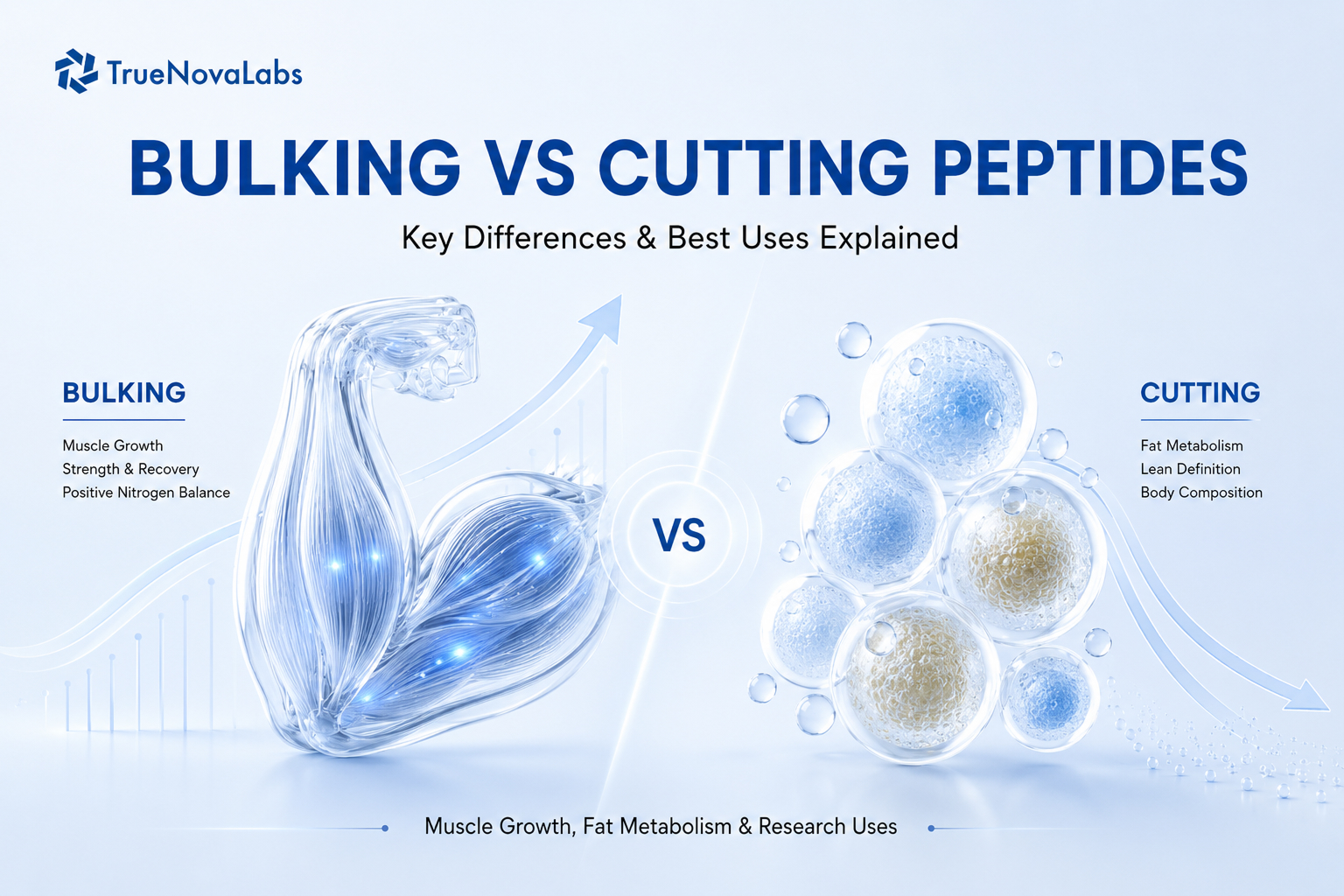
The topic of bulking vs cutting peptides is often discussed in bodybuilding research because these two phases have very different goals. Bulking focuses on building muscle mass, increasing strength, and supporting recovery during higher-calorie training periods. Cutting focuses on reducing body fat while preserving lean mass, performance, and recovery during calorie restriction.
However, peptides are not standard bodybuilding supplements. Many compounds discussed in bodybuilding communities are research compounds, prescription-regulated drugs, or unauthorized products when marketed for human use. In Canada, Health Canada has warned consumers about unauthorized injectable peptide drugs promoted online for bodybuilding, athletic performance, weight loss, recovery, anti-aging, and wellness because they can pose serious health risks.
At True Nova Labs, peptide education is approached from a research-focused perspective. This guide explains how bulking and cutting peptides are commonly discussed, what separates muscle-growth-focused research from fat-loss-focused research, and why safety, regulation, and evidence quality matter. Explore more peptide research education at SHOP ALL COMPOUNDS
How Bulking Peptides Work
In bodybuilding, a bulking phase is designed to increase muscle mass and strength over time. This usually involves a calorie surplus, progressive resistance training, adequate protein intake, and structured recovery.
In research discussions, “bulking peptides” usually refer to compounds studied for their relationship with:
- Growth hormone signaling
- IGF-1-related pathways
- Muscle recovery
- Protein synthesis environment
- Sleep-related adaptation
- Training tolerance
- Connective tissue support
The main idea is not that peptides directly “create muscle,” but that certain peptides may interact with biological systems involved in recovery, adaptation, and anabolic signaling.
For example, growth hormone-releasing peptides and growth hormone secretagogues are often discussed because growth hormone and IGF-1 pathways are connected to tissue growth, metabolism, and repair. However, influencing these pathways can also create systemic effects, so these compounds should be discussed carefully and responsibly.

👉 Learn more about performance and recovery peptides at SHOP ALL COMPOUNDS
Bulking Peptides Are Usually Recovery-Supportive
During a bulking phase, bodybuilders often train with higher volume, heavier loads, and increased food intake. Because of this, recovery becomes a major limiting factor.
Peptides discussed in bulking research are often associated with:
- Improved recovery capacity
- Better sleep-related adaptation
- Reduced downtime between sessions
- Support for connective tissue models
- Long-term training consistency
Still, training, nutrition, and sleep remain the foundation. No peptide can replace progressive overload, calorie control, or recovery discipline.
How Cutting Peptides Work
A cutting phase is focused on reducing body fat while preserving as much lean mass and performance as possible. Unlike bulking, cutting usually involves a calorie deficit, which can increase fatigue, reduce recovery capacity, and make muscle retention more difficult.
In research discussions, “cutting peptides” are often associated with:
- Fat metabolism
- Body composition models
- Energy regulation
- Insulin and glucose-related pathways
- Mitochondrial research
- Recovery during calorie restriction
- Lean mass preservation
The goal is different from bulking. Instead of maximizing growth, cutting focuses on maintaining muscle while reducing fat.
Cutting Peptides Are Often Metabolic-Focused
Cutting-related peptide discussions often focus on metabolic signaling. Some compounds are studied for their relationship with fat metabolism, visceral fat, mitochondrial function, or energy balance.
However, fat loss still depends primarily on energy balance. A calorie deficit, adequate protein intake, resistance training, sleep, and adherence remain the most important factors. Peptides should not be framed as a shortcut or guaranteed fat-loss solution.
👉 Learn more about performance and recovery peptides at SHOP ALL COMPOUNDS
Muscle Growth vs Fat Loss Goals
The main difference between bulking and cutting peptides comes down to the goal being studied.
| Category | Bulking Research Focus | Cutting Research Focus |
|---|---|---|
| Primary Goal | Muscle growth and strength | Fat loss and lean mass retention |
| Nutrition Context | Calorie surplus | Calorie deficit |
| Key Concern | Recovery and anabolic signaling | Metabolism and muscle preservation |
| Common Pathways | GH, IGF-1, tissue repair | Fat metabolism, energy regulation |
| Training Challenge | High volume and progressive overload | Maintaining performance under fatigue |
| Research Interest | Growth and adaptation | Body composition and metabolic support |
Bulking Research Priorities
Bulking-focused peptide discussions usually emphasize:
- Muscle growth environment
- Recovery between intense sessions
- Growth hormone-related pathways
- Sleep quality
- Joint and connective tissue support
- Long-term training volume
Cutting Research Priorities
Cutting-focused peptide discussions usually emphasize:
- Fat metabolism
- Energy regulation
- Lean mass preservation
- Recovery while dieting
- Reduced training fatigue
- Body composition changes
A compound that makes sense in a bulking research model may not be ideal for a cutting model, and vice versa.
Popular Peptides for Each Approach
The following compounds are commonly discussed in bodybuilding research contexts. This section is educational and does not recommend human use.
Popular Peptides for Bulking Research
CJC-1295
CJC-1295 is commonly studied for its relationship with growth hormone-releasing hormone pathways. In bodybuilding research discussions, it is often associated with growth hormone signaling, recovery, sleep quality, and body composition.
Researchers are interested in how compounds like CJC-1295 may influence pulsatile growth hormone release and downstream pathways such as IGF-1 signaling. However, altering hormone-related pathways may create broader systemic effects, so long-term safety remains an important consideration.
Ipamorelin
Researchers often discuss Ipamorelin as a growth hormone secretagogue. In bodybuilding research contexts, they commonly associate it with recovery, lean mass support, and sleep-related adaptation.
Researchers often discuss Ipamorelin alongside CJC-1295 because both compounds relate to growth hormone signaling, but they work through different mechanisms. However, writers should interpret claims around muscle growth or recovery carefully, especially when those claims rely on non-clinical findings or anecdotal evidence.
GHRP-2 and GHRP-6
GHRP-2 and GHRP-6 are growth hormone-releasing peptides commonly discussed in older bodybuilding forums and performance research spaces. They are often associated with growth hormone release models, appetite-related effects, recovery, and body composition discussions.
However, they may also influence other systems, including hunger, water retention, cortisol, and prolactin-related pathways. This makes them more complex than simple “bulking peptides.”
👉 Learn more about performance and recovery peptides at SHOP ALL COMPOUNDS
Popular Peptides for Cutting Research
Tesamorelin
Tesamorelin is a growth hormone-releasing hormone analogue that has been studied clinically in specific body composition contexts. In cutting-related discussions, it is sometimes associated with fat metabolism, visceral fat research, and body composition models.
Because bodybuilding often involves bulking and cutting phases, researchers sometimes discuss Tesamorelin in relation to fat metabolism and body composition. However, its legitimate use depends on medical and regulatory status, so writers should not present it as a casual fat-loss or bodybuilding product.
MOTS-C
Researchers often discuss MOTS-C in relation to mitochondrial and metabolic research. In cutting-related discussions, they may associate it with energy metabolism, cellular stress response, exercise adaptation, and body composition models.
However, human bodybuilding-specific evidence remains limited, so performance and fat-loss claims should be interpreted with caution.
AOD-9604
Researchers sometimes discuss AOD-9604 in fat metabolism and weight-management research contexts. They often mention it in cutting discussions because of its association with lipid metabolism models.
However, researchers should evaluate body composition claims carefully. A compound’s role in metabolic research does not mean regulators have proven, approved, or confirmed it as safe for bodybuilding use.
Peptides Discussed in Both Bulking and Cutting
Some peptides appear in both bulking and cutting discussions because researchers connect them to recovery rather than one specific body composition goal.
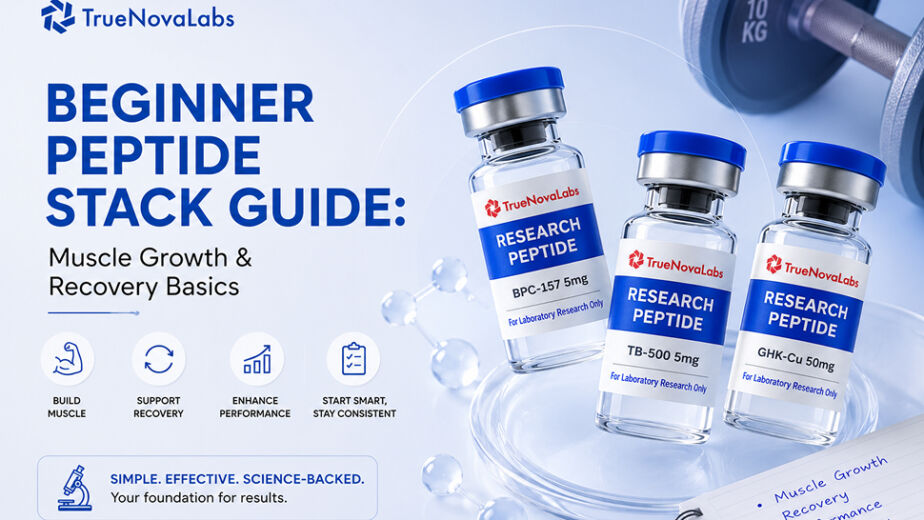
BPC-157
BPC-157 is widely discussed in recovery and tissue repair research. Researchers commonly study it in tendon, ligament, muscle, and gastrointestinal models.
In bodybuilding contexts, researchers often discuss TB-500 in relation to recovery during both bulking and cutting phases. During bulking, heavy training stress may become the main concern. During cutting, reduced recovery capacity under calorie restriction may become the main concern.
TB-500
Researchers often discuss TB-500 in tissue repair, mobility, inflammation, and recovery research models. They connect it to thymosin beta-4 research, particularly in studies involving cell migration and repair-related biological processes.
Like BPC-157, TB-500 is not strictly a bulking or cutting compound. It is more commonly discussed as a recovery-focused research peptide.
Risks and Recovery Considerations
Peptides can influence major biological systems, including hormone signaling, metabolism, immune response, and tissue repair. Because of this, risk management is central to any responsible discussion.
General Risks
Potential risks and concerns may include:
- Hormonal imbalance
- Blood sugar changes
- Water retention
- Mood changes
- Injection-site reactions
- Immune response
- Product contamination
- Mislabeling
- Sterility issues
- Unknown long-term effects
- Interactions with medical conditions
- Anti-doping violations
Health Canada has warned that unauthorized injectable peptide drugs may change how the body works. Online sellers often promote these products for bodybuilding, athletic performance, injury recovery, weight loss, sleep, anti-aging, and wellness.
Canada-Specific Safety Context
For Canadian readers, it is important to understand that Health Canada may not authorize many peptide products sold online as health products. Unauthorized products may not undergo review for:
- Safety
- Efficacy
- Quality
- Purity
- Sterility
- Accurate labeling
- Proper dosage information
This is especially important for injectable peptide products, where contamination, incorrect concentration, and sterility problems can create serious risks.
Anti-Doping Considerations
Competitive athletes should be especially careful. The World Anti-Doping Agency’s 2026 Prohibited List includes peptide hormones, growth factors, related substances, and mimetics under prohibited categories.
This means athletes in tested sports should not assume they can use a peptide simply because sellers offer it online or describe it as a wellness or recovery compound.
Choosing Between Bulking and Cutting Cycles
The choice between bulking and cutting should be based on physique goals, training status, body composition, recovery capacity, and long-term strategy.
Choose a Bulking Phase When
- The goal is muscle gain
- Strength progression is a priority
- Body fat is at a manageable level
- Recovery is strong
- Nutrition adherence is consistent
- Training performance is improving
In a research context, bulking peptide discussions usually focus on growth hormone signaling, recovery, sleep, and tissue adaptation.
Choose a Cutting Phase When
- The goal is fat loss
- Body fat reduction is the priority
- Lean mass preservation matters
- Training performance needs to be maintained
- Nutrition control is strong
- Recovery is carefully managed
In a research context, cutting peptide discussions usually focus on metabolism, body composition, energy regulation, and recovery during calorie restriction.
Avoid Constant Switching
One common mistake in bodybuilding is switching too quickly between bulking and cutting. A short bulk may not provide enough time for meaningful muscle gain, while a short cut may not create visible fat-loss progress.
A better strategy is to use structured phases:
- Lean bulk for controlled muscle gain
- Maintenance phase for stabilization
- Cutting phase for fat reduction
- Recovery phase when training stress is high
The Foundation Still Matters Most
Whether someone is bulking or cutting, the fundamentals remain the same:
- Progressive resistance training
- Adequate protein intake
- Calorie control
- Sleep consistency
- Hydration
- Recovery management
- Injury prevention
- Regular performance tracking
Researchers may discuss peptides as advanced research tools, but peptides should not replace the basics that drive long-term bodybuilding progress.
FAQ – Bulking vs Cutting Peptides
What is the difference between bulking and cutting peptides?
Researchers usually discuss bulking peptides in relation to growth hormone signaling, recovery, lean mass support, and training adaptation. They more often discuss cutting peptides in relation to fat metabolism, body composition, energy regulation, and lean mass preservation.
Are bulking peptides used for muscle growth?
In research discussions, researchers associate some peptides with pathways related to muscle growth, recovery, and anabolic signaling. However, this does not mean regulators have proven or approved them for bodybuilding use.
Are cutting peptides used for fat loss?
Some peptides are discussed in relation to fat metabolism and body composition research. However, fat loss still depends primarily on calorie deficit, training, protein intake, sleep, and adherence.
Which peptides are commonly discussed for bulking?
Researchers often discuss CJC-1295, Ipamorelin, GHRP-2, and GHRP-6 in bulking-related research because of their relationship with growth hormone signaling and recovery models.
Which peptides are commonly discussed for cutting?
Researchers often discuss Tesamorelin, MOTS-C, and AOD-9604 in cutting-related research because they associate these peptides with fat metabolism, body composition, or metabolic signaling.
Are BPC-157 and TB-500 bulking or cutting peptides?
BPC-157 and TB-500 are more commonly discussed as recovery-focused peptides. They may appear in both bulking and cutting discussions because recovery matters in both phases.
Are peptides legal in Canada?
It depends on the compound, intended use, and regulatory status. Health Canada has warned against unauthorized injectable peptide drugs promoted online for bodybuilding, recovery, athletic performance, weight loss, and wellness.
Are peptides banned in sports?
Many peptide hormones, growth factors, related substances, and mimetics are prohibited under WADA rules. Competitive athletes should review the current Prohibited List before considering any peptide-related substance.
Should beginners use peptides for bulking or cutting?
Beginners should focus on training, nutrition, sleep, recovery, and evidence-based supplementation first. Peptides are advanced research topics and should not be treated as basic bodybuilding supplements.
Final Thoughts
The discussion around bulking vs cutting peptides reflects two very different bodybuilding goals. Bulking is usually connected to muscle growth, strength, and recovery, while cutting is focused on fat loss, body composition, and lean mass preservation.
In research contexts, bulking peptides are often discussed around growth hormone signaling and tissue adaptation, while cutting peptides are often linked to fat metabolism and energy regulation. Recovery-focused peptides may appear in both phases because training consistency depends on managing stress, fatigue, and tissue repair.
However, responsible education must separate research mechanisms from unsupported performance claims. In Canada, many peptide products promoted online for bodybuilding or athletic performance may be unauthorized, risky, and unsuitable for human use. Competitive athletes must also consider anti-doping rules.
For more educational content on research peptides, bodybuilding mechanisms, and performance-related science, explore True Nova Labs
Disclaimer:
This content is provided by True Nova Labs for educational and research purposes only. It is not intended to diagnose, treat, cure, or prevent any disease, nor to provide medical or legal advice.



3 Comments
Brandon Carter
Really informative comparison between bulking and cutting peptides. I liked that the article explained how these approaches focus on different biological pathways and body composition goals rather than treating them as complete opposites. The discussion around recovery, muscle retention, and long-term adaptation was especially helpful.
Samantha Reed
Great read overall. There’s a lot of confusion online about whether bulking and cutting require completely different peptide strategies, so I appreciated the balanced explanation of how goals, nutrition, and training context all influence the approach. It definitely made the topic easier to understand.
Tyler Morgan
Very well structured and easy to follow. I especially liked how the article emphasized that body composition changes depend on recovery, training quality, and consistency rather than peptides alone. It would be interesting to see a future article comparing common bulking-focused peptide stacks with cutting-focused stacks side by side.