
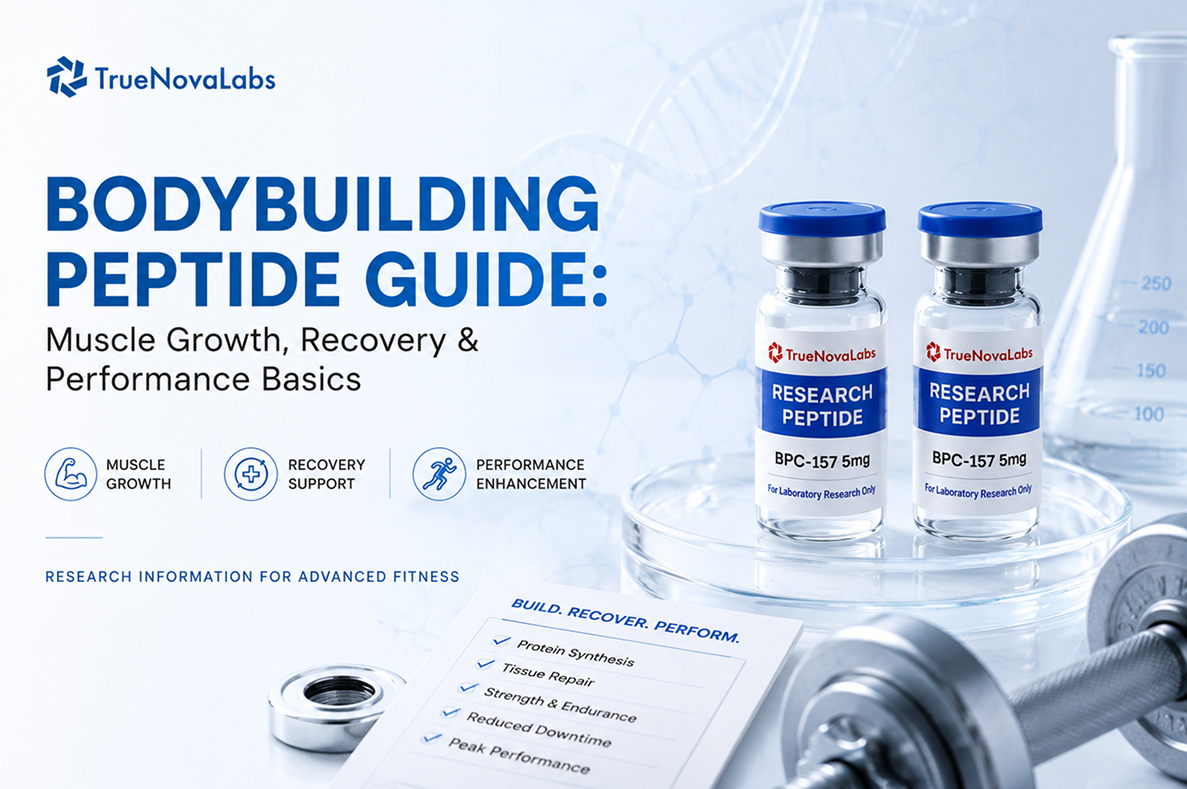
Bodybuilding relies on more than just lifting weights—it is a carefully orchestrated balance of training, nutrition, recovery, and adaptation. In recent years, interest in bodybuilding peptides has increased, and this Bodybuilding Peptide Guide explores how these compounds may influence growth hormone pathways, tissue repair, and recovery efficiency.
It’s important to understand that peptides are not direct muscle-building agents. Instead, they are studied for how they support the biological environment necessary for adaptation and performance improvements.
In Canada, peptides discussed in this context are supplied strictly for laboratory and educational purposes only. Therefore, they are not approved as performance-enhancing products.
👉 Looking for research-grade peptides with verified purity and transparent sourcing? Explore the collection at True Nova Labs.
How Peptides Are Used in Bodybuilding
In research, peptides are typically studied for their influence on growth hormone signaling, recovery pathways, and tissue repair. They are not used to replace proper training or nutrition but rather to support underlying biological processes.
Peptides in bodybuilding research are often associated with:
- muscle repair and regeneration
- recovery efficiency between training sessions
- modulation of GH and IGF-1 signaling
- adaptation to training stress
Their role is indirect, providing the biological context for improved recovery and consistency rather than rapid mass gain.
👉 Learn more about performance and recovery peptides at SHOP ALL COMPOUNDS

Popular Bodybuilding Peptides Explained
Several peptides frequently appear in discussions related to bodybuilding:
| Peptide | Primary Research Focus | Bodybuilding Context |
|---|---|---|
| CJC-1295 | GHRH signaling | Supports sustained GH release |
| Ipamorelin | GH secretagogue | Stimulates endogenous GH pulsatile release |
| BPC-157 | Tissue repair | Muscle, tendon, and ligament recovery models |
| TB-500 | Cell migration and regeneration | Recovery and adaptation processes |
| Tesamorelin | GH stimulation | Endocrine signaling and adaptation |
CJC-1295 + Ipamorelin
They are frequently studied together to explore synergistic effects on GH pathways and recovery support. In addition, they are often discussed in research focusing on muscle adaptation and repair cycles.
BPC-157 and TB-500
These peptides are commonly referenced in tissue repair research, particularly related to muscle and connective tissue recovery after intense exercise.
Bulking, Cutting and Recovery Goals
Peptides are often studied in research under specific bodybuilding objectives:
- Bulking: Peptides are studied for how they may enhance recovery and anabolic signaling during high-volume training phases.
- Cutting: Research may explore peptides’ role in maintaining lean muscle mass while supporting recovery under caloric restriction.
- Recovery: Peptides are frequently studied for improving recovery speed and consistency, which indirectly supports both bulking and cutting goals.
The effectiveness of peptides depends heavily on context, including training, nutrition, and rest.
👉 Learn more about performance and recovery peptides at SHOP ALL COMPOUNDS
Potential Benefits and Limitations
From a research perspective, peptides may provide:
| Benefit | Research Context |
| Enhanced recovery efficiency | Supports adaptation to repeated training |
| Tissue repair support | Cellular regeneration and repair pathways |
| GH signaling modulation | Long-term adaptation and performance potential |
| Consistent training adaptation | Reduces downtime between sessions |
Limitations include:
- indirect effects (do not directly increase muscle mass)
- dependence on training and nutrition
- variability in individual biological response

Risks, Side Effects & Safety Concerns
While peptides are generally studied for their recovery and signaling effects, they are biologically active compounds and require careful handling.
Potential risks in research environments include:
- hormonal variability
- altered recovery signaling
- contamination or degradation if not handled properly
Quality and safety are often associated with:
- purity verification
- proper storage
- transparent sourcing
- controlled handling procedures
In Canada, substances are regulated based on classification and intended use by Health Canada. As a result, this highlights the importance of responsible research practices.
Building a Sustainable Bodybuilding Plan
Research emphasizes that no peptide can replace the fundamental principles of bodybuilding. In other words, proper training, nutrition, and recovery remain essential for muscle growth and performance.
A sustainable plan includes:
- structured progressive resistance training
- adequate nutrition and protein intake
- sleep and recovery optimization
- consistent training schedules
Peptides may complement these systems by supporting recovery and adaptation but are most effective when integrated into a complete plan.
Read Peptides for Bodybuilding: Muscle Growth, Recovery & Performance Explained to learn more about muscle growth, recovery, performance potential, and safety considerations.
FAQ – Bodybuilding Peptide Guide
What are peptides for bodybuilding?
They are compounds studied for how they may influence recovery, growth hormone signaling, and adaptation pathways relevant to muscle development. In other words, researchers examine them to understand how these processes contribute to muscle repair and performance over time.
Do peptides build muscle directly?
No. Instead, peptides support the biological processes involved in recovery and adaptation, which may indirectly support muscle growth.
Which peptides are commonly studied?
CJC-1295, Ipamorelin, BPC-157, TB-500, and Tesamorelin.
Are peptide stacks necessary?
Stacks are sometimes studied to explore synergistic effects on GH signaling and tissue repair but are not universally required.
Are bodybuilding peptides approved in Canada?
Most are supplied as research compounds and are not approved therapeutic products unless regulated under pharmaceutical frameworks.
Conclusion
Interest in bodybuilding peptides reflects a growing understanding that performance depends on more than just training volume. Researchers study these compounds for how they may support recovery, tissue repair, and long-term adaptation.
Reliable outcomes depend on:
- high-quality peptide sourcing
- proper storage and handling
- integration with training and nutrition
- realistic expectations
Peptides are a tool for research and recovery, not a standalone solution.
Explore Research-Grade Peptides
If you’re looking for peptides backed by verified purity, transparent sourcing, and consistent quality standards, explore the full collection here: SHOP ALL COMPOUNDS
Disclaimer:
This content is provided by True Nova Labs for educational and research purposes only. It is not intended to diagnose, treat, cure, or prevent any disease, nor to provide medical or legal advice.




3 Comments
David Parker
This was a very comprehensive guide for anyone trying to understand the role of peptides in bodybuilding research. I liked that the article explained both muscle growth and recovery pathways instead of focusing only on performance outcomes. The section discussing different peptide mechanisms was especially helpful.
Christopher Bennett
Great article and easy to follow. Many people assume peptides work independently, but I appreciate how this guide highlights the importance of training, nutrition, and recovery as part of the bigger picture. It would be interesting to see a future article comparing recovery-focused peptides with growth hormone–related peptides in more detail.
Andrew Wilson
I enjoyed reading this guide. The balanced explanation of benefits, limitations, and research considerations makes it much more trustworthy than many bodybuilding articles online. I’m curious whether newer peptide research is shifting more toward recovery and tissue repair rather than purely muscle-building applications.