
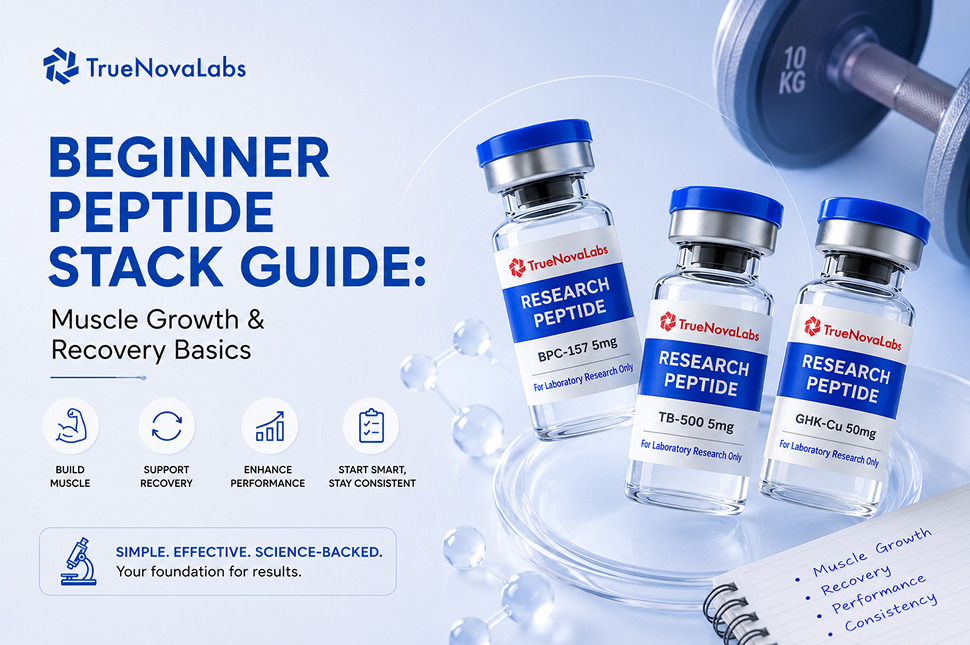
A beginner peptide stack is often discussed in bodybuilding and fitness communities as a combination of peptides studied for muscle growth, recovery, tissue repair, body composition, or hormone-related signaling. However, beginners should approach this topic carefully. Peptides are not simple supplements, and they should not be treated as casual performance products.
In Canada, Health Canada has warned that many bodybuilding products sold online and in retail stores may be marketed as dietary supplements when they are not. Some may contain hidden ingredients or unapproved drugs that have not been reviewed for safety, efficacy, or quality. Health Canada has also specifically warned consumers about unauthorized injectable peptide drugs promoted online for bodybuilding, anti-aging, weight loss, injury recovery, and wellness purposes.
At True Nova Labs, the focus is on responsible research education, transparent sourcing, and helping readers understand peptide mechanisms in a research context.
What Beginners Should Know Before Using Peptides
Before discussing any beginner peptide stack, it is important to understand what peptides are. Peptides are short chains of amino acids that may act as signaling molecules in biological systems. Depending on the peptide, they may be studied in areas such as growth hormone signaling, tissue repair, inflammation, metabolism, appetite regulation, or recovery-related pathways.
However, peptides are not one single category. Different peptides can have very different mechanisms, research purposes, and safety profiles.
Beginners should understand that:
- Peptides are not the same as protein powder or amino acid supplements.
- Different peptides target different biological pathways.
- Some peptides may influence hormone-related systems.
- Injectable peptides may carry added safety concerns.
- Research-use-only products are not intended for personal use.
- Product purity, testing, and sourcing matter.
- Legal status depends on compound identity, claims, and intended use.
Health Canada warns that unauthorized injectable peptide drugs can change how the body works and may pose serious health risks, especially when promoted online for bodybuilding, athletic performance, injury recovery, or wellness.

Common Beginner-Friendly Peptide Stack Discussions
In online fitness spaces, “beginner-friendly” peptide stacks usually refer to combinations that are discussed for general recovery, muscle support, or body composition research rather than highly aggressive performance enhancement. However, the term “beginner-friendly” can be misleading. A peptide may be commonly discussed online, but that does not mean it is approved, safe, or appropriate for personal use.
In research discussions, beginner peptide stacks may include categories such as:
- Growth hormone secretagogue peptides
- Recovery-focused peptides
- Tissue repair-related peptides
- Metabolic research peptides
- Sleep and recovery-supportive pathways
- Collagen or connective tissue-related research compounds
Examples frequently discussed in research and bodybuilding communities include CJC-1295, Ipamorelin, BPC-157, TB-500, GHRP-related peptides, and other peptide analogues. These compounds are often grouped into “stacks” based on the pathway being studied, such as recovery, muscle growth, repair, or body composition.
That said, a responsible peptide stack discussion should focus on mechanism, research purpose, and safety considerations. In contrast, it should avoid dosing, cycle instructions, or personal-use claims.
👉 Learn more about performance and recovery peptides at SHOP ALL COMPOUNDS
Bulking vs Recovery-Focused Approaches
Not every beginner peptide stack has the same goal. Most discussions fall into two broad categories: bulking-focused stacks and recovery-focused stacks.
Bulking-Focused Peptide Stack Concepts
Bulking-focused peptide stacks are usually discussed in relation to muscle growth, lean mass support, and anabolic environment research. These stacks often involve peptides studied for growth hormone-related signaling or recovery support.
The research logic is usually based on indirect support mechanisms such as:
- Growth hormone release models
- IGF-1-related signaling
- Protein synthesis environment
- Sleep and recovery quality
- Training adaptation support
- Muscle repair after resistance training
However, peptides should not be presented as a replacement for training, nutrition, sleep, or medical guidance. In most cases, muscle growth still depends primarily on progressive resistance training, sufficient calories, adequate protein intake, recovery, and consistency.
Recovery-Focused Peptide Stack Concepts
Researchers usually discuss recovery-focused stacks in relation to connective tissue, soreness, inflammation response, tendon or ligament models, and post-training repair pathways. These stacks often interest people who focus on recovery research rather than direct muscle-building mechanisms.
Recovery-focused peptide research may involve pathways related to:
- Tissue repair
- Collagen synthesis
- Inflammation signaling
- Joint and tendon models
- Muscle recovery after stress
- Mobility and training continuity
For beginners, recovery-focused education is often more realistic than expecting dramatic muscle growth from peptides alone.
👉 Learn more about performance and recovery peptides at SHOP ALL COMPOUNDS

Muscle Growth and Recovery Basics
Peptides may appear in muscle growth and recovery discussions, but they often play an indirect role. Unlike SARMs, which researchers commonly discuss through androgen receptor activity, many peptides work through signaling pathways that may influence recovery, hormone release, repair, or metabolic function.
A beginner should understand that peptide research does not replace foundational bodybuilding principles.
Core muscle growth basics include:
- Progressive overload
- Consistent resistance training
- Adequate protein intake
- Calorie surplus for bulking
- Sufficient sleep
- Recovery between sessions
- Stress management
- Training volume control
Core recovery basics include:
- Sleep quality
- Hydration
- Mobility work
- Deload periods
- Proper warm-ups
- Injury prevention
- Balanced nutrition
- Managing training intensity
Researchers may discuss a peptide stack as a research topic, but they should not frame it as the main driver of results. For beginners, better training structure, better nutrition, and better recovery habits usually drive the biggest improvements.
Training and Nutrition Support
A common mistake in beginner peptide stack discussions is focusing too much on compounds and too little on the foundation. Without proper training and nutrition, no stack discussion is meaningful.
Muscle Growth: What Beginners Should Prioritize
- A structured resistance training plan
- Compound lifts and progressive overload
- Enough weekly training volume
- Protein intake across the day
- A moderate calorie surplus
- Consistent sleep schedule
- Recovery days
Cutting and Body Recomposition: Key Priorities for Beginners
- A sustainable calorie deficit
- High protein intake
- Resistance training to preserve lean mass
- Daily movement
- Sleep and stress control
- Realistic timelines
Recovery: Essential Focus Areas for Beginners
- Proper exercise technique
- Managing training load
- Avoiding ego lifting
- Mobility and warm-up routines
- Regular rest days
- Treating pain signals seriously
Researchers often discuss peptides in advanced research contexts, but beginners usually benefit more from mastering the basics first.
Risks and Side Effects for Beginners
Peptide risks depend on the specific compound, quality, route of administration, purity, and intended use. It is inaccurate to say that peptides are automatically safe because they are made from amino acids.
Potential risks may include:
- Hormonal disruption
- Injection-site concerns
- Contamination risk
- Mislabelled products
- Unknown long-term effects
- Immune or allergic reactions
- Product impurity
- Incorrect storage or handling
- Unsafe personal use outside medical supervision
Health Canada has warned that unauthorized injectable peptide drugs can pose serious health risks. Online sellers often promote these products for bodybuilding, athletic performance, injury recovery, and wellness. Health Canada also notes that some bodybuilding products may contain hidden ingredients or unapproved drugs that regulators have not reviewed for safety, efficacy, and quality.
For competitive athletes, the risk is even higher. Sport Integrity Canada states that athletes are responsible for any prohibited substance found in their sample and warns that supplement use carries extreme risk because products may contain prohibited substances.
Legal and Regulatory Considerations in Canada
For Canadian readers, legal and regulatory context is essential.
Peptide regulation depends on the specific compound, formulation, claim, intended use, and distribution model. Regulators may classify some peptides as prescription drugs, allow others for research contexts, or consider others unauthorized when sellers promote or sell them for human use.
A product labelled “research use only” does not automatically make it compliant if the marketing implies:
- Personal use
- Human dosing
- Muscle gain claims
- Fat loss claims
- Injury healing
- Anti-aging benefits
- Performance enhancement
- Medical treatment
- Guaranteed results
Health Canada’s Drug and Health Product Portal provides information on drugs and health products authorized by Health Canada, which can help users verify whether a specific health product has authorization.
For athletes, the World Anti-Doping Agency’s Prohibited List identifies substances and methods prohibited in sport, and many hormone-related compounds, peptide hormones, growth factors, and related substances may create anti-doping risks.
Mistakes New Users Commonly Make
Beginners often make mistakes because online peptide content can be confusing, exaggerated, or non-compliant.
Common beginner mistakes include:
- Thinking peptides are the same as supplements
- Choosing stacks based on online hype
- Ignoring Canadian regulatory concerns
- Trusting suppliers without third-party testing
- Assuming “research use only” means safe
- Combining too many compounds at once
- Expecting fast muscle growth without proper training
- Ignoring side effects or warning signs
- Using products with unclear purity
- Following influencer advice without verification
Another major mistake involves confusing research discussion with personal guidance. A research article or product page may describe mechanisms, but that does not mean regulators have approved the compound or that users should treat it as appropriate for personal bodybuilding use.
For research buyers, the better approach is to evaluate:
- Compound identity
- Batch-specific certificate of analysis
- Third-party testing
- Purity data
- Storage requirements
- Clear research-use positioning
- Supplier transparency
- Absence of unsupported human-use claims
How to Think About a Beginner Peptide Stack Responsibly
A responsible beginner peptide stack discussion should begin with the research goal, not the product list.
Ask questions such as:
- What biological pathway is being studied?
- Is the compound relevant to muscle growth, recovery, repair, or metabolism?
- Is there credible research behind the mechanism?
- Is the supplier transparent about testing?
- Is the compound being marketed responsibly?
- Are Canadian regulations being considered?
- Are anti-doping risks relevant?
- Are claims being exaggerated?
This approach helps separate research education from unsafe or hype-driven bodybuilding content.
At True Nova Labs, the goal is to support informed research through educational content, quality-focused sourcing standards, and responsible compound discussions.
Read Peptides for Bodybuilding: Muscle Growth, Recovery & Performance Explained to learn more about muscle growth, recovery, performance potential, and safety considerations.
FAQ – Beginner Peptide Stack
What is a beginner peptide stack?
A beginner peptide stack usually refers to a combination of peptides discussed for basic muscle growth, recovery, tissue repair, or body composition research. However, the term should be used carefully because peptides are not casual supplements and may carry safety, regulatory, and anti-doping risks.
Are peptides legal in Canada?
It depends on the specific peptide, formulation, claims, and intended use. For example, some peptides may be regulated as prescription drugs, while others may be discussed in research contexts. Therefore, broad claims like “all peptides are legal in Canada” are inaccurate.
Are beginner peptide stacks safe?
Not automatically. Instead, safety depends on the compound, purity, testing, source, route of administration, and research context. For this reason, Health Canada has warned that unauthorized injectable peptide drugs may pose serious health risks.
Which peptides are commonly discussed for beginners?
Peptides commonly discussed in research and bodybuilding communities include CJC-1295, Ipamorelin, BPC-157, TB-500, and GHRP-related peptides. These should be understood as research compounds and not as guaranteed personal-use solutions.
Can peptides help with muscle growth?
Some peptides are studied for growth hormone-related signaling, recovery, tissue repair, or metabolic pathways that may be relevant to muscle growth research. However, training, nutrition, calories, protein, and recovery remain the foundation of muscle development.
Are peptides banned in sport?
Some peptide hormones, growth factors, and related substances are prohibited in sport. Athletes should check current anti-doping resources before using any compound or supplement. Sport Integrity Canada also states that athletes are responsible for any prohibited substance found in their sample.
What should beginners avoid?
Beginners should avoid products with unclear labels, no certificate of analysis, exaggerated claims, human-use instructions, influencer-only recommendations, and suppliers that do not provide transparent testing. In particular, transparency, batch-specific documentation, and research-use-only positioning are important factors when evaluating peptide suppliers.
What should research buyers look for?
Research buyers should look for clear compound identity, batch-specific testing, third-party analysis, transparent sourcing, certificates of analysis, proper storage information, and research-use-only positioning. Most importantly, they should avoid suppliers that make unsupported performance or medical claims.
Conclusion
A beginner peptide stack should not be treated as a shortcut to muscle growth or recovery. Peptides are complex biological signaling compounds, and their effects depend on the specific peptide, research model, purity, and context.
For beginners, the foundation should always come first: training, nutrition, sleep, recovery, and consistency. Peptides may be studied in relation to muscle growth, tissue repair, metabolism, or recovery, but they should be discussed responsibly and within appropriate research and regulatory boundaries.
In Canada, Health Canada has warned about unauthorized injectable peptide drugs and bodybuilding products that may contain hidden or unapproved ingredients. For athletes, supplement and compound use may also create anti-doping risks under strict liability rules.
To learn more about research peptides, quality standards, and responsible compound education, visit True Nova Labs
Explore Research-Grade Peptides
If you’re looking for peptides backed by verified purity, transparent sourcing, and consistent quality standards, explore the full collection here: SHOP ALL COMPOUNDS
Disclaimer:
This content is provided by True Nova Labs for educational and research purposes only. It is not intended to diagnose, treat, cure, or prevent any disease, nor to provide medical or legal advice.


3 Comments
Tyler Anderson
This is one of the clearest beginner guides I’ve come across. I appreciate that the article focuses on understanding different peptide categories and research goals instead of making unrealistic promises. The emphasis on learning the fundamentals before exploring more advanced stacks is especially valuable.
Ethan Roberts
Great article for anyone just starting to learn about peptide research. I liked how it explains that factors such as training, nutrition, and recovery still play a major role, rather than presenting peptides as a standalone solution. Do you think beginners should spend more time understanding recovery pathways before looking into growth-focused compounds?
Nathan Collins
Really informative read. There is so much conflicting information online about beginner peptide stacks, so having a guide that discusses realistic expectations and research considerations is refreshing. I’d be interested in seeing a follow-up article covering common mistakes beginners make when comparing different peptide options.