
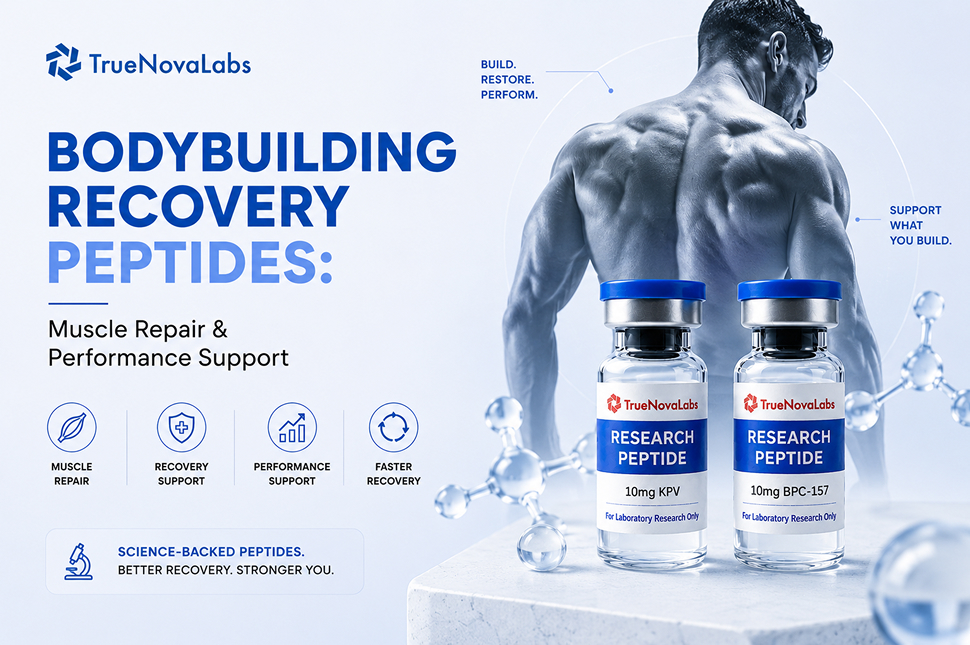
Recovery is a crucial, yet often overlooked, aspect of bodybuilding. While training intensity drives muscle growth, the body’s ability to repair and adapt determines long-term performance and progress. This is why interest in bodybuilding recovery peptides has grown in research circles—they are studied for how they may influence muscle repair, recovery efficiency, and performance adaptation.
Unlike anabolic interventions, peptides are not direct muscle builders. Instead, researchers explore how they may support the biological systems necessary for effective recovery and training adaptation.
In Canada, peptides discussed in this context are primarily supplied for laboratory and educational research purposes, not as approved performance-enhancing products.
👉 Explore research-grade peptides with verified purity and transparent sourcing at True Nova Labs
This guide explains how recovery peptides are studied in bodybuilding, which compounds are commonly referenced, and how they integrate into broader performance strategies.
Why Recovery Matters in Bodybuilding
Every bodybuilding session creates stress on muscles, tendons, and connective tissues. Without proper recovery, athletes may experience:
- delayed adaptation
- decreased performance
- higher risk of injury
- slowed progress
Recovery is the stage where the body repairs tissue, adapts to training stimulus, and prepares for subsequent workouts. Optimizing this process is critical to sustaining performance over time.

Popular Recovery Peptides for Bodybuilders
Several peptides are frequently studied in research related to bodybuilding recovery:
| Peptide | Research Focus | Role in Recovery |
|---|---|---|
| BPC-157 | Tissue repair | Supports muscle, tendon, and ligament recovery |
| TB-500 (Thymosin Beta-4) | Cell migration & regeneration | Enhances tissue repair and adaptation |
| CJC-1295 | Growth hormone signaling | Promotes GH pathway support during recovery |
| Ipamorelin | GH secretagogue | Stimulates endogenous growth hormone release |
BPC-157
Studied for tissue repair models, particularly in musculoskeletal recovery, including muscle, tendon, and connective tissue.
TB-500
Frequently researched for its role in cell migration and regenerative processes, which supports repair after intense training sessions.
CJC-1295 and Ipamorelin
These peptides are often studied together because they affect growth hormone pathways, which are closely linked to muscle repair and recovery signaling.
How Recovery Peptides Support Muscle Repair
Recovery peptides are not direct healing agents. They are studied for how they influence biological processes involved in repair, including:
- cellular regeneration
- collagen and connective tissue synthesis
- growth factor signaling
- recovery-related endocrine activity
By supporting these processes, recovery peptides may help the body maintain performance across consecutive training sessions.

Benefits for Training Frequency and Performance
From a research perspective, recovery peptides are associated with:
| Benefit | Research Context |
|---|---|
| Faster recovery | Adaptation between training sessions |
| Tissue repair support | Muscles, tendons, ligaments |
| GH signaling modulation | Supports recovery-related endocrine pathways |
| Consistent training adaptation | Reduces downtime between workouts |
| Long-term performance | Sustained improvements over repeated cycles |
Peptides may help maintain training frequency and intensity, but outcomes depend on training, nutrition, and sleep quality.
👉 Learn more about recovery peptides and performance support at TrueNovaLabs: SHOP ALL COMPOUNDS
Risks and Side Effects to Consider
Peptides are biologically active compounds, so safety is an important consideration. Potential risks in research contexts may include:
- hormonal variability
- altered signaling pathways
- contamination or degradation from improper storage
- inconsistent product quality
Many risks are tied to purity, handling, and storage, not the peptide’s mechanism itself.
| Quality Factor | Why It Matters |
|---|---|
| Purity verification | Ensures consistent outcomes |
| Storage conditions | Maintains peptide stability |
| Handling procedures | Reduces contamination risk |
| Supplier transparency | Improves reliability and consistency |
In Canada, substances are regulated according to classification and intended use by Health Canada.
Combining Recovery Methods for Better Results
Peptides are only one part of a holistic recovery strategy. Effective recovery for bodybuilders also includes:
- structured rest periods
- adequate protein and nutrient intake
- sleep optimization
- stress management
Research often emphasizes that peptides enhance but do not replace these foundational recovery practices.
FAQ – Bodybuilding Recovery Peptides
What are bodybuilding recovery peptides?
They are peptides studied for how they may support recovery, tissue repair, and adaptation in bodybuilding contexts.
Do recovery peptides build muscle directly?
No. They support the biological processes involved in repair and adaptation, which can indirectly help muscle growth.
Which peptides are commonly studied?
BPC-157, TB-500, CJC-1295, and Ipamorelin.
Can peptides reduce downtime between training sessions?
They are studied for their potential to support recovery efficiency, which may help maintain training frequency.
Are bodybuilding recovery peptides approved in Canada?
Most are classified as research compounds and are not approved therapeutic products unless regulated under pharmaceutical frameworks.
Conclusion
Bodybuilding recovery peptides are studied for their ability to support muscle repair, recovery signaling, and performance adaptation. While they are not direct muscle-building agents, they may play a role in maintaining training consistency and recovery quality.
For researchers in Canada, reliable outcomes depend on:
- verified peptide quality
- proper storage and handling
- realistic expectations
- integration with training, nutrition, and recovery strategies
Explore Research-Grade Peptides
Looking for peptides supported by verified purity, transparent sourcing, and consistent quality standards?
👉 Explore the full collection at TrueNovaLabs: SHOP ALL COMPOUNDS
Disclaimer:
This content is provided by True Nova Labs for educational and research purposes only. It is not intended to diagnose, treat, cure, or prevent any disease, nor to provide medical or legal advice.



4 Comments
Kevin Marshall
Excellent article. I like how it explains that recovery is more than just taking time off from training and involves multiple biological processes. The discussion around tissue repair and recovery-focused peptides made the topic much easier to understand.
Jason Murphy
This was a well-balanced and informative read. Many bodybuilding articles focus almost entirely on muscle growth, but I appreciate that this guide highlights how recovery quality can influence long-term progress and training consistency. It would be interesting to see more content comparing different recovery pathways in peptide research.
Brandon Cooper
Great guide and easy to follow. I especially found the explanation of how recovery, sleep, and training adaptation work together very useful. Too often people look for quick solutions, while this article does a good job emphasizing the bigger picture behind sustainable performance improvements.
ExoWatts
Great content! Keep up the good work!