
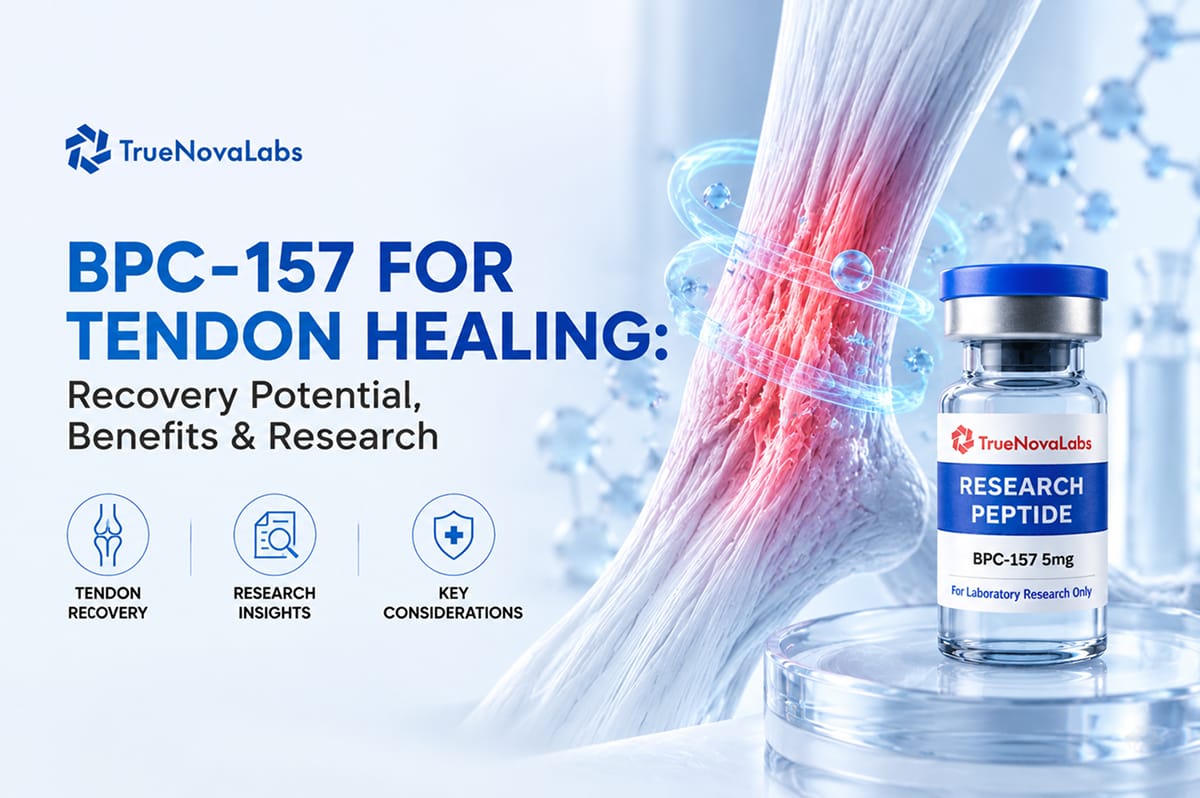
Tendon injuries are a common challenge in sports, fitness, and physical performance because these tissues often require longer recovery periods compared with muscles. As researchers continue exploring new approaches to understand tissue repair, BPC-157 for tendon healing has become a frequently discussed topic in recovery-related research.
BPC-157 is studied for its potential relationship with cellular repair pathways, connective tissue processes, and biological signaling involved in recovery. However, understanding its role requires looking beyond potential benefits and considering research limitations, safety factors, and the complexity of tendon regeneration.
This guide explores how BPC-157 is studied in tendon recovery, what current research suggests, expected recovery considerations, and why proper rehabilitation remains an essential part of tendon healing.
👉 Explore research-grade peptides and learn more about peptide research at True Nova Labs
Why Tendon Injuries Are Difficult to Heal
Tendon injuries are among the most challenging types of musculoskeletal injuries because tendons have a limited blood supply compared with muscle tissue. This slower circulation can affect how quickly nutrients, oxygen, and repair-related signals reach the damaged area.
Tendons connect muscles to bones and experience significant mechanical stress during movement and exercise. Common tendon-related issues may result from:
- repetitive strain and overuse
- intense physical activity
- insufficient recovery between training sessions
- gradual tissue degeneration over time
Unlike muscles, which can often recover relatively quickly after training stress, tendons typically require longer remodeling periods. This has led researchers to investigate compounds such as BPC-157 for tendon healing and their potential role in supporting tendon recovery pathways.
In Canada, BPC-157 and similar peptides are primarily supplied for laboratory and educational research purposes only and are not approved medical treatments.
How BPC-157 May Support Tendon Recovery
BPC-157 is a synthetic peptide commonly studied in preclinical research involving tissue repair and regeneration processes.
Research discussions around BPC-157 for tendon healing often focus on how the peptide may influence several biological pathways, including:
| Research Area | Potential Role Studied |
|---|---|
| Tissue repair signaling | Communication between cells during recovery |
| Angiogenesis pathways | Formation of new blood vessels in repair models |
| Collagen-related processes | Structural support and connective tissue remodeling |
| Cellular migration | Movement of repair-related cells to damaged areas |
Tendon recovery requires coordinated biological processes involving:
- inflammation regulation
- extracellular matrix remodeling
- collagen organization
- gradual restoration of tissue strength
Researchers study BPC-157 to better understand how peptide signaling may interact with these natural repair mechanisms.
However, it is important to note that research findings do not mean BPC-157 guarantees faster healing or replaces established rehabilitation methods.
👉 Learn more about performance and recovery peptides at SHOP ALL COMPOUNDS
Research and Recovery Findings
Most research involving BPC-157 and tendon healing has been conducted in preclinical models, including laboratory and animal studies.
Research has explored potential relationships between BPC-157 and:
- tendon repair processes
- connective tissue adaptation
- cellular signaling pathways
- recovery after tissue stress
Some studies suggest that BPC-157 may influence biological mechanisms associated with repair, but more research is needed to fully understand:
- long-term effects
- optimal research conditions
- human applications
- safety profiles
Scientific evaluation requires careful interpretation because results observed in experimental models may not directly translate into human outcomes.
Expected Recovery Timelines
Tendon recovery timelines vary significantly depending on:
- injury severity
- tendon location
- extent of tissue damage
- rehabilitation approach
- individual biological factors
A general recovery timeline may include:
| Recovery Stage | Typical Process |
|---|---|
| Early phase | Inflammation response and initial repair signaling |
| Intermediate phase | Collagen production and tissue rebuilding |
| Later phase | Remodeling and gradual strengthening |
Unlike muscle injuries, tendon recovery often requires longer periods because connective tissue adapts more slowly.
BPC-157 research focuses on understanding whether peptide signaling may support these biological stages, but recovery remains dependent on multiple factors.
Risks, Side Effects & Safety Concerns
When evaluating BPC-157 for tendon healing, safety considerations are an essential part of the research process.
Potential concerns include:
| Consideration | Why It Matters |
|---|---|
| Limited human research | More clinical data is needed |
| Biological variability | Responses may differ between individuals |
| Peptide quality | Purity affects research reliability |
| Storage conditions | Improper storage may affect stability |
| Handling procedures | Reduces contamination risks |
Because peptides are sensitive biological molecules, researchers commonly emphasize:
- analytical testing
- batch-specific documentation
- proper storage conditions
- reliable sourcing
Quality verification methods such as HPLC testing and COAs are often used to support research consistency.
In Canada, substances are regulated according to their classification and intended use by organizations such as Health Canada.
👉 Learn more about performance and recovery peptides at SHOP ALL COMPOUNDS
Additional Strategies for Tendon Recovery
While peptides are an area of ongoing research, tendon recovery typically involves multiple supportive strategies.
Important recovery factors include:
Progressive Rehabilitation
Controlled loading helps tendons gradually adapt to mechanical stress.
Proper Nutrition
Adequate protein and essential nutrients support general tissue maintenance.
Recovery Management
Sufficient rest allows repair processes to occur between periods of stress.
Movement Quality
Improving technique and addressing mechanical factors may help reduce repeated strain.
A complete tendon recovery approach combines rehabilitation principles with an understanding of biological repair processes.
Peptides for joint pain explained. Learn how BPC-157, TB-500, and recovery peptides support tissue repair, mobility, and recovery. Explore more on Peptides for Recovery & Healing: Muscle Repair, Recovery & Regeneration Explained
FAQ – BPC-157 For Tendon Healing
What is BPC-157 studied for?
BPC-157 is studied for its potential relationship with tissue repair, cellular signaling, and regeneration pathways.
Can BPC-157 heal tendon injuries?
Current research explores how BPC-157 may influence tendon repair mechanisms, but it is not an approved treatment for tendon injuries.
Why are tendons slower to heal than muscles?
Tendons have lower blood supply compared with muscles and require longer remodeling processes to restore structure and function.
How long does tendon recovery take?
Recovery depends on injury severity, tendon location, rehabilitation, and individual factors. Some injuries may require weeks, while others may take months.
Is BPC-157 approved in Canada?
BPC-157 is generally considered a research compound and is not approved as a therapeutic treatment in Canada.
Conclusion
Research into BPC-157 for tendon healing continues to attract interest because of its potential relationship with tissue repair and regeneration pathways.
Current research explores how BPC-157 may influence:
- cellular repair signaling
- connective tissue recovery
- collagen-related processes
- tendon adaptation
However, tendon healing remains a complex process influenced by rehabilitation, nutrition, recovery habits, and individual biology.
For researchers in Canada, responsible peptide research depends on:
- verified peptide quality
- proper storage and handling
- accurate interpretation of scientific evidence
- realistic expectations
Explore Research-Grade Peptides
Looking for research-grade peptides supported by verified purity, transparent sourcing, and consistent quality standards?
👉 Explore the full collection at TrueNovaLabs: SHOP ALL COMPOUNDS
Disclaimer:
This content is provided by True Nova Labs for educational and research purposes only. It is not intended to diagnose, treat, cure, or prevent any disease, nor to provide medical or legal advice.



3 Comments
Jordan Whitmore
I found the discussion of BPC-157 and tendon research interesting, particularly the focus on how researchers investigate tissue repair mechanisms. It’s useful to see the current evidence presented alongside the limitations of preclinical findings.
Clara Bennett
The research around BPC-157 and tendon repair raises some interesting questions about its proposed biological mechanisms. I appreciate the distinction between findings from laboratory or animal studies and what can actually be concluded from human research.
Marcus Wellington
This is a useful topic for understanding why BPC-157 continues to attract interest in tissue-repair research. The cautious approach to the available evidence makes the discussion more informative, especially given how much of the existing work remains preclinical.