
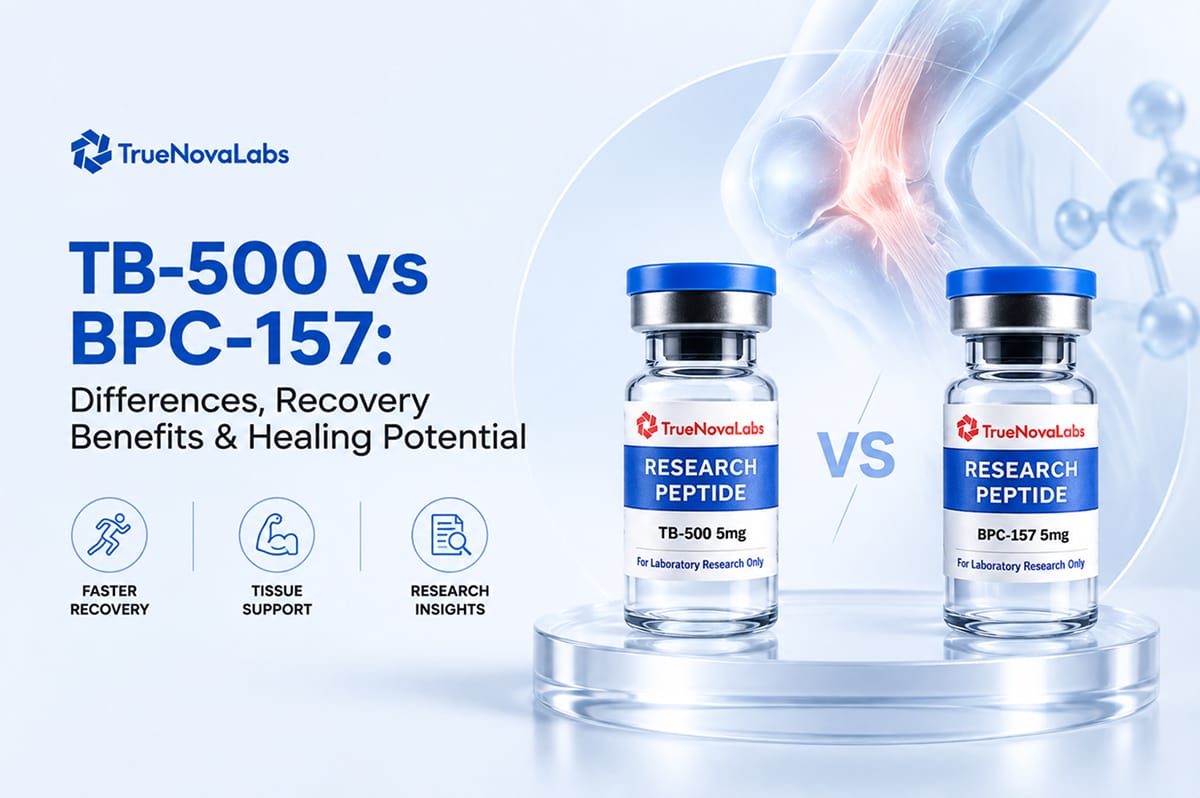
The comparison of TB-500 vs BPC-157 has become a popular topic in peptide research as scientists continue exploring different pathways involved in tissue repair, regeneration, and recovery. Although both peptides are frequently discussed in relation to healing processes, they are associated with different biological mechanisms and areas of research interest.
Understanding the differences between TB-500 and BPC-157 requires looking at how each peptide is studied, what recovery pathways they may influence, and why results can vary depending on the research model and biological factors. In particular, comparative research focuses on their distinct mechanisms, cellular interactions, and roles in experimental models related to tissue biology and recovery processes.
👉 Explore research-grade peptides with verified purity and transparent sourcing at True Nova Labs
This guide compares TB-500 vs BPC-157, including their mechanisms, recovery research, potential benefits, safety considerations, and how researchers evaluate their roles in tissue repair studies.
Understanding TB-500 vs BPC-157 in Recovery Research
Recovery and tissue repair are complex biological processes involving multiple pathways, including cellular communication, inflammation regulation, and tissue remodeling. This is why the comparison of TB-500 vs BPC-157 has become a popular topic in peptide research discussions.
Both peptides are commonly studied in relation to recovery, tissue repair, and regeneration pathways, but they are associated with different biological mechanisms. Understanding these differences is important when evaluating their potential roles in research.
TB-500 is often discussed in relation to Thymosin Beta-4 pathways and cellular migration, while BPC-157 is frequently studied for its relationship with tissue repair and recovery signaling.
In Canada, peptides discussed in this context are primarily supplied for laboratory and educational research purposes only and are not approved medical treatments. Therefore, current scientific investigations focus on understanding their biological mechanisms, research applications, and potential effects within controlled experimental settings.
👉 Learn more about performance and recovery peptides at SHOP ALL COMPOUNDS
How TB-500 Works
TB-500 is a synthetic peptide commonly associated with research on Thymosin Beta-4, a naturally occurring peptide involved in cellular processes. In particular, studies examine its relationship with actin regulation, cellular migration, tissue remodeling, and biological pathways involved in repair processes.
Research on TB-500 focuses on its potential relationship with:
| Research Area | Potential Role Studied |
|---|---|
| Cell migration | Movement of cells involved in repair processes |
| Tissue regeneration | Recovery and remodeling pathways |
| Blood vessel formation | Angiogenesis-related mechanisms |
| Cytoskeletal organization | Cellular structure and movement |
Cell migration is an important part of tissue repair because cells must move toward areas requiring regeneration.
Researchers study TB-500 to better understand how Thymosin Beta-4-related pathways may contribute to:
- tissue remodeling
- recovery processes
- structural repair mechanisms
However, research findings from experimental models do not guarantee identical outcomes in humans.
How BPC-157 Works
BPC-157 is a synthetic peptide frequently studied in relation to tissue repair and protective biological pathways. In particular, research investigates its potential interactions with cellular signaling, angiogenesis, and mechanisms involved in tissue maintenance and regeneration.
Research discussions around BPC-157 commonly focus on:
| Research Area | Potential Role Studied |
|---|---|
| Tissue repair signaling | Communication between cells during recovery |
| Connective tissue processes | Tendon and ligament repair models |
| Cellular protection | Response to tissue stress |
| Recovery pathways | Biological adaptation after injury |
BPC-157 is often researched in models involving:
- muscle tissue
- tendons
- ligaments
- gastrointestinal-related pathways
Researchers investigate how BPC-157 may interact with natural repair mechanisms involved in tissue recovery. Within this context, studies focus on understanding its relationship with cellular signaling, tissue remodeling, and biological processes associated with regeneration.
Recovery and Healing Benefits Compared
When comparing TB-500 vs BPC-157, the main difference is often the biological pathway being studied.
| Category | TB-500 | BPC-157 |
|---|---|---|
| Primary Research Focus | Cell migration and regeneration pathways | Tissue repair and recovery signaling |
| Common Research Area | Regenerative processes | Muscle, tendon, and connective tissue models |
| Biological Interest | Cellular movement and remodeling | Repair mechanisms and adaptation |
| Recovery Context | Broad tissue regeneration research | Targeted tissue recovery research |
Both peptides are studied for their potential relationship with recovery processes, but neither should be considered a direct healing solution.
Recovery depends on multiple factors, including:
- injury severity
- rehabilitation approach
- nutrition
- sleep quality
- individual biology
👉 Learn more about performance and recovery peptides at SHOP ALL COMPOUNDS
Joint, Muscle and Tendon Recovery Differences
Different tissues recover through different biological processes. For this reason, researchers study how cellular activity, vascular support, structural organization, and tissue-specific mechanisms contribute to variations in recovery responses.
Tendon and Ligament Research
Tendons and ligaments contain less blood supply compared with muscle tissue, which makes their recovery process slower. As a result, researchers study factors involved in connective tissue repair, cellular communication, and remodeling processes to better understand recovery mechanisms.
BPC-157 is frequently discussed in tendon and connective tissue research because of its association with tissue repair pathways.
TB-500 is studied for broader regenerative mechanisms involving cellular movement and remodeling.
Muscle Recovery Research
Muscle tissue has stronger blood circulation compared with connective tissue, allowing different recovery dynamics. Within this framework, researchers examine how blood supply, cellular activity, and tissue structure influence the biological processes involved in muscle repair and adaptation. These factors help explain why different tissues may respond differently during recovery processes.
Researchers study both peptides in relation to:
- muscle adaptation
- repair signaling
- recovery after physical stress
Joint Recovery Research
Joint health involves multiple structures, including:
- cartilage
- tendons
- ligaments
- surrounding connective tissue
Research into TB-500 and BPC-157 explores different aspects of these complex recovery pathways.
Side Effects and Safety Comparison
Because both TB-500 and BPC-157 are biologically active compounds, safety evaluation is an important part of peptide research.
Potential research considerations include:
| Safety Factor | Importance |
|---|---|
| Purity testing | Supports reliable research outcomes |
| Storage conditions | Maintains peptide stability |
| Handling procedures | Reduces contamination risks |
| Individual response | Biological variability affects outcomes |
Common concerns in peptide research environments are often related to: In particular, researchers consider factors such as study design, compound characterization, experimental conditions, and the interpretation of available scientific evidence.
- inconsistent product quality
- improper storage
- lack of documentation
- contamination risks
This is why researchers emphasize quality verification methods such as:
- HPLC testing
- batch-specific COAs
- controlled storage conditions
In Canada, substances are regulated according to classification and intended use by organizations such as Health Canada.
Which Option Fits Different Recovery Goals?
When comparing TB-500 vs BPC-157, there is no universal “better” option because each peptide is studied through different biological pathways.
Research interests may differ depending on the focus:
| Research Goal | Commonly Discussed Peptide |
|---|---|
| Tissue repair pathways | BPC-157 |
| Cellular regeneration research | TB-500 |
| Tendon and connective tissue models | BPC-157 |
| Broad recovery signaling | TB-500 |
The choice depends on the specific research objective rather than popularity.
Researchers typically evaluate:
- mechanism of action
- available evidence
- research model
- quality standards
rather than assuming one peptide works better in every situation.
Peptides for joint pain explained. Learn how BPC-157, TB-500, and recovery peptides support tissue repair, mobility, and recovery. Explore more on Peptides for Recovery & Healing: Muscle Repair, Recovery & Regeneration Explained
FAQ – TB-500 vs BPC-157
What is the difference between TB-500 and BPC-157?
TB-500 is mainly studied for Thymosin Beta-4-related pathways involving cellular migration and regeneration, while BPC-157 is studied for tissue repair and recovery signaling.
Is TB-500 better than BPC-157?
Neither peptide is considered universally better. In particular, they are researched for different biological mechanisms and recovery pathways, with studies focusing on their distinct interactions with cellular signaling, tissue processes, and experimental models.
Are TB-500 and BPC-157 used for tendon recovery research?
Yes. Both are discussed in tendon and connective tissue research, but they are studied through different mechanisms.
Do TB-500 and BPC-157 directly heal injuries?
No. In particular, they are research compounds studied for their potential role in biological repair processes, with investigations focusing on their mechanisms, cellular interactions, and effects observed in experimental models.
Are TB-500 and BPC-157 approved in Canada?
Both are generally considered research compounds and are not approved therapeutic treatments in Canada.
Conclusion
The comparison of TB-500 vs BPC-157 highlights how different peptides may influence different aspects of recovery research.
TB-500 is commonly studied for:
- cellular migration
- regeneration pathways
- tissue remodeling
BPC-157 is commonly studied for:
- tissue repair signaling
- connective tissue recovery
- biological adaptation processes
While both peptides remain areas of ongoing research, recovery is influenced by many factors beyond a single compound.
For researchers in Canada, responsible peptide research depends on:
- verified peptide quality
- proper storage and handling
- accurate interpretation of evidence
- realistic expectations
Explore Research-Grade Peptides
Looking for research-grade peptides supported by verified purity, transparent sourcing, and consistent quality standards?
👉 Explore the full collection at TrueNovaLabs: SHOP ALL COMPOUNDS
Disclaimer:
This content is provided by True Nova Labs for educational and research purposes only. It is not intended to diagnose, treat, cure, or prevent any disease, nor to provide medical or legal advice.



3 Comments
Natalie Wellington
I found the comparison between TB-500 and BPC-157 interesting, especially when looking at how their proposed biological mechanisms differ. Separating the available research on each compound makes the comparison much easier to understand.
Ethan Beaumont
The side-by-side approach is helpful because TB-500 and BPC-157 are often discussed in similar research contexts. I appreciate the focus on their individual characteristics and the distinction between preclinical findings and established human evidence.
Claire Sterling
I liked that the comparison looks beyond simply asking which compound is better. Understanding the different research backgrounds, proposed mechanisms, and limitations of TB-500 and BPC-157 provides a more balanced way to evaluate the available literature.