
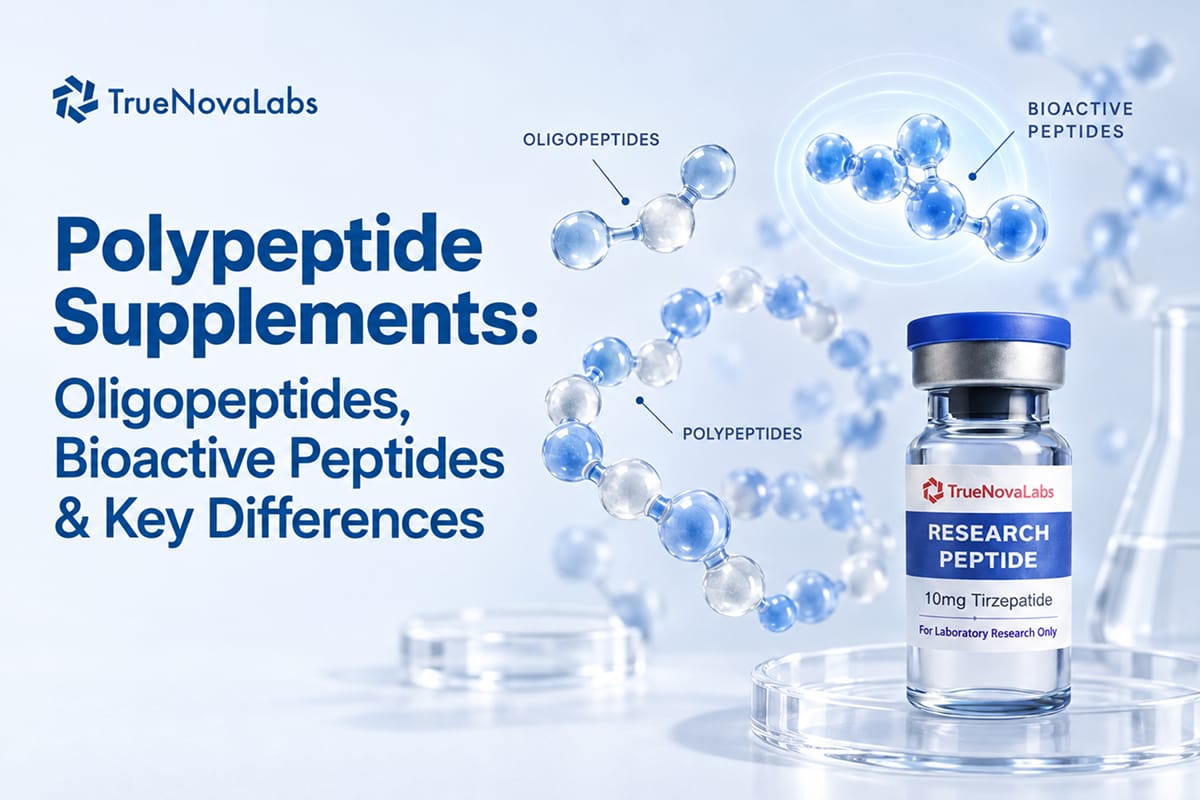
Polypeptide supplements belong to a broad group of peptide-based products used in nutrition and scientific research. However, the term can cause confusion because amino acids, oligopeptides, polypeptides, proteins, and synthetic research peptides all differ in structure and purpose.
More importantly, peptide length, amino-acid sequence, molecular structure, and formulation can influence stability, absorption, and biological activity. Therefore, researchers evaluate specific peptide characteristics instead of treating every peptide product as equivalent.
👉 Explore research-focused peptide resources and learn more about current peptide science at True Nova Labs
This guide explains what polypeptide supplements are, how oligopeptides and bioactive peptides differ, how researchers study peptide structure, and how dietary peptide products compare with research peptides in Canada.
What Are Polypeptide Supplements?
Polypeptides contain chains of amino acids connected by peptide bonds. Generally, they contain longer sequences than oligopeptides. However, scientists do not use one universal chain-length cutoff in every research field.
The phrase polypeptide supplements can describe products that contain peptide-rich protein hydrolysates or longer peptide fragments. For example, some nutritional formulas contain mixtures created when manufacturers partially break down larger proteins.
Researchers usually evaluate more than chain length. They also consider:
- amino-acid sequence
- molecular weight
- solubility
- structural characteristics
- stability
- formulation
- intended research use
Therefore, the term polypeptide provides only a broad description. The exact composition gives researchers much more useful information.
👉 Learn more about performance and recovery peptides at SHOP ALL COMPOUNDS
What Are Oligopeptides?
Oligopeptides are short chains of amino acids. They occupy the space between individual amino acids and longer polypeptides.
Dipeptides contain two amino acids, while tripeptides contain three. Other oligopeptides may contain several more amino acids, although researchers use different definitions for the upper limit.
Because of their relatively small size, oligopeptides attract attention in nutrition and absorption research. Scientists investigate how these molecules behave during digestion and whether they can cross the intestinal barrier.
For example, digestive enzymes may break some oligopeptides into smaller fragments. Meanwhile, other sequences may remain stable long enough for researchers to study their transport or biological activity.
As a result, peptide size matters, but sequence and stability matter as well.
What Are Bioactive Peptides?
Bioactive peptides are peptide sequences that produce measurable biological activity under specific research conditions.
Researchers have identified these peptides in many food sources, including:
- milk
- eggs
- fish
- meat
- soy
- legumes
- cereals
- collagen
Food proteins may release bioactive peptides during digestion, fermentation, or controlled enzymatic hydrolysis.
However, laboratory activity does not automatically translate into a meaningful human effect. A peptide must remain stable enough to reach the relevant biological environment.
Therefore, modern research examines both biological activity and bioavailability.
Scientists may study how factors such as amino-acid composition, electrical charge, hydrophobicity, and molecular size influence peptide behaviour. These properties can change how a peptide interacts with enzymes, membranes, or cellular targets.
Amino Acids vs Oligopeptides vs Polypeptides
These molecules share the same basic components, but their structures differ significantly.
| Category | Structure | Relative Size | Main Research Focus |
|---|---|---|---|
| Amino acids | Individual molecules | Smallest | Nutrition and metabolism |
| Dipeptides / tripeptides | 2–3 amino acids | Very small | Digestion and transport |
| Oligopeptides | Short amino-acid chains | Small | Absorption and bioactivity |
| Polypeptides | Longer amino-acid chains | Larger | Structure and biological function |
| Proteins | Folded polypeptide chains | Largest | Enzymatic and cellular functions |
Therefore, chain length provides a useful starting point. Nevertheless, it does not determine biological function by itself.
For instance, two peptides may contain the same number of amino acids but behave differently because their sequences differ. In addition, folding and chemical modifications can alter molecular activity.
Consequently, researchers evaluate size, sequence, and structure together.
How Peptide Structure Influences Biological Activity
In fact, peptide structure strongly influences how a molecule behaves.
First, amino-acid sequence determines which chemical groups appear along the peptide chain. These groups affect charge, solubility, and molecular interactions.
Second, molecular shape can influence how a peptide interacts with receptors, enzymes, or membranes.
Third, stability plays an important role. Digestive enzymes or environmental conditions may change peptide structure before it reaches a research target.
Researchers may therefore examine:
- amino-acid order
- molecular size
- peptide charge
- structural conformation
- enzyme resistance
- solubility
- interaction with surrounding compounds
For this reason, simply knowing that a product contains polypeptides does not provide enough information to predict its biological behaviour.
👉 Explore the science behind supplement ingredients, research methods, and quality evaluation in Supplements: Science, Ingredients, Research & Quality Standards Explained.
How Polypeptides Are Studied in Supplement Research
Researchers often use several stages to investigate polypeptide supplements and related peptide products.
Molecular Characterization
First, scientists identify peptide sequences, molecular weights, or peptide distributions. Chromatography and mass spectrometry can help characterize complex samples.
Digestion Studies
Next, researchers may expose peptide preparations to simulated gastrointestinal conditions. This helps determine whether enzymes break the peptides into smaller fragments.
Cell-Based Research
Researchers may then use cell models to investigate transport, stability, or interactions with biological pathways.
Human Research
Finally, controlled human studies can examine whether a peptide preparation produces measurable outcomes under real-world conditions.
Each stage answers a different question. Therefore, researchers should not treat a laboratory result as equivalent to human evidence.
👉 Learn more about performance and recovery peptides at SHOP ALL COMPOUNDS
Dietary Peptide Supplements vs Research Peptides
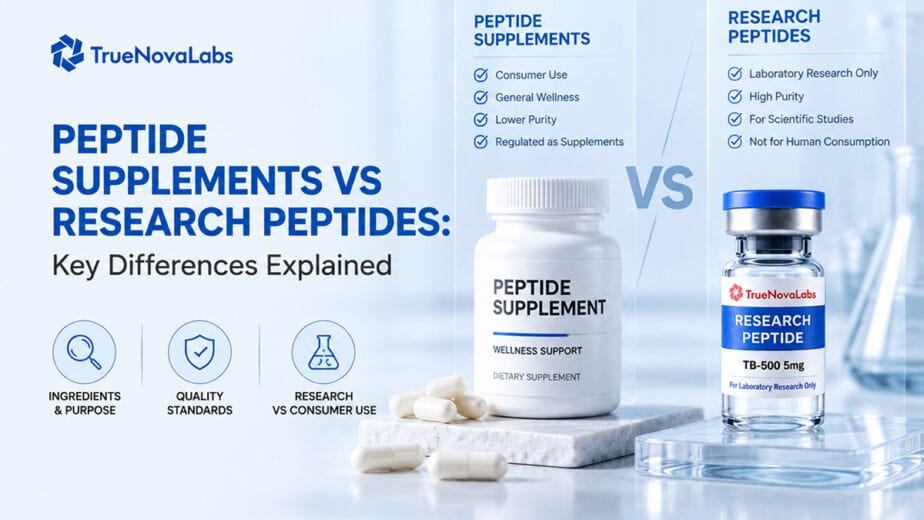
Dietary peptide products and research peptides differ in both composition and purpose.
In many cases, dietary products come from food proteins through hydrolysis or fermentation. For example, collagen peptide powders often contain multiple peptide fragments rather than one defined molecular sequence.
By contrast, synthetic research peptides usually contain a specific sequenc
Synthetic research peptides, by contrast, usually contain a defined sequence that laboratories produce for controlled experiments.
| Feature | Dietary Peptide Products | Research Peptides |
|---|---|---|
| Typical source | Food proteins | Laboratory synthesis |
| Composition | Often peptide mixtures | Usually defined sequences |
| Primary purpose | Nutrition research | Molecular pathway research |
| Common format | Powders or oral products | Research-specific preparations |
| Quality focus | Composition and manufacturing | Identity, purity, and batch testing |
This distinction also matters in Canada.
Health Canada regulates natural health products according to their ingredients, intended use, dosage form, and claims. Authorized natural health products carry a Natural Product Number.
Research compounds may fall under different regulatory frameworks, particularly when products use injectable formats or make therapeutic claims.
Therefore, researchers and consumers should evaluate the actual product category instead of assuming that all peptide-based products qualify as supplements.
👉 Want to understand peptide supplements in more detail? Explore peptide categories, formulation, quality factors, and current research in Peptide Supplements: Types, Science, Quality & Research Explained.
FAQ About Polypeptide Supplements
Are polypeptides the same as proteins?
No. Polypeptides are chains of amino acids. Proteins usually contain one or more polypeptide chains that fold into functional three-dimensional structures.
What is the difference between oligopeptides and polypeptides?
Oligopeptides usually contain shorter amino-acid chains, while polypeptides contain longer sequences. However, scientific fields may use slightly different definitions.
Are all bioactive peptides oligopeptides?
No. The term bioactive describes measurable biological activity, not a specific chain length.
Can digestion change peptide structure?
Yes. Digestive enzymes can break peptide bonds and create smaller fragments. Therefore, the peptide that enters the digestive system may not remain unchanged.
Are all polypeptide supplements absorbed intact?
No. Many peptides undergo digestion before absorption. Molecular size, sequence, stability, and transport mechanisms all influence what happens after oral intake.
What determines peptide quality?
In addition, researchers commonly assess identity, purity, composition, manufacturing controls, analytical testing, batch documentation, and storage conditions.
Conclusion
Polypeptide supplements include a wide range of peptide-based products, so clear terminology matters. Oligopeptides contain shorter chains, while polypeptides contain longer amino-acid sequences. Meanwhile, bioactive peptides describe molecules that show measurable biological activity.
However, chain length alone does not determine function. Sequence, structure, stability, digestion, and formulation can all influence research outcomes. Therefore, scientists evaluate specific peptide preparations rather than applying broad conclusions to every product.
For Canadian readers, product classification also deserves attention. Dietary peptide products and synthetic research peptides may follow different regulatory requirements. True Nova Labs focuses on peptide education, compound identity, analytical testing, and quality documentation to support more informed research decisions.
👉 Explore educational resources and research-focused peptide information at TrueNovaLabs.
Disclaimer:
This content is provided by True Nova Labs for educational and research purposes only. It is not intended to diagnose, treat, cure, or prevent any disease, nor to provide medical or legal advice.




3 Comments
Adrian Prescott
I found the discussion of polypeptide supplements useful, particularly because the term can cover a wide range of products and formulations. Understanding the source, composition, and intended purpose of a product is an important starting point when evaluating peptide-related supplements.
Caroline Sterling
The distinction between different types of peptide-based products is an important topic. I appreciate the emphasis on looking at product composition and available evidence rather than assuming that every polypeptide supplement has the same characteristics.
Edward Wellington
I liked the practical approach to understanding polypeptide supplements. Considering factors such as formulation, quality control, and the strength of the supporting evidence provides a more objective framework for evaluating these products.