
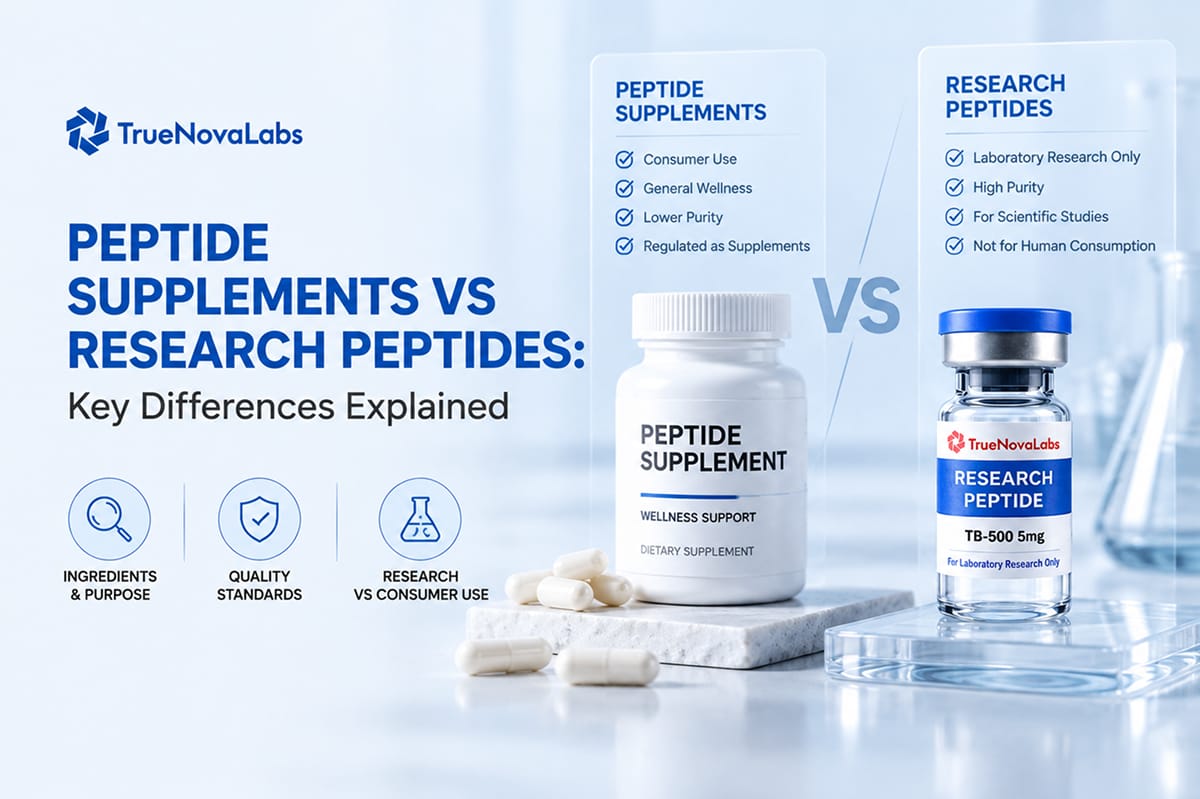
Peptides have gained significant attention in nutrition, biotechnology, and scientific research. However, Peptide Supplements vs Research Peptides represent two different categories with distinct structures, purposes, and applications.
Currently, many people compare peptide supplements and research peptides because both contain amino-acid chains. Nevertheless, these two categories serve different roles. Peptide supplements usually support nutrition-focused applications, while research peptides help scientists investigate specific biological mechanisms.
Therefore, understanding the differences between Peptide Supplements vs Research Peptides allows consumers and researchers to evaluate peptide products more accurately. In Canada, this distinction becomes especially important because regulatory requirements depend on ingredients, intended use, dosage form, and product classification.
👉 Explore research-focused peptide resources and learn more about current peptide science at True Nova Labs
This guide explains the differences between peptide supplements and research peptides, including their composition, intended use, manufacturing methods, quality standards, and research considerations.
What Are Peptide Supplements?
Peptide supplements contain peptide-based ingredients designed mainly for nutritional applications. Generally, manufacturers create these products by breaking larger proteins into smaller peptide fragments through hydrolysis.
For example, collagen peptides originate from collagen proteins that manufacturers process into smaller chains. Similarly, protein hydrolysates may come from milk, whey, soy, or plant-based proteins.
However, many peptide supplements contain multiple peptide fragments instead of one precisely defined sequence. As a result, researchers often evaluate the overall composition rather than focusing on a single peptide molecule.
Common peptide supplement categories include:
| Type | Source | Research Interest |
|---|---|---|
| Collagen peptides | Hydrolyzed collagen | Nutrition and connective tissue research |
| Protein hydrolysates | Milk, whey, soy, plants | Digestion and nutrient absorption |
| Food-derived peptides | Processed proteins | Biological activity research |
In addition, researchers consider factors such as ingredient quality, manufacturing consistency, molecular characteristics, and available scientific evidence.
Therefore, the term “peptide supplement” describes a broad category rather than one specific type of compound.
👉 Learn more about performance and recovery peptides at SHOP ALL COMPOUNDS
What Are Research Peptides?
Research peptides are peptide compounds used for scientific investigation.
Unlike many dietary peptide products, research peptides often contain a defined amino-acid sequence. Scientists use these compounds to study molecular interactions, cellular pathways, and biological mechanisms.
Researchers may investigate areas such as:
- cellular signaling
- molecular interactions
- receptor activity
- biological pathways
- experimental models
However, laboratory findings do not automatically represent proven human outcomes. A peptide that demonstrates activity in a research model still requires additional investigation before scientists can draw broader conclusions.
Furthermore, accurate identification remains essential because small changes in peptide sequence can influence experimental results.
Peptide Supplements vs Research Peptides: Key Differences
Although both categories contain peptides, their purpose and evaluation standards differ significantly.
| Factor | Peptide Supplements | Research Peptides |
|---|---|---|
| Primary purpose | Nutritional applications | Scientific investigation |
| Composition | Often peptide mixtures | Usually defined sequences |
| Production method | Protein processing or hydrolysis | Controlled laboratory synthesis |
| Main evaluation | Ingredient quality and consistency | Identity, purity, analytical verification |
| Research focus | Nutrition and biological activity | Molecular mechanisms |
Most importantly, intended use creates the biggest difference between these categories.
Peptide supplements generally focus on nutrition-related research, while research peptides allow scientists to examine specific scientific questions.
In comparison, research peptides usually require more detailed documentation because researchers need confidence in the exact material used during experiments.
How Their Composition and Intended Use Differ
Composition plays a major role in distinguishing peptide supplements from research peptides.
First, peptide supplements often contain mixtures of smaller peptide fragments. During production, manufacturers break larger proteins into smaller components, which creates different peptide sizes and structures.
On the other hand, research peptides usually focus on a specific sequence. Scientists select or produce these peptides because they want to investigate a particular molecular pathway.
For this reason, researchers examine:
- amino-acid sequence
- molecular weight
- purity level
- structural characteristics
- stability profile
Moreover, intended use influences how scientists evaluate each product. Nutritional peptide products are usually studied through food science research, whereas research peptides require more detailed molecular analysis.
Dietary Peptides vs Synthetic Research Peptides
Dietary peptides and synthetic research peptides follow different production approaches.
Generally, dietary peptides come from natural protein sources. Manufacturers may use hydrolysis or fermentation to release smaller peptide fragments.
By contrast, synthetic research peptides are produced through controlled laboratory processes that allow scientists to create specific sequences.
| Feature | Dietary Peptides | Synthetic Research Peptides |
|---|---|---|
| Source | Food proteins | Laboratory synthesis |
| Composition | Multiple peptide fragments | Defined peptide sequence |
| Main purpose | Nutrition research | Experimental research |
| Quality focus | Manufacturing consistency | Identity and purity verification |
Furthermore, both categories contribute to peptide science. However, researchers should not directly apply findings from one category to another because their composition and purpose differ.
👉 Explore the science behind supplement ingredients, research methods, and quality evaluation in Supplements: Science, Ingredients, Research & Quality Standards Explained.
How Manufacturing and Quality Standards Can Differ
Manufacturing standards depend on the intended purpose of the peptide product.
For peptide supplements, manufacturers usually focus on:
- ingredient sourcing
- production consistency
- contamination control
- nutritional quality
Meanwhile, research peptide production requires additional verification steps.
Researchers often evaluate:
| Quality Factor | Importance |
|---|---|
| Identity testing | Confirms the expected peptide |
| Purity analysis | Detects unwanted substances |
| Batch documentation | Supports consistency |
| Storage information | Helps maintain stability |
| Analytical testing | Provides verification |
As a result, even small differences between batches can influence research outcomes. Therefore, researchers rely on detailed documentation before using peptide compounds in experiments.
Why Testing and Documentation Matter for Research Peptides
Testing and documentation help researchers confirm that they study the intended compound.
Without proper verification, researchers may struggle to determine whether experimental differences come from biological factors or material variation.
For example, analytical methods such as chromatography and mass spectrometry can help evaluate peptide identity, purity, and composition.
Additionally, research documentation may include:
- batch information
- analytical reports
- purity results
- storage recommendations
- manufacturing details
Ultimately, transparent documentation improves research reliability and supports reproducible scientific work.
👉 Learn more about performance and recovery peptides at SHOP ALL COMPOUNDS
Understanding Research-Use-Only Products
Research-use-only (RUO) products are materials intended for laboratory investigation rather than consumer use.
In other words, the RUO label describes the intended application of the material. However, it does not mean that the product has approval for medical treatment or human consumption.
In Canada, regulatory classification depends on several factors, including:
- ingredients
- dosage form
- product claims
- intended purpose
Therefore, researchers and consumers should understand the difference between experimental materials and approved health products.
A laboratory finding may provide valuable scientific information. Nevertheless, it does not automatically demonstrate safety, effectiveness, or regulatory approval.
FAQ About Peptide Supplements vs Research Peptides
Are peptide supplements and research peptides the same?
No. In fact, both contain peptides, but they differ in composition, purpose, manufacturing methods, and evaluation standards.
Do peptide supplements contain specific peptide sequences?
Not always. Generally, many dietary peptide products contain mixtures of different peptide fragments.
Why do research peptides require testing?
Research peptides require accurate identification and purity information because scientists study specific biological mechanisms.
Are research peptides approved medicines?
No. Instead, research peptides support scientific investigation and do not automatically represent approved medical treatments.
How do researchers evaluate peptide quality?
To evaluate quality, researchers review identity testing, purity analysis, batch information, analytical documentation, and storage conditions.
Are peptide supplements regulated in Canada?
Currently, regulation depends on the product type, ingredients, claims, and intended use.
Conclusion
Overall, peptide supplements and research peptides share similar building blocks, but they serve different purposes.
Peptide supplements usually support nutrition-focused applications and often contain mixtures of peptide fragments. Meanwhile, research peptides typically contain defined sequences designed for laboratory investigation.
Therefore, understanding composition, intended use, manufacturing methods, and quality documentation helps create a clearer view of peptide science.
For Canadian audiences, regulatory classification also matters because dietary products and research compounds may follow different requirements.
Through this approach, True Nova Labs focuses on research-oriented peptide education, analytical testing, compound information, and quality considerations to help readers better understand the evolving field of peptide research.
👉 Explore educational resources and research-focused peptide information at TrueNovaLabs.
Disclaimer:
This content is provided by True Nova Labs for educational and research purposes only. It is not intended to diagnose, treat, cure, or prevent any disease, nor to provide medical or legal advice.



3 Comments
Marcus Beaumont
The distinction between peptide supplements and research peptides is an important one, especially since the terms can easily be confused. I found the focus on intended use, formulation, and quality considerations particularly useful for understanding the differences.
Rebecca Kensington
I liked the side-by-side explanation of peptide supplements and research peptides. Looking at their intended purpose and the standards used to evaluate them provides useful context and helps avoid treating two very different product categories as equivalent.
Jonathan Wellington
This comparison provides a useful overview of why peptide supplements and research peptides should be considered in different contexts. I especially appreciate the emphasis on product composition, quality control, and the evidence supporting specific claims.