
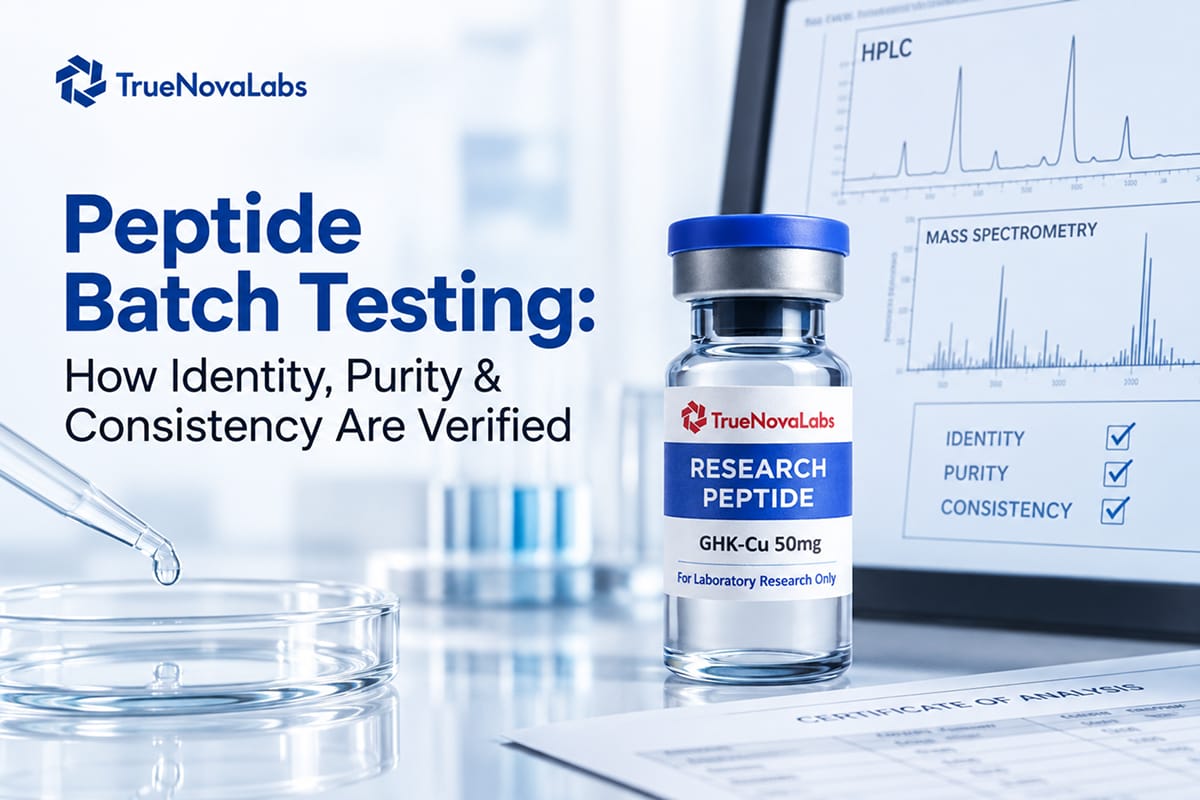
Peptide batch testing helps researchers determine whether a specific production lot meets its defined analytical specifications. Although batches may carry the same peptide name, their characteristics can vary because of differences in raw materials, manufacturing conditions, storage, and handling.
In Canada, documented specifications and batch traceability form important parts of quality-control systems. However, research peptides do not necessarily follow the same requirements as regulated pharmaceutical or natural health products. Therefore, researchers should consider the specific material, testing methods, and research context when reviewing batch documentation.
👉 Explore research-focused peptide resources and learn more about current peptide science at True Nova Labs
Most importantly, batch testing provides evidence about an individual production lot rather than relying only on general product information. Identity testing helps establish whether the expected peptide is present, while purity testing examines its composition. Meanwhile, HPLC and mass spectrometry can provide complementary information about the material.
What Is Peptide Batch Testing?
Peptide batch testing is the analytical evaluation of a specific production lot against predefined specifications. Each batch receives a lot or batch number, allowing researchers to connect laboratory results with the material they receive.
Common testing areas include:
| Testing Area | What It Evaluates |
|---|---|
| Identity | Whether the material corresponds to the intended peptide |
| Purity | Target peptide relative to detected components |
| Quantity | Amount or concentration of the material |
| Potency | Applicable quantitative or functional characteristics |
| Consistency | Similarity between different production lots |
However, not every peptide requires the same testing panel. Laboratories select analytical methods according to the compound, specifications, and research objectives. As a result, batch testing provides a more specific quality record than a general product description.
👉 Learn more about performance and recovery peptides at SHOP ALL COMPOUNDS
Why Is Each Peptide Batch Tested Separately?
Each production lot can experience differences in manufacturing and handling. For example, changes in raw materials, processing conditions, equipment, storage, or transportation may influence analytical characteristics.
Therefore, testing individual batches creates a direct connection between a research material and its laboratory results. Researchers can also use the batch number to trace a material back to its associated documentation.
Furthermore, comparing results between lots can reveal whether analytical characteristics remain consistent. If an unexpected difference appears, researchers can review the relevant batch information and determine whether additional investigation is appropriate.
This traceability becomes particularly useful when researchers need to understand differences between experiments conducted with materials from separate production lots.
What Is Checked During Peptide Batch Testing?
The exact testing program depends on the peptide and its specifications. Nevertheless, several analytical categories commonly contribute to batch evaluation.
Identity
Identity testing determines whether the analyzed material corresponds to the expected peptide. Researchers may use chromatographic or molecular characteristics to support identification.
Purity
Purity testing evaluates the target peptide relative to other detected components. These may include related compounds, degradation products, or other detectable substances.
Quantity and Concentration
Quantitative testing determines the amount or concentration of the target material according to the selected analytical method.
Additional Characteristics
Depending on the research requirements, laboratories may also examine relevant residual substances, stability indicators, or physical characteristics.
Consequently, researchers should view batch testing as a collection of complementary measurements rather than a single quality number.
👉 Want to understand the difference between peptide purity and potency? Read Peptide Purity vs Potency: What Is the Difference?
How Is Peptide Identity Confirmed?
Identity testing answers a fundamental question:
Does the analyzed material correspond to the intended peptide?
Researchers can compare analytical characteristics with an appropriate reference or established specification. For example, chromatographic retention behavior can provide useful information when the analytical method has suitable specificity.
In addition, mass spectrometry can provide molecular information that supports peptide identification and characterization.
However, identity confirmation does not establish purity. A sample may correspond to the expected peptide while still containing additional detectable components.
Therefore, identity and purity remain separate parts of peptide batch evaluation.
How Is Peptide Purity Evaluated?
Researchers commonly evaluate peptide purity through chromatographic analysis, particularly HPLC.
During HPLC analysis, different components separate within the chromatographic system. The resulting chromatogram allows researchers to examine the target peptide peak alongside other detected components.
Researchers may consider:
- target peptide peak
- related peaks
- retention characteristics
- overall chromatographic profile
- comparison with defined specifications
For example, researchers can compare chromatographic profiles from different batches to identify noticeable analytical differences.
However, a reported purity percentage should always be considered alongside the analytical method used to generate it. Different methods have different detection capabilities and may provide different types of information.
As a result, the reported purity value becomes more meaningful when researchers understand the method, specification, and analytical conditions behind it.
👉 Explore the science behind supplement ingredients, research methods, and quality evaluation in Supplements: Science, Ingredients, Research & Quality Standards Explained.
How Are HPLC and Mass Spectrometry Used?
HPLC and mass spectrometry provide complementary information during peptide analysis.
| Analytical Method | Primary Role |
|---|---|
| HPLC | Separation and purity profiling |
| Mass spectrometry | Molecular mass and identification information |
| Combined analysis | Broader peptide characterization |
HPLC helps researchers examine how different components separate within a sample. Meanwhile, mass spectrometry provides molecular information that can support identification and characterization.
For example, researchers may use HPLC to examine the overall analytical profile and then use mass spectrometry to investigate the molecular characteristics of a selected component.
Furthermore, laboratories can compare these results across different batches. This comparison can help researchers determine whether production lots demonstrate similar analytical characteristics.
What Information Should Appear on a Batch COA?
A Certificate of Analysis (COA) summarizes analytical information associated with a tested material or production batch.
For research purposes, a useful COA should clearly connect the reported results to the specific lot being evaluated.
| COA Information | Why It Matters |
|---|---|
| Product name | Identifies the material |
| Batch or lot number | Connects results to a specific production lot |
| Testing date | Indicates when testing occurred |
| Testing laboratory | Identifies the testing organization |
| Test method | Shows how results were generated |
| Specification | Defines expected criteria |
| Result | Reports the measured finding |
| Acceptance status | Indicates whether criteria were met |
Researchers should first check whether the batch number on the COA matches the material received. Additionally, they should review the analytical method and stated specification before interpreting the reported result.
A COA therefore provides useful analytical documentation, but researchers should consider the complete testing context rather than relying on one reported value.
👉 Learn more about performance and recovery peptides at SHOP ALL COMPOUNDS
Why Batch-to-Batch Consistency Matters in Research
Batch-to-batch consistency matters because researchers need to understand whether materials used at different times demonstrate comparable analytical characteristics.
For example, a laboratory may conduct related experiments using two production lots of the same peptide. If their analytical profiles differ, researchers may need to consider those differences when interpreting the results.
Useful comparisons can include:
- HPLC purity profiles
- identity results
- quantitative measurements
- chromatographic patterns
- detected impurities
- relevant stability information
Furthermore, maintaining batch records improves traceability by connecting each research material with its production history.
However, consistent analytical results do not guarantee identical experimental outcomes. Research design, experimental conditions, analytical procedures, and other variables can also influence findings.
Therefore, batch consistency represents one important part of a broader approach to research quality.
👉 Explore how researchers evaluate purity, identity, potency, and verification in Supplement Quality & Testing: Purity, Identity, Potency & Verification.
FAQ About Peptide Batch Testing
What is peptide batch testing?
Peptide batch testing evaluates a specific production lot against defined analytical specifications.
Why is each peptide batch tested separately?
Separate testing connects analytical results to a specific lot, making it easier to trace materials and compare production batches.
What does a peptide batch COA show?
A COA may include the product name, batch number, testing laboratory, analytical methods, specifications, results, and acceptance status.
Is peptide identity the same as purity?
No. Identity determines whether the material corresponds to the expected peptide, while purity evaluates the target peptide relative to other detected components.
Why is HPLC used for peptide testing?
HPLC separates components within a sample and produces a chromatographic profile that researchers can use to evaluate purity and related components.
Can a COA alone prove peptide quality?
No. Researchers should also consider the batch number, testing method, laboratory information, specifications, and reported results.
Conclusion
Peptide batch testing provides batch-specific information about identity, purity, quantity, and other relevant characteristics. First, identity testing helps establish whether the expected peptide is present, while purity analysis examines the composition of the material.
In addition, HPLC and mass spectrometry can provide complementary analytical information. Meanwhile, a batch-specific COA connects test results to a particular production lot, allowing researchers to compare batches and maintain traceability.
Ultimately, batch testing gives researchers a clearer framework for evaluating research materials and the documentation associated with each production lot.
👉 Explore educational resources and research-focused peptide information at TrueNovaLabs.
Disclaimer:
This content is provided by True Nova Labs for educational and research purposes only. It is not intended to diagnose, treat, cure, or prevent any disease, nor to provide medical or legal advice.



3 Comments
Amelia Hartwell
Batch testing is an important part of evaluating peptide research materials, especially when consistency between different batches matters. I found the discussion of analytical verification useful for understanding how researchers can identify differences in identity, purity, or composition.
Nathan Beaumont
I appreciate the focus on testing individual batches rather than assuming that every production batch has identical characteristics. Consistent analytical checks can provide useful data when comparing research materials over time.
Grace Rutherford
This is a helpful overview of why batch-to-batch testing can be valuable in peptide research. Looking at analytical results alongside documentation and testing methods provides a more complete picture of sample consistency and quality.