
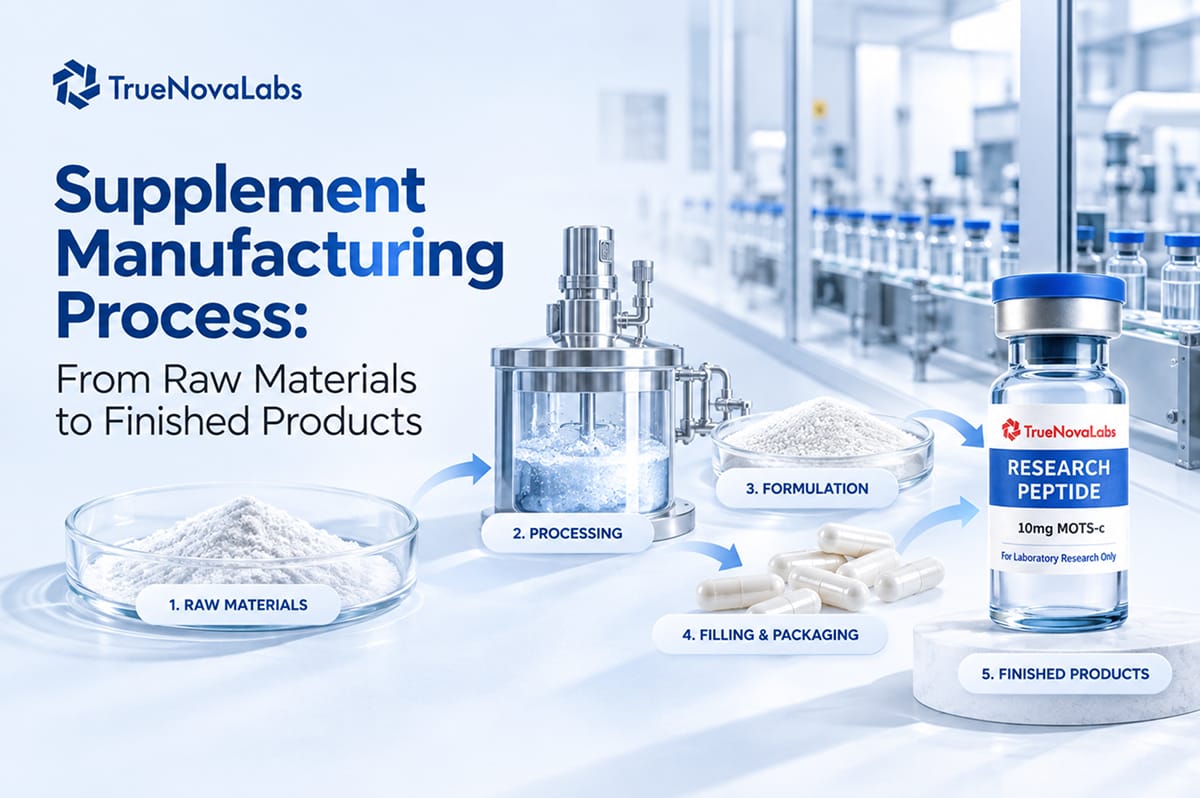
Generally, the supplement manufacturing process involves a series of controlled steps that transform raw materials into finished products. The process includes material receiving, testing, formulation, production, quality control, packaging, and documentation.
In Canada, the exact requirements depend on the product’s regulatory classification. For Natural Health Products (NHPs), manufacturers must follow applicable Good Manufacturing Practices (GMP). These requirements help control product quality, consistency, traceability, and manufacturing conditions.
👉 Explore research-focused peptide resources and learn more about current peptide science at True Nova Labs
As a result, understanding the process can help businesses and researchers evaluate how supplements are produced and what quality controls support a finished batch.
What Are the Main Stages of Supplement Manufacturing?
Although manufacturing methods vary by product, most supplement production follows a similar sequence.
| Manufacturing Stage | Main Purpose |
|---|---|
| Raw material receiving | Identify and control incoming materials |
| Material testing | Confirm materials meet specifications |
| Weighing and dispensing | Measure ingredients accurately |
| Formulation and processing | Produce the intended dosage form |
| In-process controls | Monitor important production parameters |
| Finished product testing | Verify applicable specifications |
| Packaging and labelling | Protect and identify the finished product |
| Batch review | Confirm documentation and quality requirements |
First, manufacturers receive and identify the raw materials. Next, they review the materials and perform applicable testing before production.
After approval, personnel weigh and dispense ingredients according to the approved manufacturing instructions. The production team then processes the formulation using appropriate equipment and controlled procedures.
Finally, manufacturers complete applicable testing, packaging, documentation, and quality review before releasing the batch.
For Canadian NHPs, these activities form part of a broader GMP system designed to maintain consistent product quality.
👉 Learn more about performance and recovery peptides at SHOP ALL COMPOUNDS
How Are Raw Materials Received and Prepared for Production?
Raw material control begins when ingredients arrive at the manufacturing facility. At this stage, personnel typically verify the material identity, supplier information, lot number, quantity, and relevant documentation.
However, receiving an ingredient does not necessarily mean that production can use it immediately. Instead, manufacturers place materials under appropriate control while they complete the required review and approval process.
In particular, depending on the product, manufacturers may evaluate:
- Ingredient identity
- Lot or batch number
- Quantity received
- Physical condition
- Applicable specifications
- Supplier documentation
- Certificate of Analysis, where applicable
- Required laboratory testing
For example, an ingredient may require identity or purity testing before production uses it. The manufacturer then compares the results with established specifications.
Furthermore, manufacturers store approved materials under appropriate conditions. Temperature, humidity, light, and other environmental factors can affect certain ingredients, so storage controls help maintain material quality.
How Does Supplement Formulation and Processing Work?
Once raw materials meet the applicable requirements, the manufacturer follows an approved production process. The exact method depends on the formulation and dosage form.
For example, different products may require different processing activities:
| Dosage Form | Typical Processing Activities |
|---|---|
| Capsules | Weighing, blending, encapsulation |
| Tablets | Blending, granulation, compression |
| Powders | Weighing, blending, filling |
| Liquids | Mixing, homogenization, filling |
During production, manufacturers control variables that can affect product consistency. These may include mixing time, temperature, equipment settings, weight, or filling volume.
In addition, in-process checks can help identify problems before production reaches the finished-product testing stage.
For multi-ingredient formulations, appropriate blending controls also help distribute ingredients consistently throughout the batch.
Therefore, formulation involves more than combining ingredients. Manufacturers must follow defined procedures while controlling the processing conditions that can influence the final product.
What Quality Controls Are Used During Manufacturing?
For Canadian NHPs, product specifications can address characteristics such as identity, purity, quantity, and potency, depending on the product. Manufacturers use these specifications to establish appropriate acceptance criteria.
Common quality controls include:
- Raw material testing
- Identity testing
- Weight or fill checks
- In-process testing
- Finished product testing
- Microbial testing where applicable
- Stability testing where applicable
- Equipment controls
- Sanitation procedures
- Quality assurance review
For example, manufacturers may monitor capsule weight during encapsulation or check filling quantities for liquid products.
Moreover, quality assurance provides an important final review. The manufacturer must assess the available production and testing records before releasing an applicable NHP batch.
Instead, manufacturers consider testing alongside specifications, production records, process controls, and other applicable quality requirements.
How Are Finished Supplement Products Prepared for Packaging?
Packaging represents another controlled stage of the manufacturing process. It protects the finished product while also providing important identification and storage information.
Before packaging begins, personnel verify the product, batch information, packaging components, and applicable production instructions.
The process may include:
- Preparing the approved bulk product
- Checking packaging materials
- Confirming product and batch identification
- Preparing packaging equipment
- Filling or placing the product into containers
- Applying the appropriate label
- Checking finished units
- Recording packaging information
Furthermore, manufacturers need controls that help prevent product mix-ups and incorrect labelling.
Packaging can also affect product protection and stability. Therefore, manufacturers must select and control packaging materials according to the requirements of the product.
For Canadian NHPs, packaging and labelling activities form part of the applicable GMP requirements. The associated records also contribute to batch traceability.
As a result, packaging is not simply the final presentation of a supplement. It forms part of the controlled process used to prepare the product for distribution.
👉 Learn more about performance and recovery peptides at SHOP ALL COMPOUNDS
What Documentation Is Maintained for Each Production Batch?
Documentation connects each stage of production and creates a traceable record for a specific batch.
For Canadian NHP manufacturing, records can include:
| Record | Purpose |
|---|---|
| Master production document | Defines the approved manufacturing process |
| Batch record | Documents actual production activities |
| Raw material records | Records material identity and testing |
| Product specifications | Defines applicable acceptance criteria |
| Finished product testing | Documents relevant analytical results |
| Packaging records | Records packaging and labelling activities |
| Stability records | Supports applicable shelf-life information |
| Sanitation records | Documents relevant sanitation activities |
The batch record is particularly important because it documents what happened during the production of a specific lot.
It can include information such as the product name, batch number, manufacturing dates, raw materials, quantities, processing information, and relevant production checks.
Moreover, documentation helps manufacturers investigate quality complaints, production issues, and potential recalls.
Therefore, batch records are more than administrative documents. They provide the traceability needed to connect raw materials, manufacturing activities, testing, packaging, and the finished product.
👉 Explore the science behind supplement ingredients, research methods, and quality evaluation in Supplements: Science, Ingredients, Research & Quality Standards Explained.
FAQ About the Supplement Manufacturing Process
What is the supplement manufacturing process?
The supplement manufacturing process is the series of controlled activities used to transform raw materials into finished products. It can include material testing, weighing, formulation, processing, quality control, packaging, and batch review.
What happens to raw materials before production?
Manufacturers identify and evaluate incoming materials against applicable requirements. Depending on the ingredient, they may review supplier documentation, Certificates of Analysis, specifications, and laboratory test results before approving the material.
Why are quality controls important during manufacturing?
Quality controls help manufacturers maintain consistency and identify potential problems during production. They can address raw materials, processing conditions, finished products, equipment, sanitation, and testing.
Why are batch records important?
Batch records document the manufacturing activities for a specific production lot. They provide traceability and help demonstrate that the manufacturer followed the approved production process.
Are Canadian supplement manufacturers required to follow GMP?
For Natural Health Products, applicable Canadian GMP requirements cover areas such as manufacturing, premises, equipment, quality assurance, specifications, testing, packaging, and records.
Does every supplement use the same manufacturing process?
No. Manufacturing methods vary according to the formulation, dosage form, ingredients, equipment, and regulatory classification. Capsules, tablets, powders, and liquids can therefore require different production controls.
Conclusion
The supplement manufacturing process involves multiple controlled stages, from raw material approval to formulation, quality testing, packaging, and batch documentation.
For Natural Health Products in Canada, GMP requirements provide a framework for controlling manufacturing activities and maintaining product quality. Consequently, evaluating a supplement requires more than looking at its finished packaging.
Raw material records, production procedures, testing results, specifications, packaging controls, and batch documentation can provide a clearer understanding of how a particular product was produced.
For businesses and researchers, understanding these stages also makes it easier to evaluate suppliers, review Certificates of Analysis, and assess the documentation associated with a specific production batch.
👉 Explore educational resources and research-focused peptide information at TrueNovaLabs.
Disclaimer:
This content is provided by True Nova Labs for educational and research purposes only. It is not intended to diagnose, treat, cure, or prevent any disease, nor to provide medical or legal advice.



3 Comments
Evan Rutherford
I found the step-by-step explanation of supplement manufacturing particularly useful. Seeing how formulation, ingredient handling, production, and quality checks connect together gives a clearer picture of what goes into producing a consistent finished product.
Claire Whitaker
One aspect I found interesting was the importance of consistency throughout the manufacturing process. Proper controls at different stages can make a significant difference when it comes to maintaining the same specifications across production batches.
Maxwell Caldwell
This article offers a useful look at the less visible parts of supplement production. I particularly appreciated the attention to documentation, batch controls, and quality testing, since these steps are important for product traceability and consistency.