
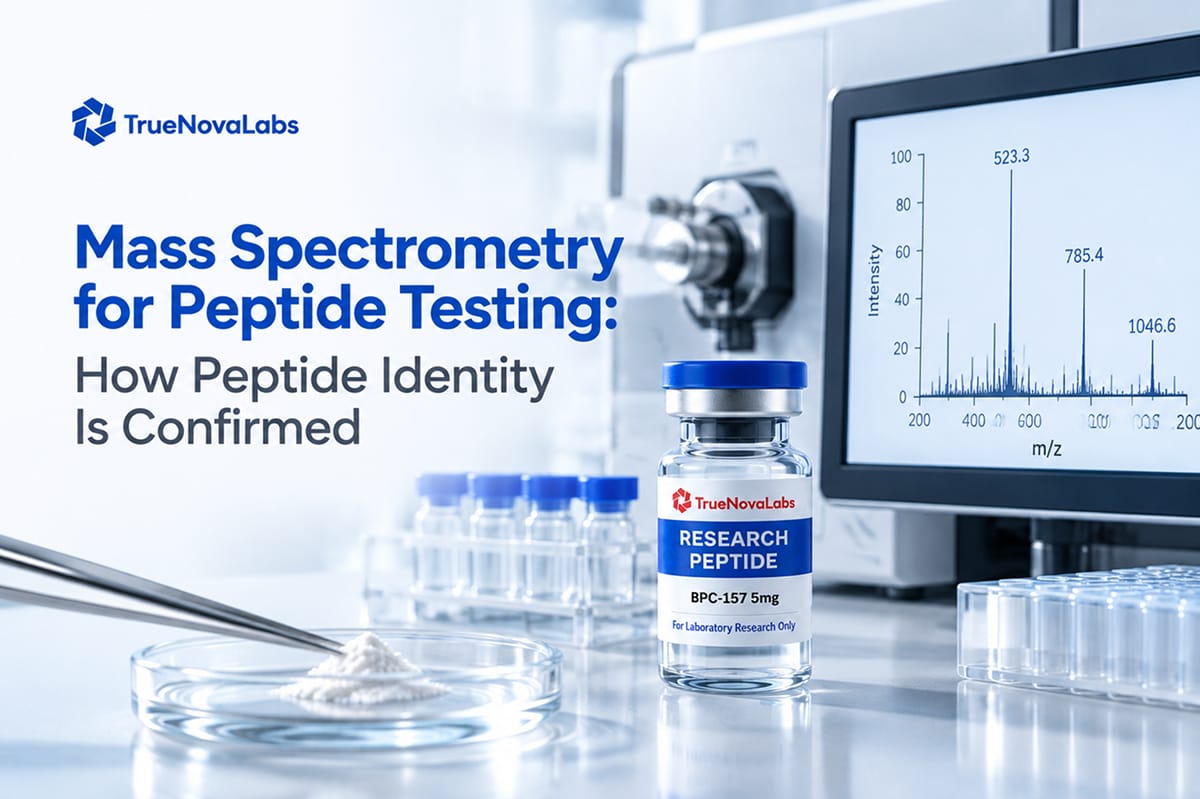
Researchers widely use mass spectrometry in peptide research to examine molecular mass and support peptide identity. Unlike HPLC, which primarily separates components within a sample, mass spectrometry provides molecular information based on the mass-to-charge ratio of detected ions.
For peptide testing, researchers can analyze the intact molecular mass or use tandem mass spectrometry (MS/MS) to examine fragmentation patterns. Therefore, these techniques can provide useful evidence when researchers evaluate whether a sample is consistent with an expected peptide.
👉 Explore research-focused peptide resources and learn more about current peptide science at True Nova Labs
However, mass spectrometry does not answer every question about a peptide sample. Identity and purity require different analytical approaches. As a result, researchers should interpret mass spectrometry alongside appropriate purity testing and batch documentation.
What Is Mass Spectrometry in Peptide Testing?
Mass spectrometry (MS) measures ions according to their mass-to-charge ratio (m/z). In peptide research, this measurement helps researchers examine molecular mass and assess characteristics relevant to peptide identity.
A simplified process is:
Sample Preparation → Ionization → Mass Analysis → Detection → Data Interpretation
First, researchers prepare the peptide sample for analysis. Next, they convert peptide molecules into charged ions. The instrument then measures these ions according to their m/z values. Finally, the detected signals form a mass spectrum.
Depending on the analytical method, researchers can analyze intact peptides or use MS/MS for additional structural information. Therefore, the selected method determines what information can be obtained from the analysis.
👉 Learn more about performance and recovery peptides at SHOP ALL COMPOUNDS
How Does Mass Spectrometry Analyze Peptides?
Before analysis, researchers must convert peptide molecules into ions. Common approaches include electrospray ionization (ESI) and matrix-assisted laser desorption/ionization (MALDI).
With ESI, a peptide can carry multiple charges. Consequently, the same peptide may produce several m/z signals in a mass spectrum. Researchers can use these signals to calculate the molecular mass of the intact peptide.
For more detailed characterization, researchers can use MS/MS. In this process, researchers fragment selected peptide ions into smaller product ions. Researchers can then examine the resulting fragments for sequence-related information.
As a result, intact-mass analysis and MS/MS can provide different levels of information during peptide characterization.
How Is Peptide Molecular Mass Determined?
Molecular mass is one of the main measurements obtained through peptide mass spectrometry.
Because peptides can carry different numbers of charges during ESI, the spectrum may contain several m/z signals from the same molecule. Researchers can use these signals to calculate the molecular mass and compare the measured value with the expected value.
| Measurement | Purpose |
|---|---|
| Expected molecular mass | Theoretical reference |
| Observed m/z | Detected ion signal |
| Calculated molecular mass | Estimated molecular mass |
| Mass difference | Comparison between expected and measured values |
A close match between the expected and measured mass can support the presence of the expected molecular species. However, researchers should also consider instrument calibration, resolution, and the analytical method.
Therefore, a single m/z signal should not be interpreted independently. The complete spectrum and testing conditions provide important context.
How Can Mass Spectrometry Help Confirm Peptide Identity?
Mass spectrometry can support peptide identity by comparing measured molecular characteristics with expected or reference data.
For an intact peptide, researchers can compare the measured molecular mass with its theoretical mass. In addition, MS/MS can provide fragment ions that offer sequence-related evidence.
The assessment may involve:
- Expected molecular mass
- Observed molecular mass
- Fragmentation pattern
- Expected sequence
- Reference data
A close molecular-mass match can support the presence of the intended peptide. However, mass alone may not distinguish every possible molecular structure.
MS/MS provides additional evidence because peptide fragmentation generates smaller ions, allowing researchers to compare them with expected fragmentation patterns. Consequently, combining intact-mass and fragmentation data can provide stronger evidence for peptide identification.
Nevertheless, identification confidence depends on spectrum quality, reference information, instrument performance, and the analytical method.
👉 Explore the science behind supplement ingredients, research methods, and quality evaluation in Supplements: Science, Ingredients, Research & Quality Standards Explained.
What Can Mass Spectrometry Reveal About a Peptide Sample?
Beyond molecular mass, mass spectrometry can provide information about molecular variants and potential modifications.
| Finding | Potential Information |
|---|---|
| Expected molecular mass | Consistency with the intended peptide |
| Fragment ions | Sequence-related evidence |
| Unexpected mass | Possible molecular variation |
| Additional signals | Potential related species |
For example, an unexpected mass difference may prompt researchers to investigate a possible modification, degradation product, or related molecular species.
However, a mass difference does not automatically identify its cause. Instead, researchers may need additional analytical evidence to determine what produced the observed result.
Therefore, mass spectrometry can reveal useful molecular characteristics while still requiring careful interpretation.
What Are the Limitations of Mass Spectrometry?
Mass spectrometry provides valuable molecular information, but it does not establish every characteristic of a peptide sample.
First, detecting the expected molecular mass does not establish sample purity. Therefore, researchers may need an appropriate chromatographic method to evaluate other detectable components.
Second, different molecular structures can sometimes have similar or identical masses. Consequently, molecular mass alone may not resolve every structural difference.
Third, MS/MS interpretation depends on fragmentation quality and reference information. Complex spectra can contain numerous signals, so researchers must evaluate the data carefully.
Finally, some structural characteristics may require additional analytical techniques. For this reason, mass spectrometry should be considered one part of a broader peptide testing strategy.
👉 Learn more about performance and recovery peptides at SHOP ALL COMPOUNDS
Mass Spectrometry vs HPLC in Peptide Testing
HPLC and mass spectrometry answer different analytical questions. HPLC primarily separates components and produces a chromatographic profile, whereas mass spectrometry provides molecular mass information and fragmentation data when researchers use MS/MS.
| Feature | HPLC | Mass Spectrometry |
|---|---|---|
| Primary purpose | Component separation | Molecular characterization |
| Main output | Chromatogram | Mass spectrum |
| Purity assessment | Commonly used | Supporting information |
| Molecular mass | Limited | Strong capability |
| Sequence information | Limited | MS/MS can provide evidence |
For example, researchers may first separate components using HPLC and then analyze selected components with mass spectrometry. In this way, the two methods can provide complementary information.
Therefore, the appropriate analytical method depends on the specific question being investigated.
👉 Learn more about how HPLC analyzes peptide purity in HPLC Peptide Testing: How Peptide Purity Is Analyzed.
How Mass Spectrometry Results Appear on a Peptide COA
A Certificate of Analysis (COA) may include mass spectrometry results as part of its analytical documentation. However, the format can vary between laboratories and testing methods.
Researchers should review:
| COA Information | What to Check |
|---|---|
| Batch number | Whether it matches the tested material |
| Expected mass | Theoretical molecular mass |
| Observed mass | Measured molecular mass |
| Mass difference | Difference between expected and observed values |
| Analytical method | MS, MS/MS, LC-MS, or another method |
| Testing date | When analysis was performed |
| Laboratory | Organization responsible for testing |
First, researchers should confirm that the batch number matches the material they are evaluating. Next, they can compare the expected and observed molecular mass. Then, they should review the analytical method and available supporting results.
Most importantly, researchers should interpret a mass spectrometry result as identity-related evidence rather than a complete purity assessment.
👉 Explore how researchers evaluate purity, identity, potency, and verification in Supplement Quality & Testing: Purity, Identity, Potency & Verification.
FAQ About Mass Spectrometry for Peptide Testing
What is mass spectrometry used for in peptide testing?
Mass spectrometry helps researchers examine molecular mass and characterize peptide samples. Additionally, MS/MS can provide fragmentation data that supports peptide identification.
Can mass spectrometry confirm peptide identity?
Mass spectrometry can provide evidence supporting peptide identity by comparing molecular mass and, when available, fragmentation data with expected or reference information. However, the strength of that evidence depends on the analytical method and data quality.
What does m/z mean in mass spectrometry?
m/z means mass-to-charge ratio. Because peptides can carry different numbers of charges, the same molecule may produce multiple m/z signals.
What is MS/MS peptide testing?
MS/MS involves selecting peptide ions and fragmenting them into smaller product ions. Researchers can then examine these fragments for sequence-related information.
Does mass spectrometry measure peptide purity?
Mass spectrometry provides molecular information, but it should not automatically be considered a complete purity measurement. Therefore, researchers may use chromatographic testing to evaluate sample purity.
What should researchers look for on a mass spectrometry COA?
Researchers should review the batch number, expected mass, observed mass, mass difference, analytical method, testing date, laboratory information, and available supporting analytical results.
Conclusion
Mass spectrometry for peptide testing provides molecular information that can support peptide identification. In particular, molecular-mass analysis can show whether a measured peptide is consistent with its expected molecular characteristics, while MS/MS can provide additional sequence-related evidence.
However, molecular identity and purity are separate analytical considerations. Therefore, a mass spectrometry result should not be interpreted as a complete assessment of peptide quality.
Instead, researchers can consider mass spectrometry alongside HPLC and other appropriate analytical methods. By reviewing these results together with batch-specific documentation, researchers can better understand what the available testing data demonstrates.
👉 Explore educational resources and research-focused peptide information at TrueNovaLabs.
Disclaimer:
This content is provided by True Nova Labs for educational and research purposes only. It is not intended to diagnose, treat, cure, or prevent any disease, nor to provide medical or legal advice.





3 Comments
Daniel Rutherford
The explanation of mass spectrometry in peptide testing is quite useful, especially for understanding how researchers can verify molecular mass and peptide identity. I found the distinction between mass analysis and other purity-testing methods particularly helpful.
Chloe Beaumont
I appreciate the focus on analytical verification and how mass spectrometry can complement other testing techniques. Looking at molecular mass alongside chromatographic data can provide a more complete picture of a peptide sample.
Marcus Hartwell
This is a helpful introduction to the role of mass spectrometry in peptide research. Understanding what MS can reveal about molecular identity, as well as its limitations, makes it easier to interpret laboratory testing results accurately.