
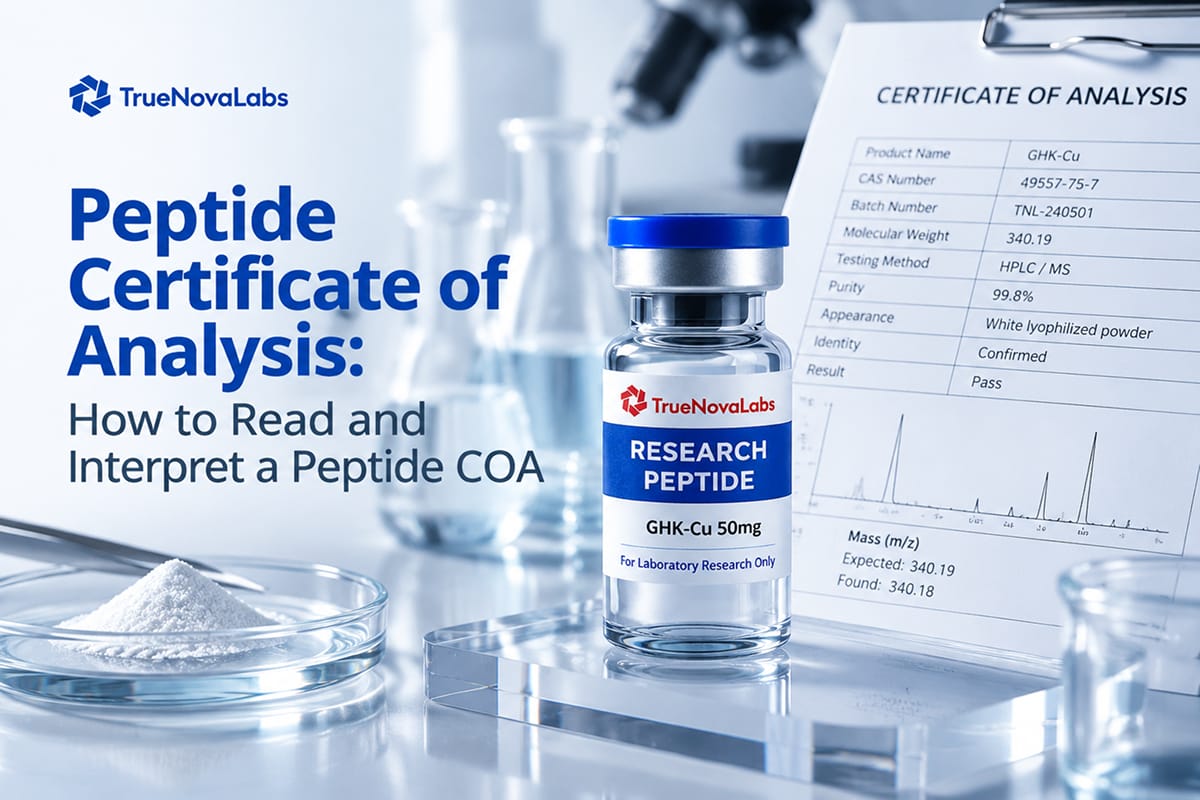
A Peptide Certificate of Analysis (COA) is a batch-specific document that provides analytical information about a peptide material. In addition, it allows researchers to review testing details related to peptide identity, purity, molecular characteristics, and analytical methods.
However, a COA does not represent a single measurement that defines every aspect of a peptide sample. Instead, each analytical method provides different information. For example, HPLC focuses on chromatographic analysis, while mass spectrometry provides molecular information that can support peptide identity.
👉 Explore research-focused peptide resources and learn more about current peptide science at True Nova Labs
Therefore, understanding how to read a peptide COA helps researchers interpret analytical results more accurately and understand what each test can demonstrate.
What Is a Peptide Certificate of Analysis?
A Peptide Certificate of Analysis is a document that summarizes analytical testing performed on a specific peptide batch or lot. In general, it connects laboratory results with the material evaluated during testing.
First, laboratories use COAs to connect testing results with the exact material they analyze. As a result, researchers can review the document to understand how the laboratory evaluated the peptide sample.
For example, a peptide COA commonly includes:
- Peptide name
- Batch or lot number
- Testing date
- Purity results
- HPLC analysis
- Mass spectrometry data
- Molecular mass information
- Laboratory details
In addition, the information included in a COA can vary depending on the laboratory and testing procedures. Therefore, researchers should review both the reported results and the analytical methods used to generate them.
👉 Learn more about performance and recovery peptides at SHOP ALL COMPOUNDS
What Information Should a Peptide COA Include?
First, a complete COA should provide enough information for researchers to understand the tested material and the methods used during evaluation.
| COA Information | Purpose |
|---|---|
| Peptide name | Confirms the tested compound |
| Batch number | Connects results to a specific production lot |
| Testing date | Shows when analysis occurred |
| Purity result | Provides chromatographic purity information |
| HPLC data | Shows separation and peak analysis |
| Mass spectrometry | Provides molecular characterization |
| Laboratory details | Identifies the testing source |
First, researchers should check whether the COA identifies the peptide and batch clearly. Next, they should review the analytical methods and reported specifications.
Furthermore, analytical results provide more value when researchers understand how the laboratory generated each measurement.
How to Verify the Peptide Name and Batch Number
Before reviewing analytical results, researchers should confirm that the COA matches the peptide material they are evaluating.
First, researchers should check the peptide name. Next, they should compare the batch number on the COA with the tested material. After that, they should review the testing date and related documentation.
The batch number is important because analytical results apply only to the specific production lot tested by the laboratory.
For example, a purity result from one batch does not automatically represent another batch. Therefore, researchers should verify batch information before interpreting purity or identity results.
How to Interpret Peptide Purity Results
Peptide purity describes the amount of detected target material compared with other detectable components under a specific analytical method.
However, researchers should interpret purity results within the context of the testing procedure.
| Factor | Importance |
|---|---|
| Reported purity value | Shows the analytical measurement |
| Testing method | Explains how purity was calculated |
| Testing conditions | Provides additional context |
| Supporting data | Helps evaluate the result |
For this reason, a high purity value indicates that the sample achieved the reported analytical measurement. However, this result alone does not confirm molecular identity.
Therefore, researchers should review purity results together with other analytical methods. In addition, identity-related testing can provide further information about the characteristics of the peptide sample.
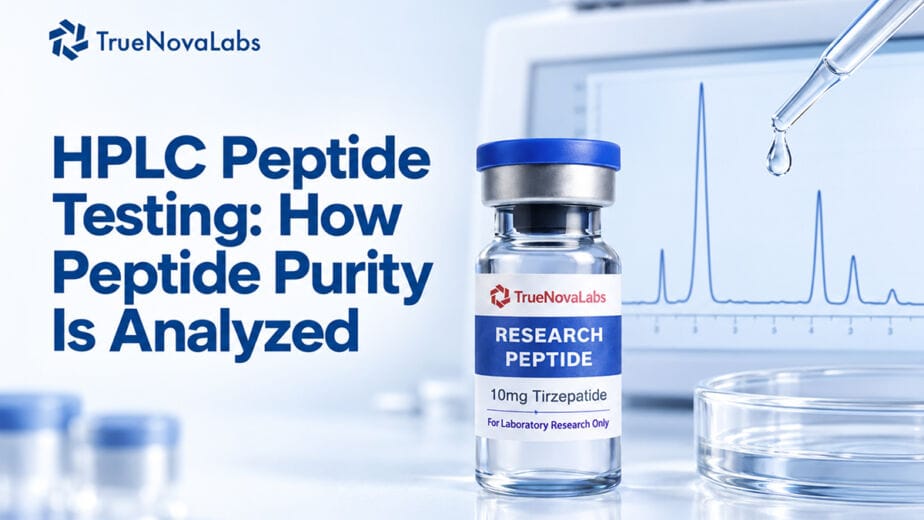
How to Read HPLC Data on a Peptide COA
High-Performance Liquid Chromatography (HPLC) separates components within a peptide sample and creates a chromatographic profile.
Meanwhile, researchers can examine the chromatogram to understand detected components and evaluate the reported purity result.
| HPLC Data | Meaning |
|---|---|
| Main peak | Primary detected component |
| Additional peaks | Other detectable components |
| Retention time | Time required for a component to reach detection |
| Peak area | Detector response used for calculations |
| Purity percentage | Calculated chromatographic result |
First, researchers can review the main peak to understand the primary detected component. Next, they can examine additional peaks to identify other detectable signals.
However, HPLC does not independently confirm complete molecular identity. Therefore, researchers should evaluate HPLC results together with additional analytical information.
👉 Explore the science behind supplement ingredients, research methods, and quality evaluation in Supplements: Science, Ingredients, Research & Quality Standards Explained.
How to Interpret Mass Spectrometry Results
Mass spectrometry provides molecular information by measuring ions according to their mass-to-charge ratio (m/z).
First, researchers compare the expected molecular mass with the observed molecular mass. Next, they evaluate whether the measured characteristics match the expected peptide.
| Result | Meaning |
|---|---|
| Expected mass | Theoretical molecular mass |
| Observed mass | Measured molecular mass |
| Mass difference | Difference between expected and observed values |
| MS/MS fragments | Additional sequence-related information |
As a result, a close match between expected and observed mass can support peptide identity. In addition, MS/MS fragmentation can provide further information about peptide structure.
However, molecular mass alone cannot resolve every possible structural difference. Therefore, researchers should consider the analytical method, reference information, and supporting data.
Peptide Purity vs Identity: Why Both Matter
Purity and identity describe different analytical characteristics.
| Characteristic | Purity | Identity |
|---|---|---|
| Main question | How much target material is detected? | Does the material match the expected peptide? |
| Common method | HPLC | Mass spectrometry |
| Primary output | Chromatogram | Mass spectrum |
First, HPLC helps researchers evaluate chromatographic purity by separating components within a sample. Meanwhile, mass spectrometry provides molecular information that supports peptide identification.
Therefore, researchers should consider both types of analytical evidence when interpreting a peptide COA.
👉 Learn more about performance and recovery peptides at SHOP ALL COMPOUNDS
What to Look for When Reviewing a Peptide COA
Researchers can review a peptide COA more effectively by following a structured process.
| Step | Question |
|---|---|
| 1 | Does the peptide name match the material? |
| 2 | Does the batch number correspond to the tested lot? |
| 3 | Does the COA identify the analytical method? |
| 4 | Does the document report purity results? |
| 5 | Does it include HPLC or mass spectrometry data? |
| 6 | Does it provide laboratory information? |
First, researchers should confirm the peptide name and batch number. Next, they should review the analytical methods and reported results.
After that, researchers can compare the available information to understand what each test demonstrates. Finally, they should evaluate the complete COA instead of focusing on a single measurement.
Most importantly, reviewing the full document provides a clearer understanding of the analytical information available for the tested batch.
👉 Explore how researchers evaluate purity, identity, potency, and verification in Supplement Quality & Testing: Purity, Identity, Potency & Verification.
FAQ About Peptide Certificate of Analysis
What is a peptide COA?
A peptide COA is a batch-specific document that reports analytical testing information for a peptide material, including purity, identity testing, and laboratory analysis.
Does a COA prove peptide purity?
A COA reports purity results from a specific analytical method. However, researchers should consider the testing method and supporting information when interpreting the result.
Is peptide purity the same as peptide identity?
No. Purity evaluates the detectable composition of a sample, while identity evaluates whether the material matches the expected peptide.
Why is the batch number important?
The batch number connects analytical results with a specific production lot. As a result, researchers can confirm whether the COA matches the material they are reviewing.
What information should researchers check first on a peptide COA?
Researchers should first review the peptide name, batch number, testing method, and laboratory information. Then, they can analyze detailed testing results.
Conclusion
A Peptide Certificate of Analysis provides important analytical information about a specific peptide batch. By reviewing identity data, purity results, HPLC information, mass spectrometry results, and batch details, researchers can better understand the available testing evidence.
However, each analytical method provides different information. Therefore, researchers should evaluate the complete COA instead of relying on a single measurement.
Ultimately, understanding how to interpret a peptide COA helps researchers review analytical documentation more effectively and understand what each result demonstrates.
👉 Explore educational resources and research-focused peptide information at TrueNovaLabs.
Disclaimer:
This content is provided by True Nova Labs for educational and research purposes only. It is not intended to diagnose, treat, cure, or prevent any disease, nor to provide medical or legal advice.



3 Comments
Ethan Hartwell
The explanation of peptide Certificates of Analysis is very useful, especially for understanding what laboratory data can tell us about a research material. I found the focus on identity, purity, and testing details particularly helpful when evaluating a COA.
Rebecca Rutherford
I appreciate the practical approach to reading a peptide COA rather than simply treating the reported purity percentage as the whole story. Understanding the testing method, batch information, and supporting analytical data gives a much clearer picture of sample quality.
Julian Beaumont
This is a helpful reference for researchers who want to better understand peptide testing documentation. I especially liked the emphasis on checking the source of analytical results and making sure the reported information is linked to the specific batch being evaluated.