
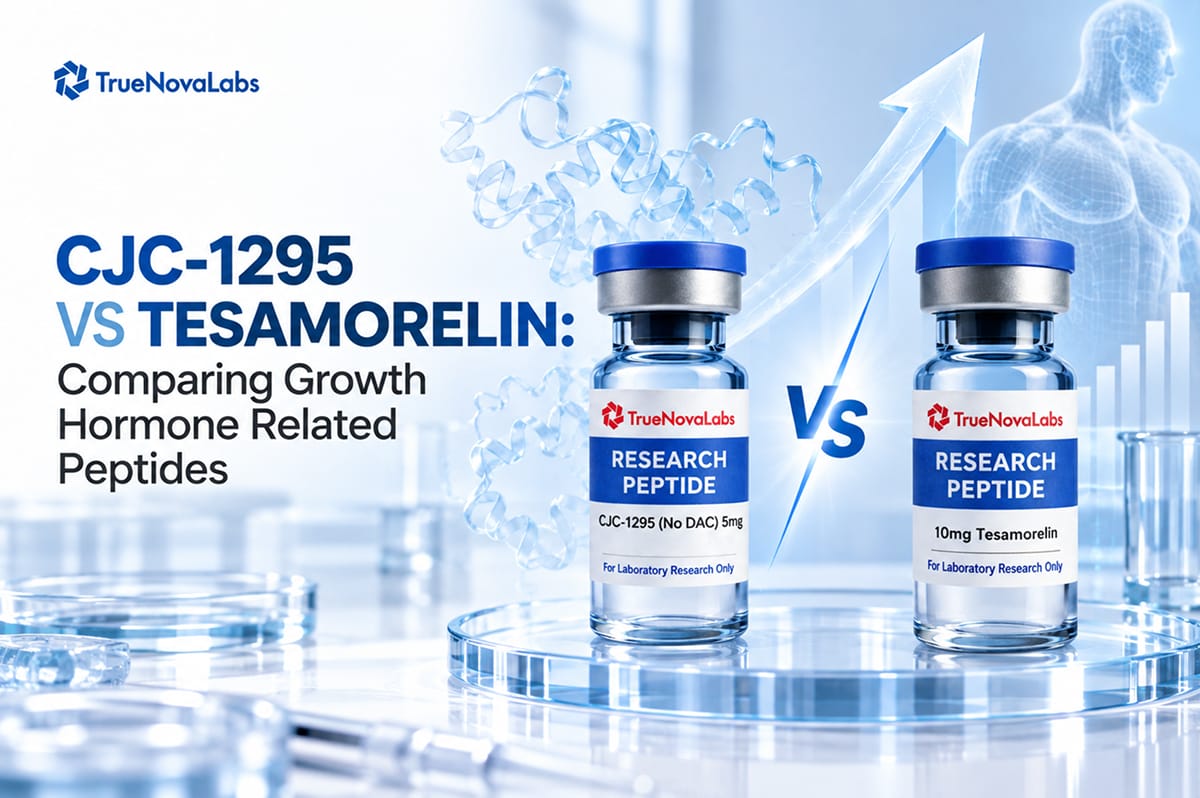
When comparing CJC-1295 vs Ipamorelin, it is important to understand that both peptides have been studied in relation to the growth hormone (GH) axis, but they influence this system through different pathways. CJC-1295 is a synthetic analogue of growth hormone-releasing hormone (GHRH), while Ipamorelin is a growth hormone secretagogue that acts through the growth hormone secretagogue receptor (GHS-R).
👉 Explore research-focused peptide resources and learn more about current peptide science at True Nova Labs
Although both compounds can influence GH secretion, their structures, mechanisms, pharmacokinetic characteristics, and research applications are not identical. Therefore, researchers should evaluate each compound based on the available evidence rather than treating them as interchangeable.
What Is CJC-1295?
First, CJC-1295 is a synthetic analogue of GHRH. As a result, its primary research interest involves the GHRH signalling pathway and its relationship with GH and insulin-like growth factor 1 (IGF-1).
Additionally, the commonly studied CJC-1295 form containing Drug Affinity Complex (DAC) has an extended pharmacokinetic profile. In early human research, administration of CJC-1295 produced sustained increases in GH and IGF-1 concentrations in healthy adults.
Key characteristics include:
- Synthetic GHRH analogue
- Primarily associated with GHRH signalling
- Studied in relation to GH and IGF-1
- DAC form has an extended pharmacokinetic profile
- Investigated in human endocrine research
However, these findings come from specific research settings. Therefore, researchers should not automatically apply these findings to applications that those studies did not evaluate.
👉 Explore our research-grade peptide blend designed for studies involving growth hormone-related pathways with CJC-1295 + Ipamorelin.
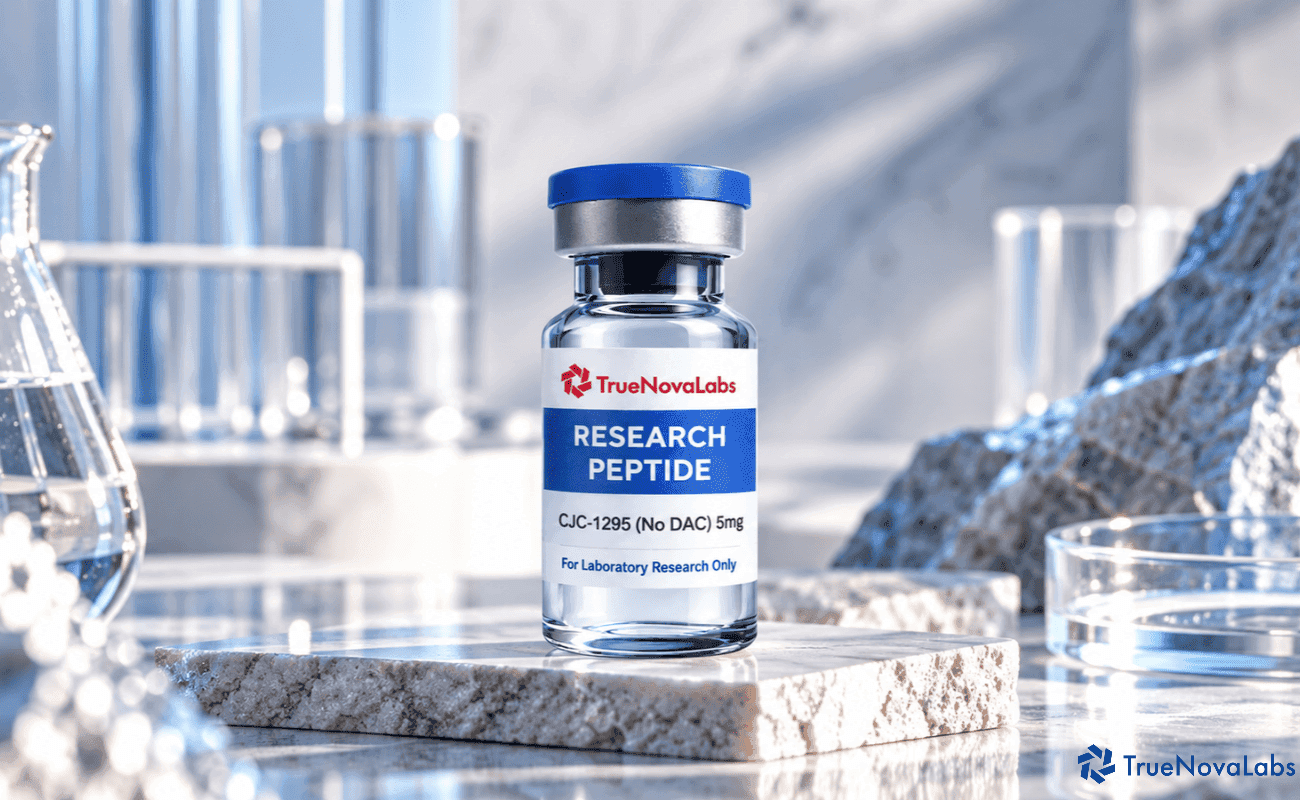
What Is Ipamorelin?
In contrast, Ipamorelin is a synthetic pentapeptide classified as a growth hormone secretagogue. Unlike CJC-1295, it is not a GHRH analogue. Instead, researchers have investigated Ipamorelin for its activity at GHS-R.
Early research characterized Ipamorelin as a relatively selective GH secretagogue. Furthermore, human pharmacokinetic research examined its GH response and reported a substantially shorter terminal half-life than the extended profile reported for CJC-1295 with DAC.
Important characteristics include:
- Synthetic pentapeptide
- Growth hormone secretagogue
- Acts through GHS-R
- Primarily studied in relation to GH secretion
- Investigated in human pharmacokinetic research
Consequently, Ipamorelin has a different pharmacological profile from CJC-1295.
👉 Discover a high-purity research compound designed for analytical and laboratory research with Ipamorelin 10mg.
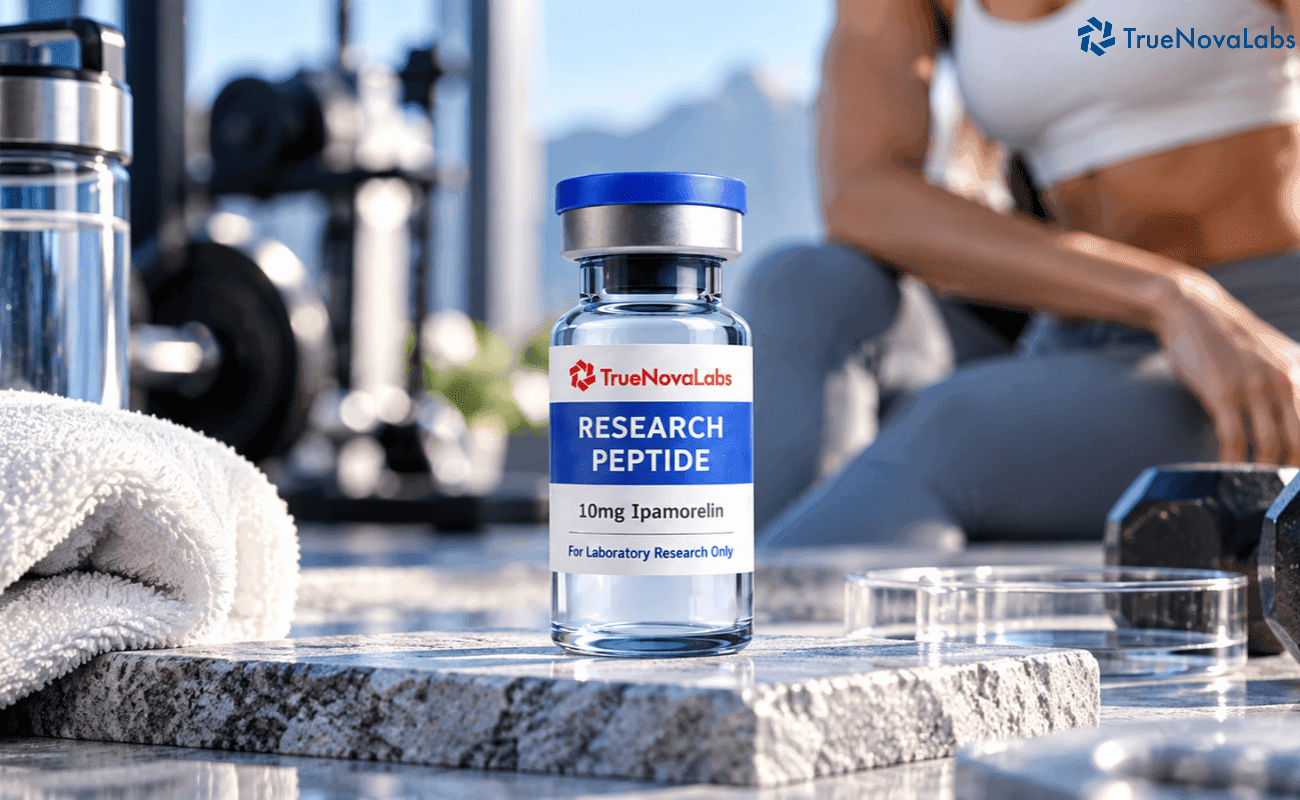
How Do CJC-1295 and Ipamorelin Differ?
The main difference between CJC-1295 and Ipamorelin is their signalling pathway. CJC-1295 primarily engages GHRH signalling, whereas Ipamorelin acts through GHS-R.
Both pathways can influence GH secretion. However, they initiate this response through different receptor systems.
| Feature | CJC-1295 | Ipamorelin |
|---|---|---|
| Peptide class | GHRH analogue | GH secretagogue |
| Primary pathway | GHRH receptor | GHS-R |
| Main research focus | GH and IGF-1 | GH secretion |
| Pharmacokinetic profile | Extended with DAC form | Relatively short in human PK research |
| Human research | Endocrine and PK studies | Endocrine and PK studies |
| Research status | Investigational | Investigational |
Moreover, the available studies do not always measure the same outcomes. Therefore, comparing the compounds only by their reported effects on GH would provide an incomplete picture.
Comparing Their Research Mechanisms
CJC-1295 and Ipamorelin influence the GH axis through different upstream mechanisms.
First, CJC-1295 acts as a GHRH analogue. GHRH normally stimulates somatotroph cells in the pituitary to release GH. Consequently, CJC-1295 research focuses on GHRH-like signalling and subsequent hormonal responses.
By comparison, Ipamorelin acts through GHS-R, a receptor involved in the regulation of GH secretion. This makes its mechanism distinct from the GHRH pathway associated with CJC-1295.
Researchers comparing these mechanisms can focus on:
- Primary receptor or signalling pathway
- GH secretion
- IGF-1 response
- Duration of hormonal changes
- Pharmacokinetic characteristics
- Experimental model used
Therefore, even if both peptides produce a GH response, that does not mean they have the same mechanism of action.
Comparing Their Research Applications
Research on both peptides has primarily focused on the GH axis. Nevertheless, their research histories differ in several areas.
Researchers have mainly investigated CJC-1295 in relation to:
- GH secretion
- IGF-1 responses
- Endocrine physiology
- Pharmacokinetics
- Duration of hormonal responses
Researchers have investigated Ipamorelin in areas including:
- GH secretion
- Pharmacokinetics
- Endocrine responses
- Specific clinical research applications
For example, researchers have investigated Ipamorelin in studies of postoperative gastrointestinal recovery. However, that clinical study did not demonstrate a statistically significant improvement in its primary efficacy endpoint compared with placebo.
Therefore, the research history of one compound should not automatically be applied to the other.
| Research Area | CJC-1295 | Ipamorelin |
|---|---|---|
| GH secretion | Studied | Studied |
| IGF-1 response | Important focus | Less central |
| Pharmacokinetics | Studied | Studied |
| Endocrine physiology | Studied | Studied |
| Gastrointestinal research | Limited | Investigated |
Current Research on CJC-1295 and Ipamorelin
Both compounds have been investigated in human and preclinical research. However, the available evidence remains limited for many broader claims associated with these peptides.
CJC-1295 research has examined sustained GH and IGF-1 responses as well as pharmacokinetic characteristics. Meanwhile, Ipamorelin research has examined GH responses, pharmacokinetics, and specific clinical applications.
When evaluating the evidence, researchers should consider:
- Study population
- Experimental model
- Study design
- Duration
- Measured endpoints
- Control group
- Study limitations
Furthermore, researchers should not automatically apply findings from one research model to another. In vitro studies, animal research, pharmacokinetic studies, and human trials answer different scientific questions.
The Canadian context also requires a distinction between scientific research and regulatory authorization. The existence of published research does not automatically mean that a specific peptide product is authorized for general human use or sale in Canada.
Therefore, researchers should evaluate the scientific evidence and regulatory status of a specific product separately.
👉 Discover high-purity research peptides designed for laboratory and analytical studies involving growth hormone-related pathways with CJC-1295 and Ipamorelin.
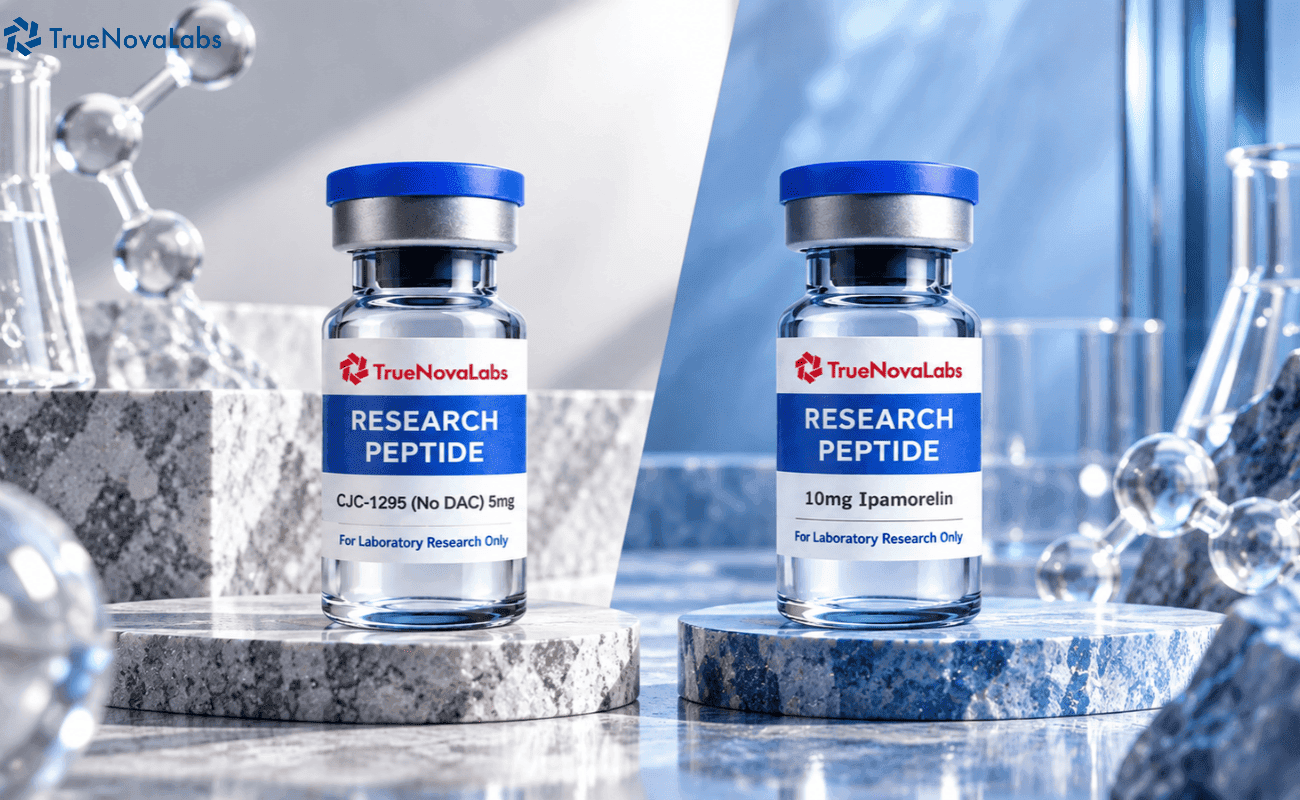
Key Factors to Consider When Comparing These Peptides
More importantly, a meaningful CJC-1295 vs Ipamorelin comparison should consider several factors rather than focusing on one reported hormonal effect.
| Factor | Why It Matters |
|---|---|
| Molecular target | Shows how biological activity begins |
| Mechanism | Distinguishes different signalling pathways |
| Structure | Helps explain activity and stability |
| Pharmacokinetics | Provides information about exposure and duration |
| Research model | Determines how findings should be interpreted |
| Human evidence | Shows whether findings were studied in people |
| Study design | Helps identify strengths and limitations |
| Research endpoint | Shows what the study actually measured |
| Regulatory status | Separates scientific evidence from authorization |
For example, an increase in GH during a controlled study demonstrates a hormonal response under those specific conditions. However, it does not automatically demonstrate outcomes that the study did not measure.
Similarly, researchers cannot automatically translate findings from animal research into equivalent human effects. Therefore, researchers should consider the study model, endpoint, and evidence quality before drawing conclusions.
👉 Learn how researchers compare peptide structure, mechanisms, and evidence in Peptide Comparisons: Understanding Differences Between Research Compounds.
FAQ About CJC-1295 vs Ipamorelin
Is CJC-1295 the same as Ipamorelin?
No. CJC-1295 is a GHRH analogue, while Ipamorelin is a growth hormone secretagogue that acts through GHS-R. Therefore, they influence the GH axis through different mechanisms.
What is the main difference between CJC-1295 and Ipamorelin?
The primary difference is their signalling pathway. CJC-1295 primarily engages GHRH signalling, whereas Ipamorelin acts through GHS-R.Their pharmacokinetic characteristics also differ.
Does CJC-1295 with DAC have the same profile as other forms?
Not necessarily. The DAC form has an extended pharmacokinetic profile, while other forms may have different characteristics. Therefore, researchers should identify the specific form being evaluated.
Is Ipamorelin studied in humans?
Yes. Human research has examined its pharmacokinetics, GH response, and specific clinical applications. However, the evidence should be assessed according to the design and purpose of each study.
Does research on CJC-1295 apply to Ipamorelin?
No. Although both influence the GH axis, they act through different pathways and have different pharmacokinetic characteristics. Consequently, findings from one peptide should not automatically be applied to the other.
Are CJC-1295 and Ipamorelin authorized for general use in Canada?
Scientific research and Canadian regulatory authorization are separate considerations. Therefore, the regulatory status of a specific product should be evaluated independently rather than inferred from published research.
Conclusion
CJC-1295 vs Ipamorelin is a useful comparison because both peptides have been investigated in relation to the GH axis while acting through different biological pathways.
CJC-1295 is a GHRH analogue, while Ipamorelin is a GHS-R agonist. Furthermore, the DAC form of CJC-1295 has an extended pharmacokinetic profile, whereas Ipamorelin has demonstrated a shorter profile in human pharmacokinetic research.
However, neither compound should be evaluated solely through reported hormonal changes. Research model, study design, pharmacokinetics, measured endpoints, and evidence quality all influence how findings should be interpreted.
Ultimately, comparing these factors provides a clearer framework for understanding what current research supports, where evidence remains limited, and which questions require further investigation.
👉 Explore educational resources and research-focused peptide information at TrueNovaLabs.
Disclaimer:
This content is provided by True Nova Labs for educational and research purposes only. It is not intended to diagnose, treat, cure, or prevent any disease, nor to provide medical or legal advice.





3 Comments
Ryan Mitchell
This comparison makes the differences between CJC-1295 and Ipamorelin much easier to understand. I found the discussion of their distinct mechanisms and research characteristics particularly useful when looking at the two compounds side by side.
Jessica Turner
I liked that the article focuses on the scientific differences rather than treating CJC-1295 and Ipamorelin as interchangeable compounds. Understanding how they interact with different pathways provides useful context for reviewing the available research.
Matthew Collins
The side-by-side format is helpful for anyone trying to understand these two peptides from a research perspective. I especially appreciate the distinction between proposed mechanisms, research findings, and conclusions that still require further evidence.