
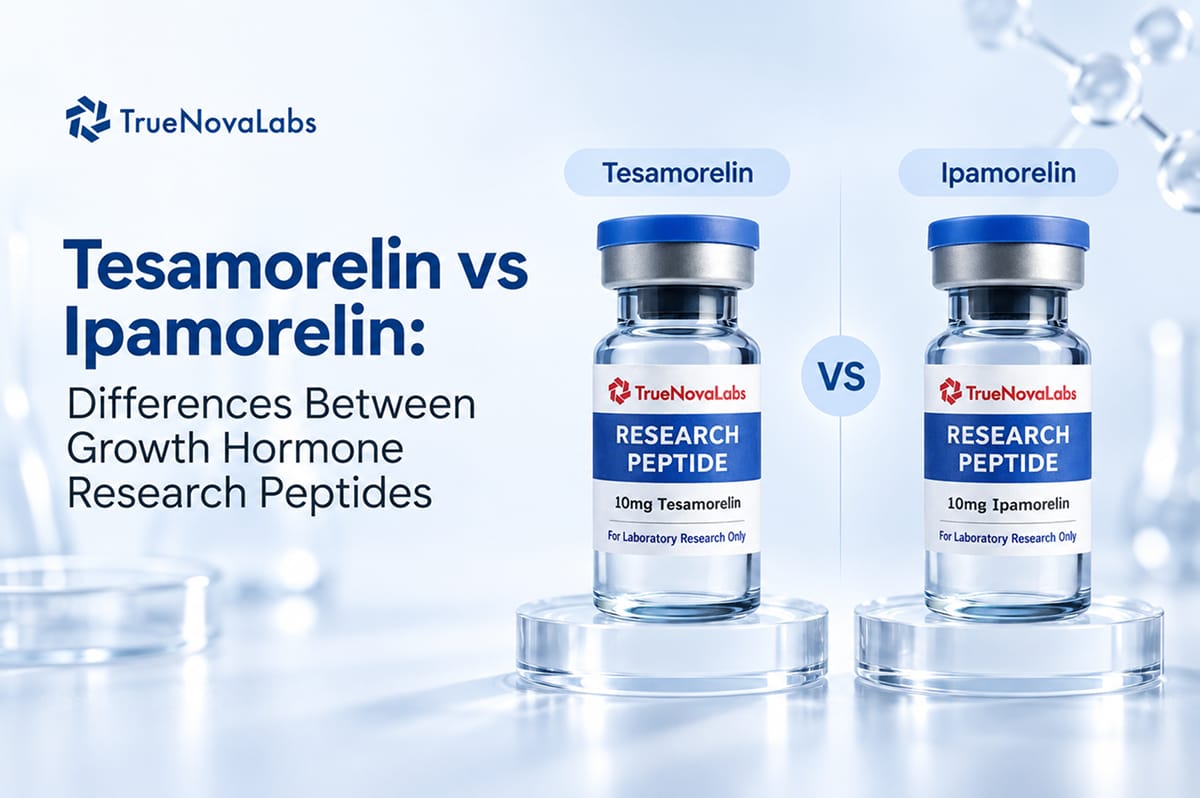
When comparing Tesamorelin vs Ipamorelin, it is important to understand that both peptides have been investigated in relation to the growth hormone (GH) axis. However, they influence this system through different biological pathways. Tesamorelin is a synthetic growth hormone-releasing hormone (GHRH) analogue, whereas Ipamorelin is a growth hormone secretagogue that acts through the growth hormone secretagogue receptor (GHS-R).
👉 Explore research-focused peptide resources and learn more about current peptide science at True Nova Labs
Therefore, the two compounds should not be treated as interchangeable research peptides. Instead, researchers can compare their molecular characteristics, receptor pathways, pharmacokinetics, research focus, and available evidence. For Canadian research evaluation, scientific evidence and regulatory status should also be considered separately.
What Is Tesamorelin?
Tesamorelin is a synthetic analogue of human GHRH. More specifically, it is based on the GHRH sequence and was developed with structural modifications intended to provide greater stability than native GHRH.
As a result, researchers have investigated Tesamorelin in relation to GH secretion, insulin-like growth factor 1 (IGF-1), body composition, and visceral adipose tissue. Human research has also examined GH pulsatility and metabolic parameters.
Key characteristics include:
- Synthetic GHRH analogue
- Structurally related to human GHRH
- Acts primarily through the GHRH receptor pathway
- Studied in relation to GH and IGF-1
Importantly, Tesamorelin has a relatively extensive human research history, particularly involving visceral adipose tissue. Therefore, findings should be interpreted according to the study population and endpoint.
👉 Discover a high-purity research peptide for laboratory studies with Tesamorelin 10mg.
What Is Ipamorelin?
Ipamorelin is a synthetic pentapeptide classified as a growth hormone secretagogue. Unlike Tesamorelin, it is not a GHRH analogue. Instead, Ipamorelin acts through GHS-R, a receptor involved in the regulation of GH secretion.
Early research characterized Ipamorelin as a relatively selective GH secretagogue. Subsequently, human pharmacokinetic research examined its concentration over time and the associated GH response.
Key characteristics include:
- Synthetic pentapeptide
- Growth hormone secretagogue
- Acts through GHS-R
- Primarily studied in relation to GH secretion
However, the clinical research base for Ipamorelin is smaller. Consequently, researchers should evaluate the evidence for each compound separately.
👉 Discover a high-purity research compound designed for analytical and laboratory research with Ipamorelin 10mg.
How Are Tesamorelin and Ipamorelin Different?
The main difference between Tesamorelin and Ipamorelin is their primary signalling pathway. Tesamorelin acts through GHRH-related signalling, while Ipamorelin acts through GHS-R.
Although both pathways can influence GH secretion, they initiate that response through different receptor systems. Therefore, a similar hormonal response does not mean that the compounds have the same mechanism.
| Feature | Tesamorelin | Ipamorelin |
|---|---|---|
| Peptide class | GHRH analogue | GH secretagogue |
| Primary pathway | GHRH receptor | GHS-R |
| Structure | GHRH-derived peptide | Pentapeptide |
| Main research focus | GH, IGF-1, visceral adipose tissue | GH secretion and pharmacokinetics |
| Human evidence | Clinical and pharmacological studies | Pharmacological and limited clinical studies |
| Research profile | More developed clinical evidence | More limited clinical evidence |
Consequently, researchers should consider both mechanism and evidence quality rather than focusing only on reported GH changes.
Comparing Their Molecular Characteristics
The molecular differences between these peptides help explain their different research profiles.
First, Tesamorelin is structurally related to human GHRH, with modifications intended to improve stability and duration. By comparison, Ipamorelin consists of five amino acids and belongs to the growth hormone secretagogue class.
The main differences include:
- Tesamorelin is derived from the GHRH sequence.
- Ipamorelin is a five-amino-acid peptide.
- Tesamorelin primarily engages GHRH signalling.
- Ipamorelin acts through GHS-R.
- Their pharmacokinetic characteristics differ.
Furthermore, experimental conditions can influence peptide behaviour. Therefore, researchers should identify the exact compound and study conditions before comparing results.
Comparing Their Research Focus
The research focus of each peptide represents another important distinction.
Researchers have extensively investigated Tesamorelin in relation to visceral adipose tissue, particularly in people with HIV-associated lipodystrophy. Clinical research has also examined GH secretion, IGF-1, trunk fat, liver fat, and metabolic measures.
Ipamorelin research, meanwhile, has focused more heavily on GH pharmacology and pharmacokinetics. Researchers have studied its ability to stimulate GH release and have also investigated specific clinical questions.
For example, researchers have examined Ipamorelin in studies involving postoperative gastrointestinal recovery. However, that clinical study did not demonstrate a statistically significant improvement in its primary efficacy endpoint compared with placebo.
| Research Area | Tesamorelin | Ipamorelin |
|---|---|---|
| GH secretion | Extensively studied | Studied |
| IGF-1 response | Important research area | Less central |
| Pharmacokinetics | Studied | Studied |
| Visceral adipose tissue | Major research focus | Limited evidence |
| Postoperative research | Not a major focus | Investigated |
As a result, the research history of one peptide should not automatically be applied to the other.
What Does Current Research Investigate?
Current research continues to examine how peptides affecting the GH-IGF-1 axis behave across different populations and experimental conditions.
For Tesamorelin, research has investigated visceral adipose tissue, body composition, hepatic fat, metabolic parameters, and GH-related responses. Meanwhile, Ipamorelin research has focused more heavily on pharmacokinetic and pharmacodynamic properties and selected clinical questions.
When reviewing evidence, researchers should consider:
- Study population
- Experimental model
- Study design
- Treatment duration
- Measured endpoints
- Study limitations
Furthermore, researchers should not automatically transfer results from one research model to another. For instance, animal studies, pharmacokinetic studies, and human clinical trials answer different scientific questions.
For Canadian researchers, they should also review regulatory information separately from scientific evidence. A published study does not automatically establish Canadian authorization for a specific product. Researchers should therefore verify its current regulatory status.
👉 Discover high-purity research peptides designed for laboratory and analytical studies involving growth hormone-related pathways with Tesamorelin 10mg and Ipamorelin.
Understanding Research Limitations
A meaningful comparison also requires attention to what the evidence does not establish. Tesamorelin has a more developed clinical research history for certain questions; however, this does not establish every proposed application. Similarly, human studies involving Ipamorelin do not establish evidence for every commonly discussed application.
Important limitations include:
- Studies may involve specific patient populations.
- Research durations may vary.
- Different studies may measure different endpoints.
- Preclinical findings may not translate directly to humans.
- A hormonal response does not automatically establish a broader physiological outcome.
Consequently, researchers should approach Tesamorelin vs Ipamorelin as a comparison of research characteristics rather than a simple determination of which compound is better.
Therefore, Canadian researchers should assess scientific evidence, regulatory status, and product documentation separately.
👉 Learn how researchers compare peptide structure, mechanisms, and evidence in Peptide Comparisons: Understanding Differences Between Research Compounds.
FAQ About Tesamorelin vs Ipamorelin
Is Tesamorelin the same as Ipamorelin?
No. Tesamorelin is a GHRH analogue, whereas Ipamorelin is a growth hormone secretagogue that acts through GHS-R. Therefore, they influence the GH axis through different pathways.
What is the main difference between Tesamorelin and Ipamorelin?
The main difference is their molecular pathway. Tesamorelin primarily engages GHRH signalling, while Ipamorelin acts through GHS-R. Their structures and pharmacokinetic characteristics also differ.
Which peptide has more human clinical research?
Tesamorelin has a more developed clinical research history, particularly regarding visceral adipose tissue and HIV-associated lipodystrophy. Ipamorelin has human pharmacokinetic research and more limited clinical evidence.
Does research on Tesamorelin apply to Ipamorelin?
No. Although both peptides influence the GH axis, their molecular structures, receptor pathways, pharmacokinetics, and research populations differ. Therefore, findings should be evaluated separately.
Are Tesamorelin and Ipamorelin currently authorized for general use in Canada?
Regulatory status depends on the specific product and its current authorization. Therefore, researchers should verify the status of a specific product through current Canadian regulatory records rather than infer authorization from published research.
Conclusion
Tesamorelin vs Ipamorelin is a useful comparison because both peptides have been investigated in relation to the GH axis, yet they operate through different molecular pathways.
Tesamorelin is a GHRH analogue with a relatively extensive human clinical research history, particularly involving visceral adipose tissue and HIV-associated lipodystrophy. Meanwhile, Ipamorelin is a smaller GHS-R agonist whose research has focused more heavily on GH secretion, pharmacokinetics, and selected clinical questions.
However, neither compound should be evaluated solely through its reported effect on GH. Instead, researchers should consider molecular structure, receptor pathway, pharmacokinetics, study population, research endpoints, and evidence quality together.
Ultimately, this approach provides a clearer framework for understanding what current research supports, where evidence remains limited, and which questions require further investigation.
👉 Explore educational resources and research-focused peptide information at TrueNovaLabs.
Disclaimer:
This content is provided by True Nova Labs for educational and research purposes only. It is not intended to diagnose, treat, cure, or prevent any disease, nor to provide medical or legal advice.



3 Comments
Andrew Wilson
This comparison provides a useful overview of how tesamorelin and ipamorelin differ in their interactions with growth hormone-related pathways. I especially appreciate the focus on mechanism rather than treating the two peptides as interchangeable research compounds.
Jessica Carter
I found the side-by-side comparison helpful for understanding the distinct research profiles of tesamorelin and ipamorelin. Looking at their mechanisms and molecular characteristics separately makes it easier to see why they are studied in different experimental contexts.
Matthew Clark
A helpful reference for anyone researching the differences between these two peptides. The discussion of their respective biological pathways and research applications gives a clearer framework for evaluating tesamorelin and ipamorelin based on scientific characteristics.