
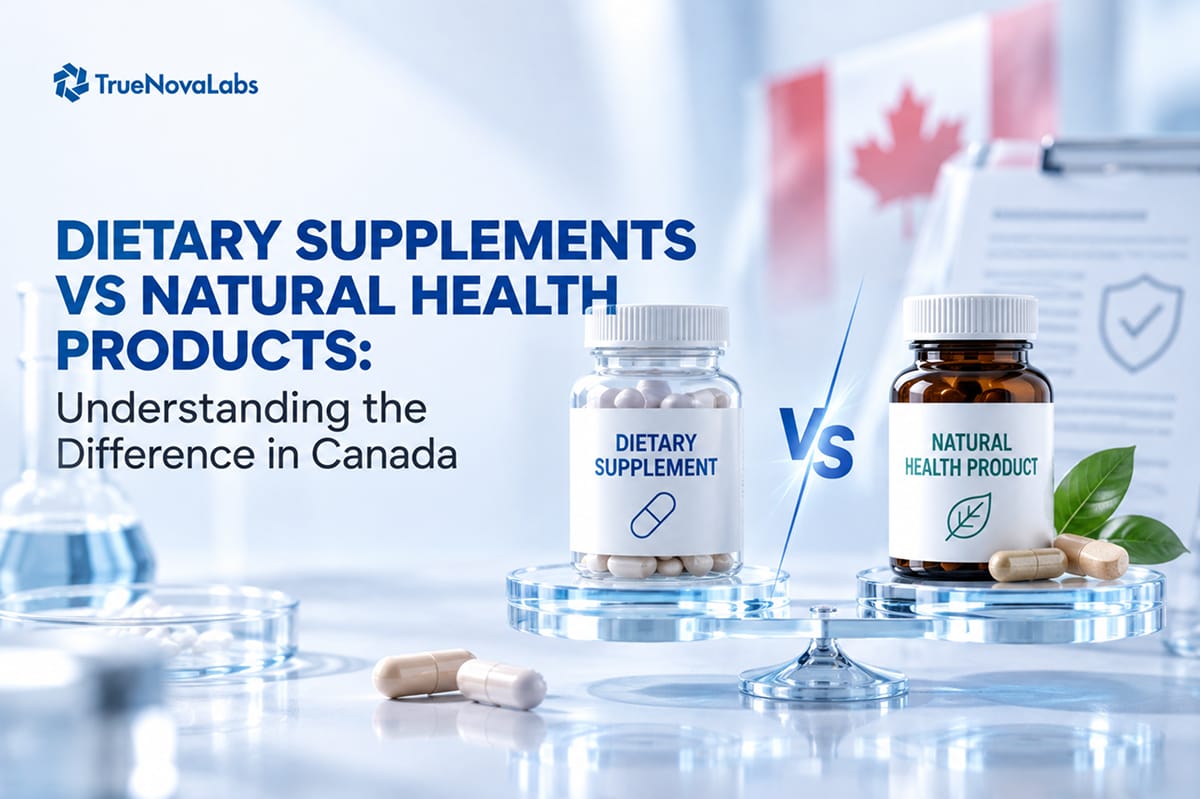
The difference between dietary supplements vs natural health products is important when evaluating products in Canada. Although these terms are often used interchangeably, they do not have exactly the same regulatory meaning. Product classification can affect licensing, labelling, manufacturing, and marketing requirements.
“Dietary supplement” is a broad industry and consumer term. In contrast, Natural Health Product (NHP) is a defined Canadian regulatory category. Therefore, understanding how dietary supplements and natural health products differ can help businesses and researchers evaluate products more accurately.
👉 Explore research-focused peptide resources and learn more about current peptide science at True Nova Labs
In this guide, we examine the key differences between these product categories, including their classification, licensing, labelling, and regulatory requirements in Canada.
What Are Dietary Supplements?
When comparing dietary supplements vs natural health products, a dietary supplement generally refers to a product intended to supplement the diet with nutrients or other substances.
For example, common examples include:
- Vitamins and minerals
- Herbal ingredients
- Amino acids
- Fatty acids
- Probiotics
- Botanical extracts
However, the term “dietary supplement” does not have the same regulatory meaning in every country.
In Canada, however, using this term on packaging does not automatically determine how a product is regulated. Instead, Canadian authorities consider factors such as ingredients, dosage form, intended purpose, recommended use, and product representation.
As a result, a product marketed internationally as a dietary supplement may qualify as an NHP in Canada, while another product may fall under food or another regulatory category.
👉 Learn more about performance and recovery peptides at SHOP ALL COMPOUNDS
What Are Natural Health Products in Canada?
When examining dietary supplements vs natural health products, Natural Health Products represent a defined regulatory category in Canada. They include a range of products such as:
- Vitamins and minerals
- Herbal and plant-based products
- Probiotics
- Traditional medicines
- Certain amino acids
- Essential fatty acid products
- Homeopathic medicines
However, an ingredient alone does not determine whether a finished product qualifies as an NHP. Canadian classification considers the product as a whole, including its formulation, dosage form, intended use, and representation.
When an NHP receives authorization for sale, it generally receives an eight-digit Natural Product Number (NPN). Homeopathic medicines may receive a DIN-HM.
Therefore, an NPN can help identify a product that has received the applicable Canadian NHP authorization.
How Do Dietary Supplements and Natural Health Products Differ?
The primary difference is their regulatory meaning. “Dietary supplement” describes a broad category of products, while “Natural Health Product” represents a specific Canadian regulatory category.
| Feature | Dietary Supplements | Natural Health Products in Canada |
|---|---|---|
| Meaning | Broad industry term | Defined regulatory category |
| Common ingredients | Vitamins, minerals, botanicals, amino acids, etc. | Vitamins, minerals, botanicals, probiotics, and others |
| Canadian classification | Not automatically a specific category | Subject to the NHP framework |
| Product licence | Depends on classification | Generally required for sale |
| Product identifier | Depends on category | NPN or DIN-HM where applicable |
| Labelling | Depends on classification | Specific NHP requirements |
| Manufacturing | Depends on classification | Subject to applicable NHP requirements |
Consequently, businesses should not assume that “dietary supplement” and “NHP” are interchangeable terms in Canada.
How Are They Classified and Regulated in Canada?
When evaluating dietary supplements vs natural health products, Canadian classification focuses on the characteristics of the finished product rather than simply the terminology used by the manufacturer.
Important factors include:
- Ingredients and their sources
- Dosage form
- Intended purpose
- Recommended use
- Health claims
- Product representation
- Overall composition
These factors can determine whether a product falls under the NHP framework, food regulations, or another category.
For NHPs, Canadian requirements can cover product licensing, site licensing, manufacturing, quality, labelling, and importation.
By comparison, products classified as foods follow the applicable food regulatory framework.
Therefore, businesses should establish the correct classification before making decisions about manufacturing, labelling, importing, or marketing.
How Do Their Labelling and Licensing Requirements Differ?
Labelling requirements depend on the product’s Canadian classification.
For a licensed NHP, the label may include:
- Product name
- NPN or DIN-HM
- Medicinal ingredients
- Amount or potency
- Non-medicinal ingredients
- Recommended use
- Directions
- Warnings
- Lot number
- Expiry information
The label should also correspond with the product’s authorized information.
Licensing creates another important distinction. An NHP generally requires a product licence before it can be marketed and sold in Canada. Businesses that manufacture, package, label, or import NHPs for sale may also require an appropriate site licence.
| Requirement | Purpose |
|---|---|
| Product licence | Authorizes a specific NHP for sale |
| NPN or DIN-HM | Identifies the authorized product |
| Site licence | Covers specified NHP activities |
| Product label | Provides required product information |
Therefore, businesses should evaluate product authorization, labelling, and site requirements together.
👉 Learn more about performance and recovery peptides at SHOP ALL COMPOUNDS
Why Does the Distinction Matter When Evaluating a Product?
The distinction matters because the terminology on a product label does not automatically establish its Canadian regulatory status.
For example, a product described as a “dietary supplement” may require NHP authorization before it can be sold in Canada. Likewise, the presence of familiar ingredients does not automatically determine the classification of the finished product.
When evaluating a product, consider:
| Evaluation Factor | What to Check |
|---|---|
| Classification | How is the product categorized in Canada? |
| Ingredients | Are the ingredients clearly identified? |
| Licence | Does the product have the required authorization? |
| NPN/DIN-HM | Is the applicable number available? |
| Labelling | Does the label meet applicable requirements? |
| Quality | Are testing and specifications documented? |
| Manufacturer | Can the responsible manufacturing activities be verified? |
It is also important to distinguish regulatory documentation from laboratory documentation.
For example, a Certificate of Analysis can provide information about a specific batch, including identity or purity results. However, a COA does not replace a required Canadian product licence.
Similarly, regulatory authorization does not replace appropriate quality testing and batch controls.
Ultimately, these documents serve different purposes: licensing addresses regulatory authorization, while laboratory testing provides analytical information about the tested material.
👉 Explore the science behind supplement ingredients, research methods, and quality evaluation in Supplements: Science, Ingredients, Research & Quality Standards Explained.
FAQ About Dietary Supplements and Natural Health Products
Are dietary supplements and natural health products the same in Canada?
Not necessarily. “Dietary supplement” is a broad term, while Natural Health Product is a defined Canadian regulatory category. A product marketed as a dietary supplement may qualify as an NHP, depending on its characteristics.
Does every supplement in Canada need an NPN?
No. An NPN applies to licensed natural health products. Products under other regulatory categories follow different requirements.
What does an NPN mean?
An NPN is an eight-digit Natural Product Number associated with an authorized natural health product in Canada.
Can a product be a dietary supplement in another country and an NHP in Canada?
Yes. Regulatory classification depends on the requirements of each country. Classification in another market does not automatically determine classification in Canada.
Do vitamins count as natural health products?
Many vitamin products can fall within Canada’s NHP framework. However, classification depends on the characteristics and intended use of the finished product.
Does a Certificate of Analysis prove that a product is an NHP?
No. A COA provides laboratory testing information. NHP status depends on regulatory classification and applicable product authorization.
Why should businesses determine classification before selling a supplement?
Classification determines which regulatory requirements apply. Therefore, businesses should establish the Canadian category before finalizing licensing, labelling, manufacturing, importation, and marketing decisions.
Conclusion
Dietary supplements vs natural health products can overlap in everyday language, but these terms have different meanings within Canada’s regulatory framework.
“Dietary supplement” is generally a broad term for products intended to supplement the diet. In contrast, Natural Health Product is a defined Canadian category with specific requirements for licensing, labelling, manufacturing, and quality.
Therefore, businesses should not rely on product terminology alone. Instead, they should consider the ingredients, dosage form, intended use, representation, licensing status, and quality documentation.
Understanding this distinction provides a clearer framework for evaluating products and determining which Canadian requirements may apply.
👉 Explore educational resources and research-focused peptide information at TrueNovaLabs.
Disclaimer:
This content is provided by True Nova Labs for educational and research purposes only. It is not intended to diagnose, treat, cure, or prevent any disease, nor to provide medical or legal advice.




3 Comments
Marcus Whitaker
This comparison makes the distinction between dietary supplements and natural health products much easier to understand. I found the discussion of terminology and regulatory differences particularly useful, especially when researching products in the Canadian market.
Isabelle Whitmore
I liked that the article does not treat the two terms as interchangeable. Understanding how products are classified and regulated can be important when comparing labels, claims, and other product information.
Caleb Rutherford
The side-by-side explanation provides a useful starting point for understanding these two categories. I especially appreciated the focus on definitions and regulatory context, since the terminology can be confusing for people researching supplements online.