
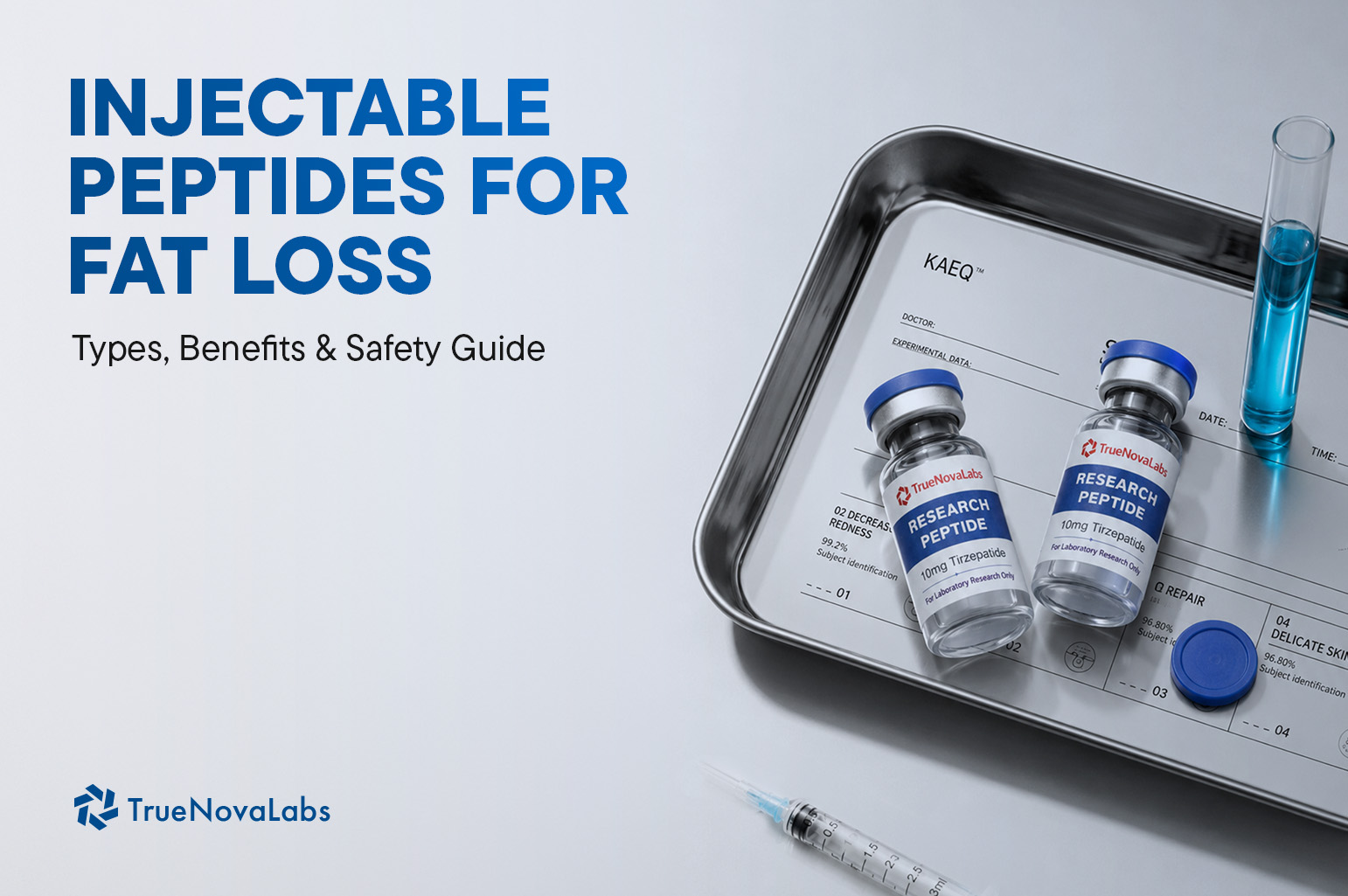
The growing interest in injectable peptides for fat loss reflects a broader shift in metabolic research—from short-term stimulation toward understanding how the body regulates appetite, hormones, and energy balance over time.
Researchers often discuss injectable delivery because many peptides do not remain stable in oral form. Researchers therefore study these peptides using methods that preserve their structure and help them interact effectively with biological pathways. As a result, the administration method becomes an important factor in evaluating peptides in research environments.
In Canada, most peptides referenced in this context are supplied strictly for laboratory and educational purposes only, not as approved consumer products. Understanding both the science and the limitations is essential before interpreting their role in fat loss research.
👉 Looking for research-grade peptides with verified purity and transparent sourcing? Explore the collection here SHOP ALL COMPOUNDS
This guide explores how injectable peptides are studied, which compounds are most commonly discussed, and what safety considerations matter most—available at True Nova Labs
How Injectable Fat Loss Peptides Work
Injectable peptides are studied for how they interact with receptor-based signaling systems that regulate metabolism.
Rather than directly “burning fat,” many peptides influence:
- appetite signaling pathways
- satiety responses
- glucose-related systems
- hormonal communication
These effects are often linked to pathways such as:
- GLP-1 (satiety and appetite control)
- GIP (metabolic and insulin signaling)
- glucagon-related pathways (energy balance)
The injectable route allows peptides to enter circulation more directly, avoiding degradation that may occur through digestion. This helps preserve their structure and supports more consistent interaction with target receptors in research models.
What makes this important is that fat loss, from a biological perspective, is not driven by a single mechanism. It is the result of coordinated signaling across multiple systems, and peptides are studied as part of that network.

Most Common Injectable Peptides for Fat Loss
Several peptides are frequently discussed in metabolic research due to their interaction with appetite and endocrine pathways.
Semaglutide is widely studied for its role in GLP-1 receptor signaling, particularly in relation to satiety and reduced energy intake. Tirzepatide expands on this by interacting with both GLP-1 and GIP pathways, making it a focus in multi-pathway metabolic research.
Retatrutide has gained attention for its broader signaling profile, involving GLP-1, GIP, and glucagon-related pathways. Meanwhile, Cagrilintide is explored in connection with amylin signaling, which is associated with fullness and appetite control.
These compounds are not interchangeable. Each operates through distinct pathways, which is why their research profiles—and potential observations—can differ significantly.
Potential Benefits and Risks
| Aspect | Key Points in Research Context |
|---|---|
| Potential Areas of Influence | Appetite regulation, satiety timing, energy intake behavior, and metabolic signaling patterns are commonly studied in relation to injectable peptides |
| Research Status | These effects are part of ongoing research and should not be interpreted as guaranteed outcomes |
| Primary Risk Factors | Purity and quality, contamination during preparation, improper storage, and inconsistent handling |
| Why Risks Matter | Peptides are sensitive molecules, and even minor degradation or contamination can alter their stability and biological behavior |
👉 This is why sourcing matters. Explore peptides backed by verified testing and quality control here SHOP ALL COMPOUNDS
Injection Methods and Administration Basics
In research environments, injectable peptides are typically studied using methods designed to maintain consistency and minimize variability.
The focus is not on the act of injection itself, but on:
- ensuring accurate concentration
- maintaining sterile conditions
- preserving peptide stability
Because peptides are fragile, improper preparation can compromise their structure before they are even studied.
Researchers often discuss injectable peptides with a strong emphasis on laboratory discipline and controlled conditions for this reason.
Important Safety and Storage Tips
Peptide stability is directly tied to how they are stored and handled.
Exposure to heat, light, or repeated temperature changes can lead to degradation. Once reconstituted, many peptides require more controlled storage conditions to maintain their integrity.
From a research perspective, safety is not just about avoiding adverse outcomes—it is about ensuring that results remain reliable and reproducible.
In Canada, organizations such as Health Canada regulate substances according to their classification and intended use, reinforcing the importance of proper handling and appropriate research context.
Who Should Avoid Injectable Peptides?
Researchers do not intend injectable peptides for casual or unsupervised use.
Because suppliers provide most of them strictly for research purposes, users should not treat them as consumer products. Misuse—especially outside controlled environments—can introduce unnecessary risks.
Anyone without a clear understanding of:
- peptide stability
- handling requirements
- research context
should avoid attempting to work with injectable peptides outside appropriate settings.

Curious about how peptides may support fat loss and appetite control? Discover the science, research insights, and key considerations in Peptides for Fat Loss: How They Work, Research Insights & Key Considerations from True Nova Labs
FAQ
Why are peptides often injected instead of taken orally?
Because many peptides are unstable in the digestive system and may break down before reaching target pathways.
Do injectable peptides burn fat directly?
No. They are studied for how they influence appetite, metabolism, and hormonal signaling rather than direct fat oxidation.
Are injectable peptides safe?
Safety depends on factors such as purity, handling, storage, and research conditions.
What are the most common peptides studied for fat loss?
Semaglutide, Tirzepatide, Retatrutide, and Cagrilintide are frequently discussed due to their metabolic signaling roles.
Are injectable peptides approved in Canada?
Researchers classify many as research peptides and do not approve them as therapeutic products unless they comply with pharmaceutical regulatory frameworks.
Conclusion
The discussion around injectable peptides for fat loss is ultimately about understanding how the body regulates energy and metabolism.
These compounds are not studied as simple fat-burning tools, but as part of a broader effort to understand:
- appetite signaling
- endocrine pathways
- metabolic adaptation
Injectable delivery plays a role in preserving peptide integrity, but it also introduces the need for greater care in handling and storage.
For researchers in Canada, reliable outcomes depend on:
- verified peptide quality
- controlled conditions
- proper storage
- and a clear understanding of biological systems
Explore Research-Grade Peptides
If you’re looking for research peptides supported by verified purity, transparent sourcing, and consistent quality standards, explore the full collection here SHOP ALL COMPOUNDS
Disclaimer:
This content is provided by True Nova Labs for educational and research purposes only. It is not intended to diagnose, treat, cure, or prevent any disease, nor to provide medical or legal advice.



3 Comments
Michael Turner
Really informative guide with a balanced explanation of injectable peptides for fat loss. I appreciated that the article covered different peptide types, potential benefits, and safety considerations instead of presenting them as simple quick-fix solutions. The focus on realistic expectations and proper understanding made the content feel much more trustworthy. Do you think injectable peptides will continue gaining popularity compared to other fat-loss approaches in the next few years?
Ashley Reynolds
Excellent article with a very research-oriented approach. A lot of online content focuses only on results, but I liked that this guide also discussed safety, different peptide categories, and how these compounds may work biologically. The explanations were detailed without being overwhelming for beginners. It would be interesting to read more about how injectable peptides compare with newer delivery methods like nasal sprays
Brandon Cooper
This was one of the more realistic and educational guides I’ve seen on injectable peptides for fat loss. I liked how the article emphasized long-term progress, informed decision-making, and safety instead of overhyping rapid transformations. The comparison between peptide types was especially helpful for understanding the topic better. Have researchers identified whether some injectable peptides are generally better tolerated than others when used over longer periods?