
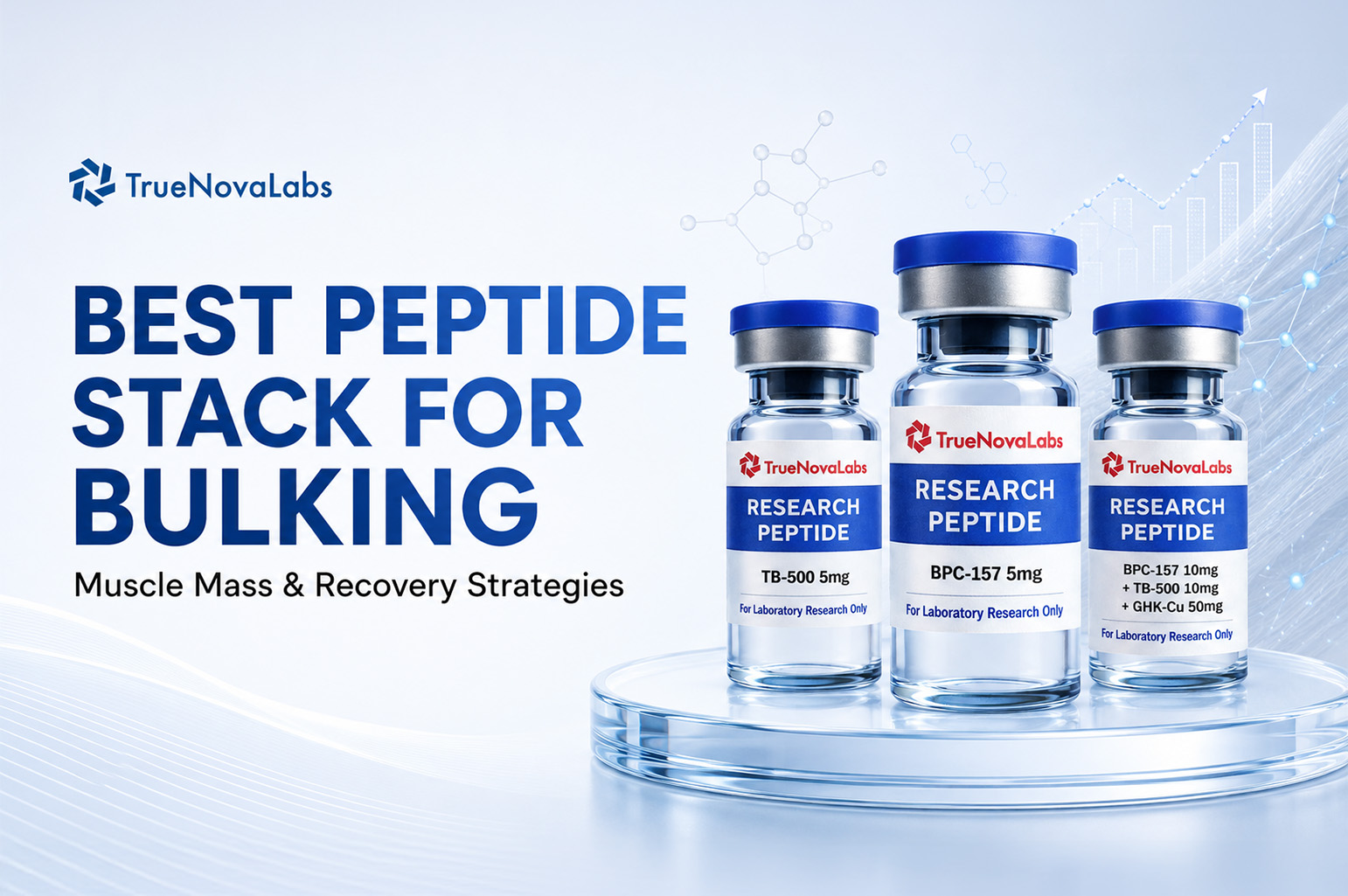
Interest in the best peptide stack for bulking continues to grow as researchers explore how multiple peptide pathways may interact to influence recovery, growth hormone signaling, and long-term muscle adaptation.
However, the concept of a peptide stack is often misunderstood. In research settings, stacking does not simply mean combining multiple compounds to accelerate results. Instead, it refers to studying how different peptides may affect complementary biological systems involved in muscle development and recovery.
Researchers are often interested in how peptide combinations influence:
- growth hormone pathways
- tissue repair processes
- recovery efficiency
- adaptation to training stress
- long-term body composition changes
In Canada, many peptides discussed in this context are supplied strictly for laboratory and educational purposes only, not as approved muscle-building products.
👉 Looking for research-grade peptides with verified purity and transparent sourcing? Explore the collection at SHOP ALL COMPOUNDS
This guide explains what bulking peptide stacks typically include, how common combinations differ, and what factors ultimately influence muscle growth outcomes.
What Bulking Peptide Stacks Typically Include
In research discussions, bulking stacks often combine peptides that target different biological pathways. Rather than focusing on a single mechanism, researchers may explore combinations that involve:
- growth hormone signaling
- recovery and repair pathways
- adaptation-related endocrine activity
- tissue regeneration processes
The rationale behind stacking is based on the idea that muscle development depends on multiple systems working together rather than one isolated pathway.
For example, one peptide may be studied primarily for growth hormone release, while another may be investigated for its role in tissue recovery.
This systems-based approach is one reason peptide stacking remains a popular area of research.

Popular Peptide Combinations for Muscle Mass
Several peptide combinations frequently appear in discussions surrounding muscle growth and recovery.
| Peptide Combination | Primary Research Focus |
|---|---|
| CJC-1295 + Ipamorelin | Growth hormone signaling |
| CJC-1295 + Ipamorelin + BPC-157 | Recovery and adaptation |
| CJC-1295 + Ipamorelin + TB-500 | Recovery and tissue repair |
| Growth hormone peptides + recovery peptides | Multi-pathway performance research |
CJC-1295 + Ipamorelin
This is one of the most commonly discussed combinations because both compounds influence growth hormone pathways through different mechanisms.
Researchers often study this stack to explore how coordinated GH signaling may affect recovery and adaptation.
Recovery-Oriented Combinations
Stacks that include BPC-157 or TB-500 are frequently discussed in research focused on tissue repair, recovery, and regeneration.
These peptides are generally studied for different reasons than GH-related compounds, which is why they are often explored together.
Bulking vs Lean Muscle Stacks
Not all peptide stacks are studied with the same objective.
Bulking-Oriented Research
Bulking-focused discussions often emphasize:
- recovery during higher training volumes
- anabolic signaling pathways
- long-term muscle development
Lean Muscle Research
Lean muscle approaches tend to focus on:
- body composition
- recovery efficiency
- minimizing unnecessary weight gain
- maintaining muscle quality
The distinction is important because gaining weight and gaining lean muscle are not necessarily the same outcome.
Researchers often evaluate peptide stacks according to the specific biological pathways being studied rather than categorizing them simply as “bulking” or “cutting.”

Recovery, Nutrition and Training Support
One of the most important concepts in muscle-building research is that peptides are never studied in isolation from other performance variables.
Muscle growth remains heavily influenced by:
Progressive Training
Mechanical tension and progressive overload remain fundamental drivers of adaptation.
Nutrition
Adequate protein and energy intake support muscle protein synthesis and recovery.
Sleep
Sleep quality strongly influences growth hormone release, recovery signaling, and nervous system restoration.
Recovery Management
Recovery capacity often determines how consistently training adaptations occur over time.
Even when peptide stacks are discussed, these foundational variables remain essential.
👉 Learn more about muscle growth and recovery research at SHOP ALL COMPOUNDS
Risks and Side Effects of Stacking Peptides
Because stacking involves multiple compounds, complexity increases.
Potential concerns discussed in research settings may include:
- overlapping signaling effects
- variability in biological response
- difficulty isolating outcomes
- increased handling requirements
Many risks are linked to external factors rather than the peptides themselves.
| Quality Factor | Why It Matters |
| Purity verification | Supports research reliability |
| Proper storage | Preserves peptide stability |
| Handling procedures | Reduces contamination risk |
| Supplier transparency | Improves consistency between batches |
Researchers frequently emphasize analytical verification methods such as:
- HPLC testing
- batch-specific COAs
- controlled storage conditions
In Canada, substances are regulated according to classification and intended use by organizations such as Health Canada.
Choosing a Stack Based on Your Goals
The concept of the “best peptide stack for bulking” depends entirely on the objective being studied. In other words, there is no single universal stack; researchers typically evaluate peptide combinations based on specific goals such as recovery, growth hormone signaling, tissue repair, or adaptation pathways.
If research focuses on:
- growth hormone pathways
- recovery signaling
- muscle adaptation
then GH-related peptides may be the primary focus.
If research focuses on:
- tissue repair
- recovery from training stress
- regeneration pathways
then recovery-oriented peptides may be more relevant.
The most effective stack is not necessarily the largest combination of compounds. Researchers often prioritize understanding how specific pathways interact rather than simply increasing the number of peptides involved.
FAQ – Peptide Stack For Bulking
What is a peptide stack for bulking?
A peptide stack refers to a combination of peptides studied together to explore how multiple biological pathways may influence muscle growth and recovery.
What peptides are commonly included in bulking stacks?
CJC-1295, Ipamorelin, BPC-157, and TB-500 are among the most frequently discussed.
Do peptide stacks directly build muscle?
No. Instead, researchers study them for how they may influence recovery, growth hormone signaling, and adaptation pathways.
Are larger stacks always better?
Not necessarily. In fact, additional compounds increase complexity and may make research outcomes more difficult to interpret.
Are peptide stacks approved in Canada?
Many peptides are classified as research compounds and are not approved therapeutic products unless regulated under pharmaceutical frameworks.
Conclusion
Interest in the best peptide stack for bulking reflects a growing understanding that muscle growth involves multiple biological systems. As a result, researchers often examine peptide combinations in relation to recovery, growth hormone signaling, tissue repair, and adaptation pathways.
Researchers study peptide combinations for how they may influence:
- growth hormone signaling
- recovery pathways
- tissue repair
- adaptation to training stress
Rather than acting as direct muscle-building agents, peptide stacks are explored as tools for understanding how these systems interact.
For researchers in Canada, reliable outcomes depend on:
- verified peptide quality
- proper storage and handling
- realistic expectations
- strong training and nutrition foundations
Explore Research-Grade Peptides
Looking for peptides supported by verified purity, transparent sourcing, and consistent quality standards?
👉 Explore the full collection at SHOP ALL COMPOUNDS
Disclaimer:
This content is provided by True Nova Labs for educational and research purposes only. It is not intended to diagnose, treat, cure, or prevent any disease, nor to provide medical or legal advice.



3 Comments
Ethan Cooper
Really informative article on peptide stacks for bulking and the different roles each peptide may play in recovery, growth signaling, and performance adaptation. I liked that the article explained the reasoning behind stacking instead of making it sound like more compounds automatically lead to better results. The focus on structure and long-term consistency was especially valuable.
Madison Turner
Great read overall. There’s a lot of confusion online about peptide stacking, so I appreciated the balanced explanation of how different peptides may complement each other through separate recovery and growth-related pathways. It definitely helped make a complex topic much easier to understand.
Carter Wilson
Very well structured and easy to follow. I especially liked the discussion around realistic expectations and the importance of training, nutrition, and recovery alongside any bulking-focused peptide strategy. It would be interesting to see a future article comparing common bulking stacks with recovery-focused stacks side by side.