
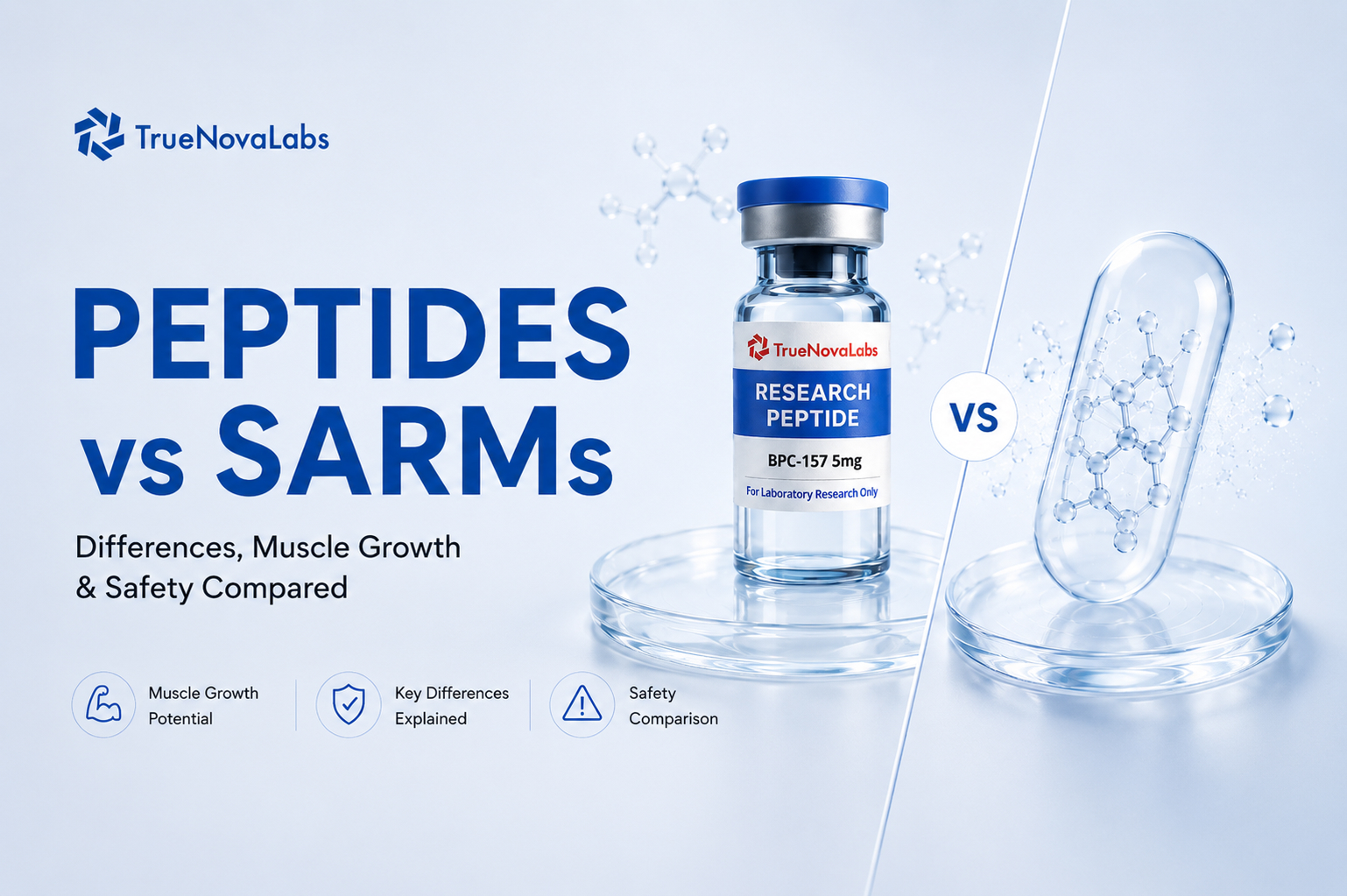
The comparison of peptides vs SARMs has become a common topic in fitness, bodybuilding, and performance research. Both categories are often discussed in relation to muscle growth, recovery, body composition, and athletic performance, but they are not the same. They work through different biological pathways, carry different safety concerns, and face different legal and regulatory considerations.
For researchers, educators, and informed buyers in Canada, understanding these differences is essential. SARMs are specifically identified by Health Canada as unauthorized drugs not approved for any use in Canada, and they may carry serious risks such as liver damage, heart attack, and stroke.
At True Nova Labs, we focus on research-driven education and high-quality research peptide information.
What Are Peptides?
Peptides are short chains of amino acids that act as signaling molecules in biological systems. In the body, naturally occurring peptides help regulate many processes, including hormone signaling, immune communication, tissue repair, metabolism, appetite regulation, and cellular response.
In research settings, synthetic or modified peptides may be studied to better understand:
- Cellular signaling pathways
- Growth hormone-related mechanisms
- Recovery and tissue repair models
- Metabolic activity
- Inflammation-related pathways
- Body composition research
Examples commonly discussed in research contexts include BPC-157, TB-500, CJC-1295, Ipamorelin, GHRP peptides, and other peptide analogues. However, not all peptides have the same purpose. Some are studied for recovery, some for endocrine signaling, and others for metabolic or immune-related pathways.
Researchers should not treat peptides as one single category with one single effect. Their activity depends on structure, receptor target, stability, route of study, and the specific model under investigation.
👉 Learn more about performance and recovery peptides at SHOP ALL COMPOUNDS

How SARMs Work
SARMs stands for Selective Androgen Receptor Modulators. These compounds are designed to interact with androgen receptors, which are involved in testosterone-related signaling. The original goal behind SARMs research was to explore compounds that could support anabolic activity in specific tissues, such as muscle or bone, while potentially reducing some androgenic effects associated with traditional anabolic steroids.
In theory, researchers describe SARMs as “selective” because they are intended to target certain androgen receptors more specifically than anabolic steroids. In practice, however, this does not mean SARMs are risk-free or fully understood.
Common SARMs discussed online include:
- Ostarine / MK-2866
- Ligandrol / LGD-4033
- RAD-140 / Testolone
- Andarine / S4
- YK-11
Health Canada states that SARMs are not authorized in Canada for any use and has not reviewed them for safety, effectiveness, or quality. The U.S. FDA has also warned that companies often market SARMs illegally for muscle gain and performance enhancement, even though regulators have not approved them and serious safety concerns remain.
How Peptides Differ From SARMs
The biggest difference in peptides vs SARMs is their mechanism of action.
SARMs primarily work through androgen receptor modulation. Their activity is connected to testosterone-like anabolic signaling. This is why they are commonly discussed in relation to muscle growth, strength, and physique enhancement.
Peptides, on the other hand, may work through many different biological pathways depending on the peptide. Some peptides interact with growth hormone-releasing pathways, while others are studied for tissue repair, inflammation signaling, metabolic regulation, or immune response.
Peptides vs SARMs: Mechanism Comparison
| Category | Peptides | SARMs |
|---|---|---|
| Basic structure | Short amino acid chains | Non-steroidal synthetic compounds |
| Main pathway | Depends on peptide type | Androgen receptor modulation |
| Common research focus | Recovery, signaling, metabolism, GH pathways, tissue repair | Muscle growth, strength, body composition |
| Hormonal impact | Varies by peptide | May affect androgen-related pathways |
| Regulatory concern | Depends on compound and use | Not authorized for any use in Canada |
| Sport status | Many peptide hormones and growth factors are prohibited in sport | SARMs are prohibited in sport |
This distinction matters because online fitness content often groups peptides and SARMs together as “performance compounds.” Scientifically, they are very different categories.
Muscle Growth and Recovery Comparison
When researchers compare peptides vs SARMs for muscle growth, they usually discuss SARMs for their direct relationship with androgen receptor activity. Because androgen signaling strongly links to muscle protein synthesis, online sellers often promote SARMs as muscle-building compounds. However, safety, purity, and legality remain major concerns for these products.
Peptides are usually discussed in a broader way. Some peptide categories are studied for indirect support of muscle growth and recovery through mechanisms such as:
- Growth hormone release models
- IGF-1-related signaling
- Tissue repair pathways
- Collagen and connective tissue research
- Inflammation response
- Sleep and recovery-related signaling
For example, researchers often study growth hormone secretagogue peptides for how they influence GH-related signaling. They usually discuss other peptides, such as BPC-157 or TB-500, in tissue repair and recovery research models rather than direct anabolic muscle-building models.
Which Is More Direct for Muscle Growth?
SARMs are generally more directly associated with androgenic/anabolic muscle growth mechanisms. Peptides are often more pathway-specific and may be studied for recovery, repair, endocrine signaling, or metabolic regulation.
However, “more direct” does not mean safer. In Canada, regulators classify SARMs as unauthorized drugs, and Health Canada has warned that bodybuilding products containing SARMs may pose serious health risks.
👉 Learn more about performance and recovery peptides at SHOP ALL COMPOUNDS

Side Effects and Safety Risks
Safety is one of the most important parts of the peptides vs SARMs discussion.
SARMs Safety Risks
Online sellers often promote SARMs as a safer alternative to anabolic steroids. This claim misleads consumers. Regulatory agencies have warned that SARMs may carry serious risks.
Potential risks discussed by regulators and medical literature include:
- Liver injury
- Hormonal suppression
- Cardiovascular concerns
- Heart attack risk
- Stroke risk
- Unknown long-term effects
- Product contamination or mislabeling
Health Canada warns that SARMs have not been reviewed for safety, effectiveness, or quality. Moreover, they may pose serious risks such as heart attack, stroke, and liver damage. In addition, published medical reviews have reported adverse events, especially drug-induced liver injury, associated with SARM agonist use.
Peptide Safety Risks
Peptide safety depends heavily on the specific compound, purity, source, and intended research model. Peptides are not automatically safe simply because they are made of amino acids. Some peptides may influence hormone pathways, immune activity, cardiovascular function, appetite signaling, or cell communication.
Potential peptide-related research concerns may include:
- Hormonal disruption depending on peptide type
- Injection-site or formulation-related issues in experimental contexts
- Unknown long-term effects for many compounds
- Purity and contamination risks
- Incorrect labeling from unreliable sources
- Misuse outside controlled research settings
In Canada, many products marketed for bodybuilding may contain hidden or unauthorized drug ingredients, especially when sold online or through unverified retailers. Health Canada advises consumers to be cautious with bodybuilding products because some contain unapproved drugs or hidden ingredients not reviewed for safety, efficacy, and quality.
Legal and Regulatory Considerations in Canada
For the Canadian market, legal and regulatory accuracy is especially important.
SARMs in Canada
Health Canada has clearly stated that SARMs are drugs not authorized in Canada for any use. As a result, they have not been approved by Health Canada and have not undergone review for safety, effectiveness, or quality.
This is a major distinction for consumers, researchers, and businesses. Products marketed as “supplements” may still contain unauthorized drug ingredients.
Peptides in Canada
Peptide regulation is more complex because regulators do not treat peptides as one single legal category. In practice, they may regulate some peptides as prescription drugs, study others in research contexts, and classify others under different frameworks depending on claims, intended use, formulation, and distribution.
For this reason, peptide-related content should avoid broad claims such as “legal,” “safe,” or “approved” without specifying the exact compound and context.
Competitive Sport Considerations
Athletes should be especially cautious. The World Anti-Doping Agency’s Prohibited List includes categories such as anabolic agents, peptide hormones, growth factors, related substances, and hormone/metabolic modulators. Global DRO also provides athletes in Canada with information about prohibited status based on the current WADA Prohibited List.
In simple terms: both SARMs and many peptide-related compounds may create anti-doping risks.
Which Option Fits Different Fitness Goals?
The question “Which is better: peptides or SARMs?” is too broad. A more accurate question is: Which category is being studied for which biological pathway?
For Muscle Growth Research
SARMs are more directly connected to androgen receptor activity and anabolic signaling. However, they also carry major safety and regulatory concerns, especially in Canada.
For Recovery Research
Certain peptides may be more relevant in tissue repair, connective tissue, inflammation, or recovery-related research models. However, researchers usually do not study these peptides in the same way as SARMs because their mechanisms are not primarily androgen receptor-based.
For Body Composition Research
Both categories may appear in body composition discussions, but through different mechanisms. SARMs are often discussed through lean mass and androgen signaling. Peptides may be studied through GH-related pathways, appetite signaling, metabolism, or recovery support, depending on the compound.
For Athletes
Athletes should use extreme caution with both categories. For instance, WADA prohibits SARMs in sport and also bans many peptide hormones, growth factors, and related compounds.
For Research Buyers
Research buyers should focus on:
- Compound identity
- Third-party testing
- Certificate of analysis
- Batch transparency
- Clear research-use positioning
- No unsupported medical or performance claims
- Compliance with Canadian regulations
For research-focused peptide education and product information, visit TrueNovaLabs.com to explore resources built around quality, transparency, and responsible research use.
Peptides vs SARMs: Key Takeaways
The debate around peptides vs SARMs is often oversimplified online. SARMs and peptides are not interchangeable, and they should not be marketed as casual fitness supplements.
SARMs are synthetic compounds designed to influence androgen receptor activity. Although researchers often discuss them in relation to muscle growth and strength, Health Canada states that SARMs are not authorized for any use in Canada and may carry serious health risks.
Peptides are a broad category of amino acid-based signaling compounds. Some are studied for recovery, hormone signaling, tissue repair, metabolism, or immune communication. However, peptide safety and legality depend on the specific compound, intended use, and regulatory context.
For readers in Canada, the most responsible approach is to avoid hype-driven claims and focus on research quality, accurate labeling, transparent sourcing, and regulatory awareness.
To continue learning about research peptides, compound mechanisms, and responsible sourcing standards, visit TrueNovaLabs.com.
Read Peptides for Bodybuilding: Muscle Growth, Recovery & Performance Explained to learn more about muscle growth, recovery, performance potential, and safety considerations.
FAQ – Peptides vs SARMs
Are peptides the same as SARMs?
No. Peptides are short chains of amino acids that may act as biological signaling molecules. SARMs are synthetic compounds designed to interact with androgen receptors. They differ in structure, mechanism, research purpose, and regulatory status.
Are SARMs legal in Canada?
Health Canada states that SARMs are drugs and has not authorized them for any use in Canada. Additionally, Health Canada has not reviewed them for safety, effectiveness, or quality.
Are peptides safer than SARMs?
Not automatically. Peptide safety depends on the specific peptide, purity, source, formulation, and research context. Some peptides may influence hormone, immune, metabolic, or cardiovascular pathways. They should not be described as universally safe.
Which is better for muscle growth: peptides or SARMs?
SARMs interact more directly with androgen receptor activity and anabolic signaling. Researchers may study peptides for indirect pathways such as growth hormone signaling, tissue repair, recovery, or metabolism. However, SARMs carry serious safety and regulatory concerns.
Can athletes use peptides or SARMs?
Athletes should use extreme caution. For example, WADA prohibits SARMs in sport, and it also prohibits many peptide hormones, growth factors, and related substances. In Canada, athletes can use Global DRO to check a compound’s prohibited status.
Why are SARMs considered risky?
SARMs may cause or contribute to liver injury, hormonal disruption, cardiovascular risks, and unknown long-term effects. Health Canada has warned that bodybuilding products containing SARMs may pose serious risks, including heart attack, stroke, and liver damage.
What should research buyers look for when evaluating peptides?
Research buyers should look for clear compound identity, transparent sourcing, third-party testing, batch-specific certificates of analysis, and research-use-only positioning. They should avoid unsupported claims about human performance, disease treatment, or guaranteed results.
Final Thoughts
When comparing peptides vs SARMs, readers should understand that these compounds do not belong to the same category. Specifically, SARMs work mainly through androgen receptor modulation, and people commonly discuss them in relation to muscle growth. However, SARMs also carry serious safety and regulatory concerns, especially in Canada.
Peptides are broader and more mechanism-specific. Depending on the compound, they may be studied for recovery, tissue repair, metabolic signaling, or hormone-related pathways. However, peptides should still be evaluated carefully based on purity, research context, testing, and compliance.
For researchers and informed buyers, the best approach is to focus on accurate information, transparent sourcing, and responsible research use instead of hype-driven claims.
To explore high-quality research peptide information and sourcing standards, visit True Nova Labs
Disclaimer:
This content is provided by True Nova Labs for educational and research purposes only. It is not intended to diagnose, treat, cure, or prevent any disease, nor to provide medical or legal advice.




3 Comments
Mitchell Ross
Really informative comparison between peptides and SARMs. I liked that the article focused on how differently these compounds interact with the body rather than simply comparing muscle-building potential. The discussion around recovery, hormonal signaling, and long-term considerations was especially helpful.
Lauren Davis
Great read overall. There’s a lot of confusion online because peptides and SARMs are often discussed together, so I appreciated the balanced explanation of their distinct mechanisms and intended uses. It definitely helped make a complex topic easier to understand.
Connor Phillips
Very well structured and easy to follow. I especially liked how the article discussed the trade-offs between muscle growth, recovery support, and overall safety considerations instead of presenting a one-sided argument. It would be interesting to see a future article comparing common peptide categories with popular SARMs in more detail.