
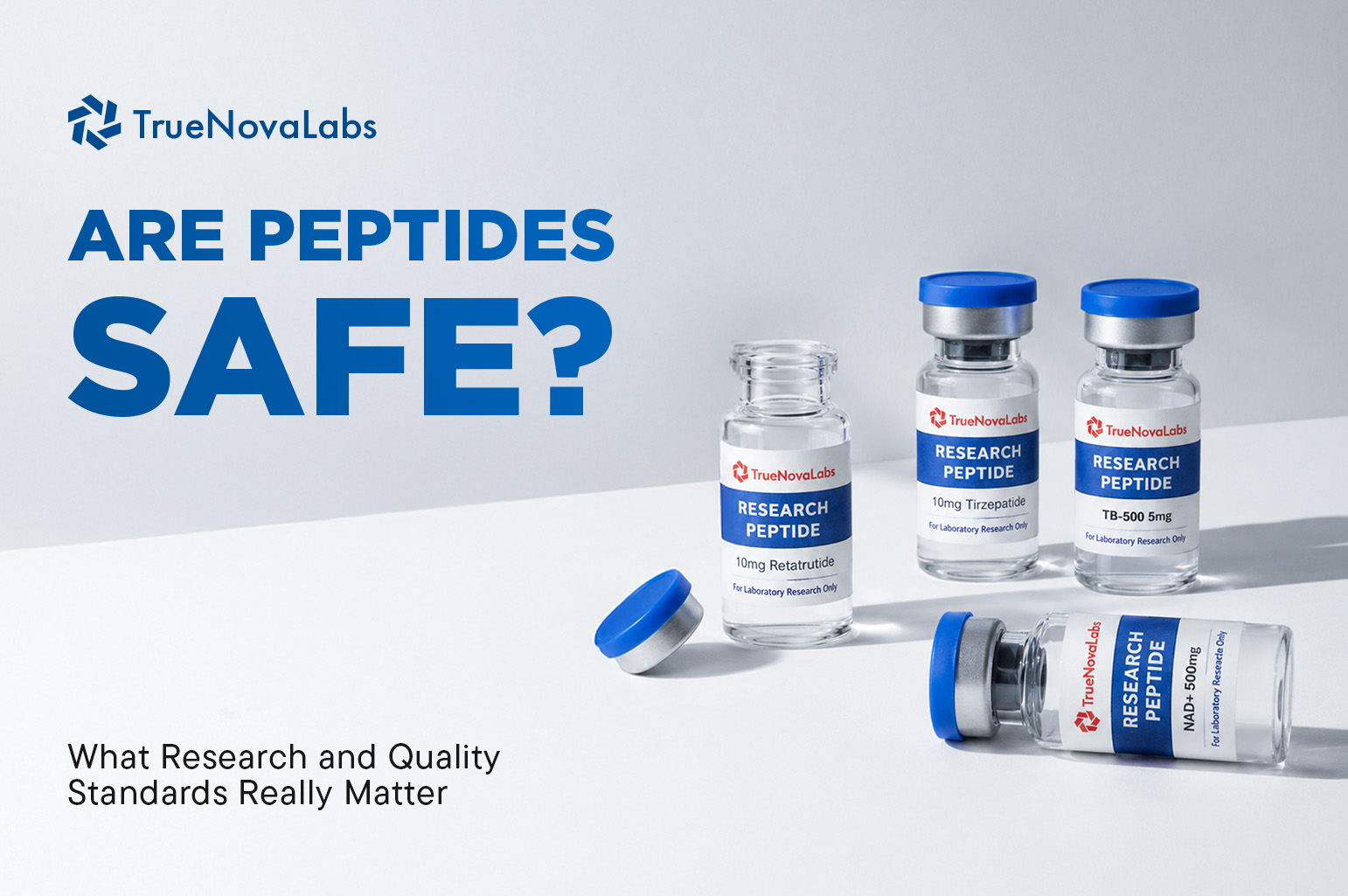
As peptides continue to gain attention in research and biotechnology, one question appears repeatedly: are peptides safe?
The answer is more complex than a simple yes or no. Peptide safety depends on several important factors, including the type of peptide being studied, its purity level, how it is stored and handled, the intended research use, the transparency of the supplier, and the overall research conditions. Even small differences in quality control or storage practices can influence stability and research reliability.
In Canada, most peptides available online are sold strictly for laboratory and educational purposes only, not as approved therapeutic products. Understanding this distinction is essential when evaluating safety and quality.
Looking for research peptides backed by transparent sourcing and verified quality standards? Explore the collection at True Nova Labs. Overall, this guide explains what determines peptide safety, why quality testing matters, and how researchers can reduce risk through responsible sourcing and handling practices.
What Determines Safety?
Peptides are biologically active compounds that interact with receptors and signaling pathways throughout the body. Therefore, safety is influenced by more than just the peptide itself.
Key Factors That Affect Safety
| Factor | Why It Matters |
|---|---|
| Purity | Impurities may affect biological responses |
| Storage Conditions | Poor storage may accelerate degradation |
| Supplier Transparency | Reliable documentation supports consistency |
| Handling Procedures | Contamination risks increase with improper technique |
| Peptide Type | Different peptides interact with different systems |
A high-quality peptide handled properly in controlled research conditions presents a very different situation compared to poorly sourced or improperly stored products.
Importantly, a key principle is that peptide safety depends heavily on quality control and research practices.
Research vs Medical Use
| Category | Research Peptides | Medical (Pharmaceutical) Peptides |
|---|---|---|
| Intended Use | Laboratory and scientific research | Approved medical and therapeutic use |
| Regulatory Status | Typically labeled “for research use only” | Undergo clinical evaluation and approval |
| Human Consumption | Not approved for human consumption | Authorized under regulated medical frameworks |
| Oversight | Research-use framework | Regulated by Health Canada |
| Distribution Context | Sold for educational and laboratory purposes | Require formal approval, oversight, and regulated access |
The same peptide compound may exist in both categories depending on its regulatory status and intended use, which is why context plays a major role when discussing peptide safety.
Risks of Low-Quality Peptides
One of the biggest safety concerns in peptide research, therefore, involves low-quality or poorly verified products.
Potential Problems Include
- contamination
- incorrect peptide sequences
- synthesis impurities
- degradation from improper storage
- inaccurate labeling
These issues may:
- affect biological responses
- reduce research reliability
- create inconsistent experimental outcomes
Why Purity Matters
Even small impurities may influence:
- receptor interactions
- signaling pathways
- study reproducibility
As a result, peptide purity testing has become a major focus in research environments.
Importance of Testing
Quality verification is one of the most important parts of responsible peptide research.
Common Testing Methods
| Testing Method | Purpose |
|---|---|
| HPLC (High-Performance Liquid Chromatography) | Measures purity and identifies impurities |
| COA (Certificate of Analysis) | Provides batch-specific testing information |
| Third-Party Verification | Adds independent quality confirmation |
What Researchers Should Look For
- batch-specific COAs
- transparent reporting
- third-party testing
- clear product labeling
Reliable suppliers, therefore, prioritize documentation and analytical transparency rather than exaggerated claims.
Explore research-grade peptides supported by verified quality standards at True Nova Labs
Safe Handling Practices
Even high-purity peptides can become unreliable if handled incorrectly.
Best Practices Include
- storing peptides under stable temperature conditions
- minimizing light exposure
- using sterile handling techniques
- avoiding contamination during reconstitution
- following proper labeling procedures
Storage Considerations
- Lyophilized peptides are generally more stable
- Reconstituted peptides require more controlled storage conditions
Proper handling helps preserve:
- peptide integrity
- stability
- research consistency
Who Should Avoid Peptides?
Research peptides are not intended for:
- casual consumer use
- unregulated experimentation
- therapeutic self-administration
In Canada, therefore, research peptides are supplied strictly within a research-use framework.
Products labeled:
- “not for human consumption”
- “for laboratory use only”
should be treated accordingly.
Therefore, anyone seeking medically approved peptide-based therapies should consult qualified healthcare professionals and regulated pharmaceutical channels.
FAQ – Are peptides safe?
Are peptides safe in research settings?
Safety depends on factors such as purity, handling, storage, supplier quality, and the specific peptide being studied.
Why are low-quality peptides risky?
As a result, impurities, contamination, and inaccurate synthesis may affect biological signaling and reduce research reliability.
What does HPLC testing do?
In particular, HPLC helps measure peptide purity and identify unwanted byproducts or contaminants.
Why are research peptides labeled “not for human consumption”?
Because they are intended strictly for laboratory and educational use and are not approved therapeutic products.
How can researchers reduce peptide-related risks?
By choosing transparent suppliers, verifying testing documentation, and following proper storage and handling practices.
Conclusion
So, are peptides safe?
The better question is: Are the peptides properly tested, stored, and sourced responsibly?
Peptide safety depends heavily on product quality, purity verification, proper storage conditions, supplier transparency, and responsible research practices. Even well-known peptides can become unreliable when sourced from unverified suppliers or handled improperly in research environments.
For researchers in Canada, understanding both scientific and regulatory considerations is essential for maintaining high standards and reliable outcomes.
Explore Research-Grade Peptides
Looking for research peptides supported by transparent sourcing and verified quality standards? Explore the full collection at True Nova Labs
Disclaimer:
This content is provided by True Nova Labs for educational and research purposes only. It is not intended to diagnose, treat, cure, or prevent any disease, nor to provide medical or legal advice.



3 Comments
Sarah Mitchell
Very balanced and informative article about peptide safety and research quality standards. I liked that the post focused on proper testing, transparency, and lab practices instead of only discussing benefits. The section about third-party verification was especially helpful.
Jason Cooper
Good overview of why quality standards matter so much in peptide research. A lot of information online feels overly promotional, so it was refreshing to read something more research-focused and practical. Curious if stricter testing standards will become more common across the industry in the next few years.
Natalie Brooks
I appreciate how the article explains peptide safety in a straightforward and educational way. The emphasis on purity testing, sourcing, and informed research makes the content feel much more trustworthy. It definitely seems like more people in Canada are paying attention to research quality now instead of just marketing claims.