
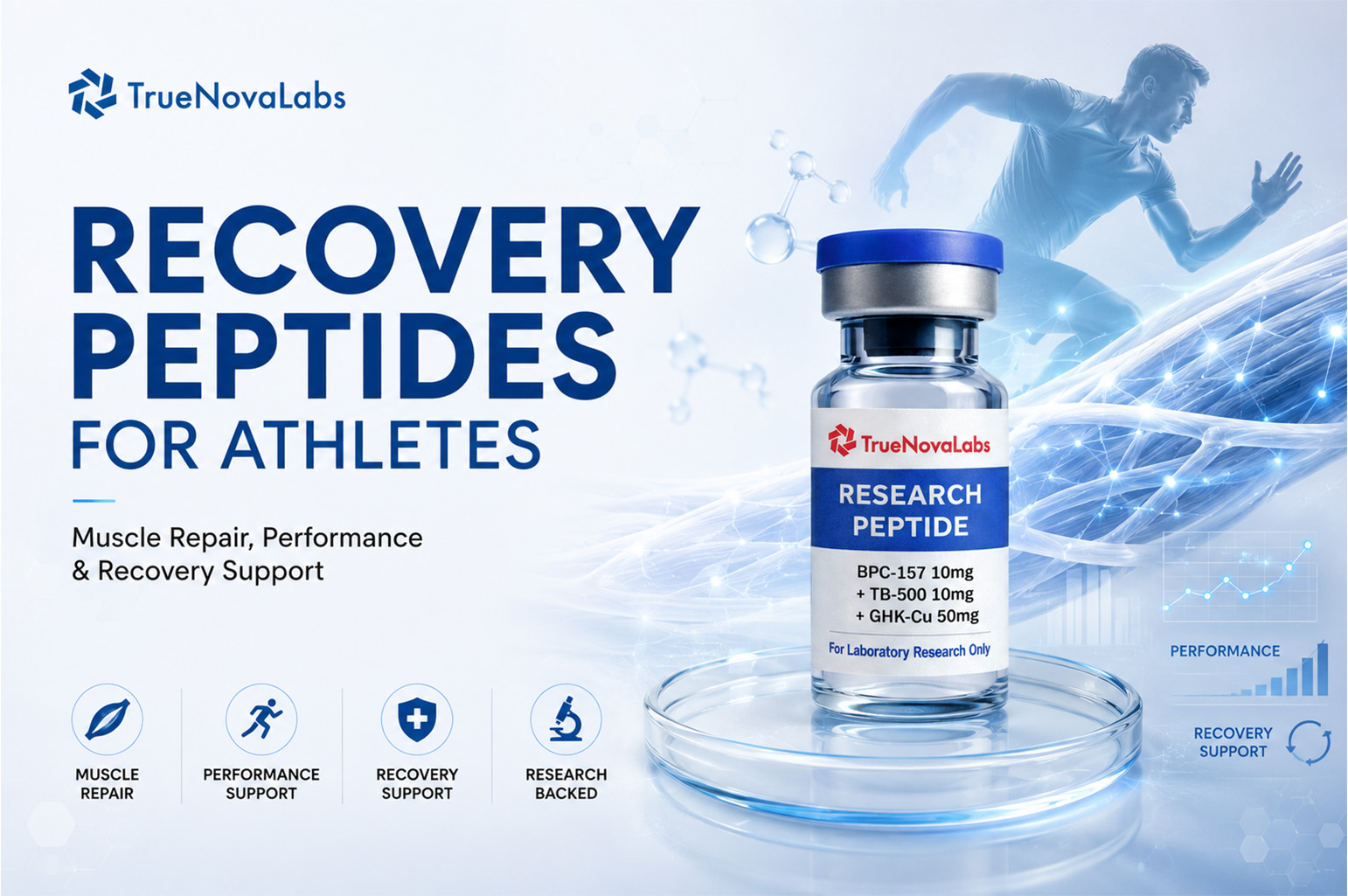
In modern sports science, recovery is no longer viewed as a passive process—it is an active, measurable component of performance. This is where interest in recovery peptides for athletes has grown, particularly in research exploring how the body repairs tissue, adapts to stress, and maintains long-term performance capacity.
Rather than focusing solely on muscle growth, recovery peptides are studied for how they influence cellular repair, inflammation response, and signaling pathways involved in adaptation.
In Canada, most peptides referenced in this context are supplied strictly for laboratory and educational purposes only. Therefore, they should not be described as approved performance-enhancing products.
👉 Looking for research-grade peptides with verified purity and transparent sourcing? Explore available options here SHOP ALL COMPOUNDS
This guide explains how recovery peptides are studied, which compounds are commonly discussed, and how they fit into a broader performance and recovery system. In addition, it highlights why recovery research should be interpreted carefully within laboratory, educational, and regulatory contexts.
Why Recovery Matters for Athletes
Performance is not determined only by training intensity—it is shaped by how effectively the body recovers between sessions.
During intense training, the body undergoes several biological changes, including micro-damage to muscle fibers, stress on connective tissue, fluctuations in hormonal balance, and inflammatory responses.
Recovery is the process through which the body repairs and adapts, leading to improved performance over time.
If recovery is insufficient, athletes may experience:
- reduced performance output
- increased fatigue
- higher risk of injury
This is why recovery is now considered a critical variable in athletic performance, not just a secondary factor.

Popular Recovery Peptides Used by Athletes
| Peptide | Research Focus | Recovery Context |
|---|---|---|
| BPC-157 | Tissue repair models | Commonly studied in muscle, tendon, and ligament recovery research |
| TB-500 (Thymosin Beta-4) | Cell migration and regeneration | Explored for processes involved in healing and recovery |
| CJC-1295 | Growth hormone signaling | Studied for recovery support through GH-related pathways |
| Ipamorelin | Growth hormone release | Researched for its role in recovery, repair, and adaptation signaling |
These peptides differ in function:
- some focus on direct repair processes
- others influence hormonal pathways that support recovery
Understanding these differences is essential when interpreting research.
How Peptides Support Muscle Repair
From a research perspective, recovery peptides are studied for how they interact with biological processes involved in repair and adaptation.
These processes may include:
- cellular regeneration
- collagen synthesis
- inflammatory response modulation
- growth factor signaling
Rather than directly “healing” tissue, researchers explore peptides for how they may support the environment where repair occurs.
This distinction is important. Recovery is not a single event—it is a multi-stage process involving multiple systems.

Recovery Benefits After Intense Training
In research discussions, interest in recovery peptides often relates to how they may influence:
- speed of recovery between training sessions
- consistency of performance output
- adaptation to repeated stress
These effects are not immediate. Instead, they develop over time as the body responds to consistent signaling and recovery conditions.
Athletes who manage recovery effectively may experience:
- improved training consistency
- reduced downtime between sessions
- more stable performance over time
However, these outcomes depend on multiple variables—not just peptide-related factors.
Safety, Risks & Athletic Considerations
Because peptides are biologically active compounds, safety considerations are essential.
Most risks in research environments are linked to:
- purity and quality
- contamination during preparation
- improper storage
- inconsistent sourcing
Peptides are sensitive molecules, and degradation can affect both their stability and behavior.
For athletes, there are additional considerations:
- regulatory compliance in competitive sports
- differences between research use and approved substances
- long-term impact on performance systems
In Canada, organizations such as Health Canada regulate substances based on classification and intended use, which reinforces the importance of context.
👉 For consistent quality and verified sourcing, explore research peptides here SHOP ALL COMPOUNDS
Recovery Strategies Beyond Peptides
Peptides are only one part of the recovery equation.
Effective recovery strategies also include:
- structured rest periods
- proper nutrition and protein intake
- sleep quality optimization
- stress management
These factors influence the same biological systems that peptides are studied for. Therefore, without them, even the most advanced approaches cannot produce meaningful results. Ultimately, this reinforces a key principle: recovery is a system, not a single solution.
Want to understand how peptides are studied in relation to muscle growth, performance, and recovery? Read our full guide: Peptides for Muscle Growth: Benefits, Performance & What to Expect to explore the key mechanisms, research context, and realistic expectations.
FAQ
What are recovery peptides for athletes?
They are peptides studied for how they may influence tissue repair, recovery processes, and adaptation to training stress. In other words, researchers examine them to better understand how biological repair and performance-related recovery pathways respond after physical stress.
Do recovery peptides heal injuries directly?
No. Instead, they are studied for how they may support biological processes involved in repair.
Which peptides are most commonly discussed?
BPC-157, TB-500, CJC-1295, and Ipamorelin are frequently referenced in research.
Are these peptides safe for athletes?
Safety depends on quality, handling, and regulatory context.
Are recovery peptides approved in Canada?
Regulators classify many of them as research peptides, and pharmaceutical frameworks must regulate them before they qualify as approved therapeutic products.
Conclusion
The study of recovery peptides for athletes reflects a deeper understanding of how the body adapts to stress and training. More importantly, it also highlights how recovery, repair, and adaptation pathways are often interconnected in performance-related research.
Rather than focusing only on performance output, modern research emphasizes:
- recovery efficiency
- tissue repair
- long-term adaptation
Peptides are explored as part of this system—not as standalone solutions.
For athletes and researchers in Canada, reliable outcomes depend on:
- high-quality sourcing
- proper storage and handling
- understanding biological mechanisms
- integrating recovery strategies holistically
Explore Research-Grade Peptides
If you’re looking for peptides supported by verified purity, transparent sourcing, and consistent quality standards, explore the full collection here SHOP ALL COMPOUNDS
Disclaimer:
This content is provided by True Nova Labs for educational and research purposes only. It is not intended to diagnose, treat, cure, or prevent any disease, nor to provide medical or legal advice.




3 Comments
Logan Pierce
Really informative article on recovery peptides for athletes. I liked how the focus was placed on tissue repair, recovery cycles, and adaptation rather than treating peptides like instant performance boosters. The explanation around recovery signaling and consistency in training was especially valuable.
Madison Clarke
Great read overall. A lot of content online tends to oversimplify recovery peptides, so I appreciated the balanced discussion about how they may support recovery pathways without replacing proper training, nutrition, and rest. That made the article feel much more credible and realistic.
Eric Bennett
Very easy to follow and well structured. I especially liked the discussion about how different peptides may support different aspects of recovery and adaptation in athletes. It would be interesting to read a future article comparing recovery-focused peptides versus performance-focused compounds in more detail.