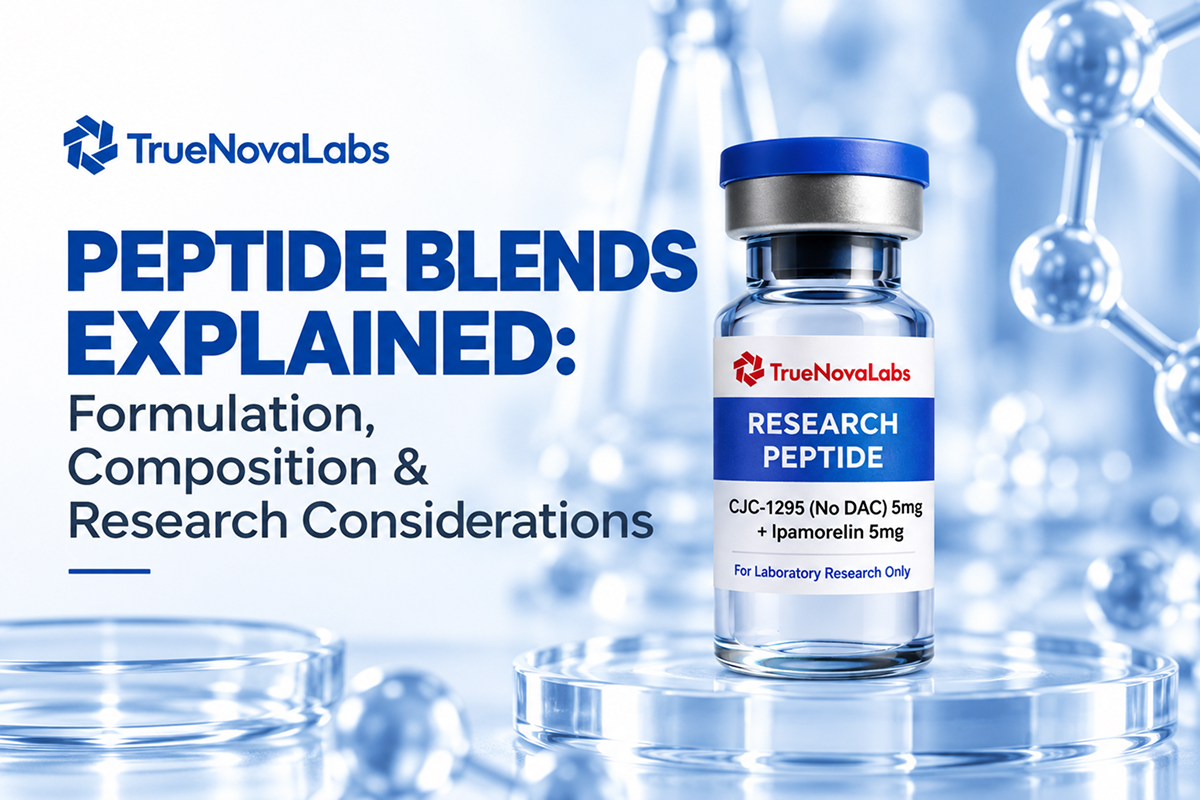
Peptide blends explained from a research perspective require more than listing several compounds in one product. A blend contains multiple peptides within one formulation, so researchers must consider identity, composition, stability, compatibility, and analytical data. Moreover, the finished blend may behave differently from each peptide studied separately.
👉 Explore research-focused peptide resources and learn more about current peptide science at True Nova Labs
For Canadian researchers, this distinction matters when evaluating laboratory materials. Scientific literature can describe individual peptides, while a specific blend requires its own composition and quality assessment. Therefore, researchers should treat a blend as a defined research material rather than assuming that evidence for each component applies to the final formulation.
What Are Peptide Blends?
Peptide blends are formulations containing two or more peptide compounds within the same research material. Depending on the formulation, the peptides may remain together in a dry form or exist in a prepared solution. However, “blend” does not describe one specific manufacturing method.
Researchers may encounter blends designed around:
- Related biological pathways
- Complementary research targets
- Different mechanisms within the same research area
- Multiple peptides for comparative laboratory investigation
- Formulations intended for a specific experimental model
For example, a blend may contain peptides associated with mitochondrial research, tissue biology, or signalling pathways. Nevertheless, shared research interests do not prove that the components interact in a beneficial or predictable way.
A blend therefore has two levels of identity. First, researchers need to identify each individual peptide. Second, they need to characterize the complete formulation. Consequently, both component-level and blend-level information matter.
👉 Learn more about performance and recovery peptides at SHOP ALL COMPOUNDS

How Are Peptide Blends Different From Peptide Combinations?
The terms peptide blend and peptide combination often appear together, but they describe different concepts.
A peptide combination generally refers to an experimental study in which researchers evaluate two or more peptides together. In contrast, a peptide blend usually describes a formulated material containing multiple peptides in the same preparation.
| Feature | Peptide Combination | Peptide Blend |
|---|---|---|
| Main meaning | Experimental co-evaluation | Multi-peptide formulation |
| Research focus | Biological interaction | Composition and formulation |
| Components | May be tested separately | Usually contained in one preparation |
| Key question | What happens when compounds are studied together? | What does the finished material contain? |
| Evidence requirement | Combination-specific research | Component and formulation characterization |
Therefore, research on a combination does not automatically validate a commercial blend. Likewise, a well-characterized blend does not prove that its components produce a synergistic response.
This distinction matters when researchers interpret published studies. If a paper evaluates two peptides separately, researchers should not describe those findings as evidence for a blended formulation.
How Are Multiple Peptides Formulated Into a Blend?
Formulating multiple peptides requires attention to compatibility, concentration, solubility, and stability. First, formulators need to determine whether the peptides can coexist without unwanted chemical or physical changes.
For example, different peptides may respond differently to pH, temperature, ionic conditions, concentration, or excipients. Moreover, one peptide can potentially influence another through interactions within the formulation.
Common formulation considerations include:
- Peptide identity and purity
- Relative composition of each component
- Solubility
- pH compatibility
- Buffer and excipient compatibility
- Physical stability
- Chemical degradation
- Aggregation risk
- Container interactions
Dry or lyophilized formulations can have different stability characteristics from aqueous preparations. However, lyophilization does not eliminate every stability concern. Researchers may still need to evaluate reconstitution behaviour, aggregation, degradation, and storage conditions.
In addition, batch or lot information can connect analytical results with a specific formulation. As a result, documentation becomes particularly important when a blend contains several peptides.
What Factors Affect the Stability and Composition of a Peptide Blend?
Stability is a major consideration when several peptides share one formulation. Each peptide has its own sequence and chemical characteristics, so factors that destabilize one component may affect another differently.
Temperature, pH, concentration, oxidation, moisture, agitation, and surface interactions can influence peptide stability. Furthermore, peptides can undergo chemical changes such as oxidation, deamidation, hydrolysis, or disulfide-related reactions when their structures allow those processes.
Physical changes can also occur. For example, peptide molecules may associate and form aggregates under certain conditions. Consequently, a blend can experience changes in both chemical composition and physical state during storage.
Researchers should therefore consider:
- Identity of every peptide
- Relative amount of each component
- Purity and impurity profile
- Potential degradation pathways
- Aggregation or precipitation
- Storage environment
- Container compatibility
- Stability over the research period
Moreover, researchers should not assume that the stability profile of each individual peptide predicts the stability of the complete blend.
👉 Learn more about performance and recovery peptides at SHOP ALL COMPOUNDS
How Are Peptide Blends Characterized and Quality-Checked?
A reliable peptide blend requires more than a total purity number. Researchers should determine whether analytical data support the identity and composition of individual components.
High-performance liquid chromatography can help evaluate chromatographic purity and related components. Meanwhile, mass spectrometry can support molecular-mass and identity assessment. Depending on the formulation, researchers may also use additional methods to investigate aggregation, impurities, concentration, or degradation.
A useful quality review can include:
| Quality Area | What Researchers Can Examine |
|---|---|
| Identity | Confirmation of each peptide |
| Purity | Main peptide and related impurities |
| Composition | Presence and relative amount of components |
| Molecular mass | Expected versus observed mass |
| Degradation | Chemical or physical breakdown |
| Aggregation | Formation of higher-molecular-weight species |
| Batch information | Traceability between material and testing |
| Stability | Changes during storage or handling |
However, one analytical method rarely answers every quality question. Therefore, researchers should interpret HPLC, mass spectrometry, and other results together.
For example, chromatography may indicate a purity profile while mass spectrometry supports molecular identity. Similarly, stability testing can reveal changes that an initial purity test cannot predict.
In practice, this layered approach provides a clearer picture of the research material and can support reproducible laboratory work.
For Canadian researchers, regulatory considerations should also remain separate from scientific characterization. A material described for laboratory research should not automatically be interpreted as an authorized product for human use. Therefore, researchers should review the exact product status, intended research application, documentation, and applicable Canadian requirements.
👉 Learn how to compare compounds, research focus, and evidence in Research Peptide Comparison: How to Compare Compounds, Research Focus & Evidence.
FAQs About Peptide Blends
What are peptide blends?
Peptide blends are formulations containing two or more peptide compounds in the same research material. They require evaluation of both individual components and the complete formulation.
Are peptide blends the same as peptide combinations?
Not exactly. A combination describes the study of multiple peptides together, while a blend generally refers to multiple peptides formulated into one preparation.
Does a peptide blend prove that the peptides work better together?
No. A blend establishes that multiple compounds exist within the same formulation. Researchers need direct experimental evidence to determine whether the components interact or produce another type of response.
Why does composition matter in a peptide blend?
Each component can have different stability, purity, and degradation characteristics. Therefore, researchers need to know what peptides the formulation contains and whether the composition remains consistent.
Can peptide blends become unstable?
Yes. Peptides can undergo chemical degradation, aggregation, precipitation, or other physical changes. Moreover, interactions between components and formulation conditions can influence stability.
Is HPLC enough to evaluate a peptide blend?
Not always. HPLC provides useful chromatographic information, but researchers may also need mass spectrometry or other methods to assess identity, degradation, aggregation, or composition.
Why is batch information important?
Batch information connects a specific research material with its analytical documentation. As a result, researchers can trace differences between lots and investigate unexpected results.
Conclusion
Peptide blends require broader evaluation than individual peptide products because several compounds share one formulation. Researchers must therefore consider identity, composition, compatibility, stability, analytical characterization, and batch traceability together.
Moreover, an experimentally studied peptide combination is not necessarily the same as a formulated blend. Evidence for individual peptides can provide useful background, but researchers should not automatically extend those findings to the complete formulation.
Ultimately, careful characterization helps researchers understand what a blend contains and interpret experimental results more confidently. For Canadian laboratories, scientific evidence and regulatory considerations should also remain separate. By reviewing composition, analytical data, stability information, and applicable requirements, researchers can make more informed decisions when evaluating peptide blends for laboratory research.
👉 Explore educational resources and research-focused peptide information at TrueNovaLabs.
Disclaimer:
This content is provided by True Nova Labs for educational and research purposes only. It is not intended to diagnose, treat, cure, or prevent any disease, nor to provide medical or legal advice.