
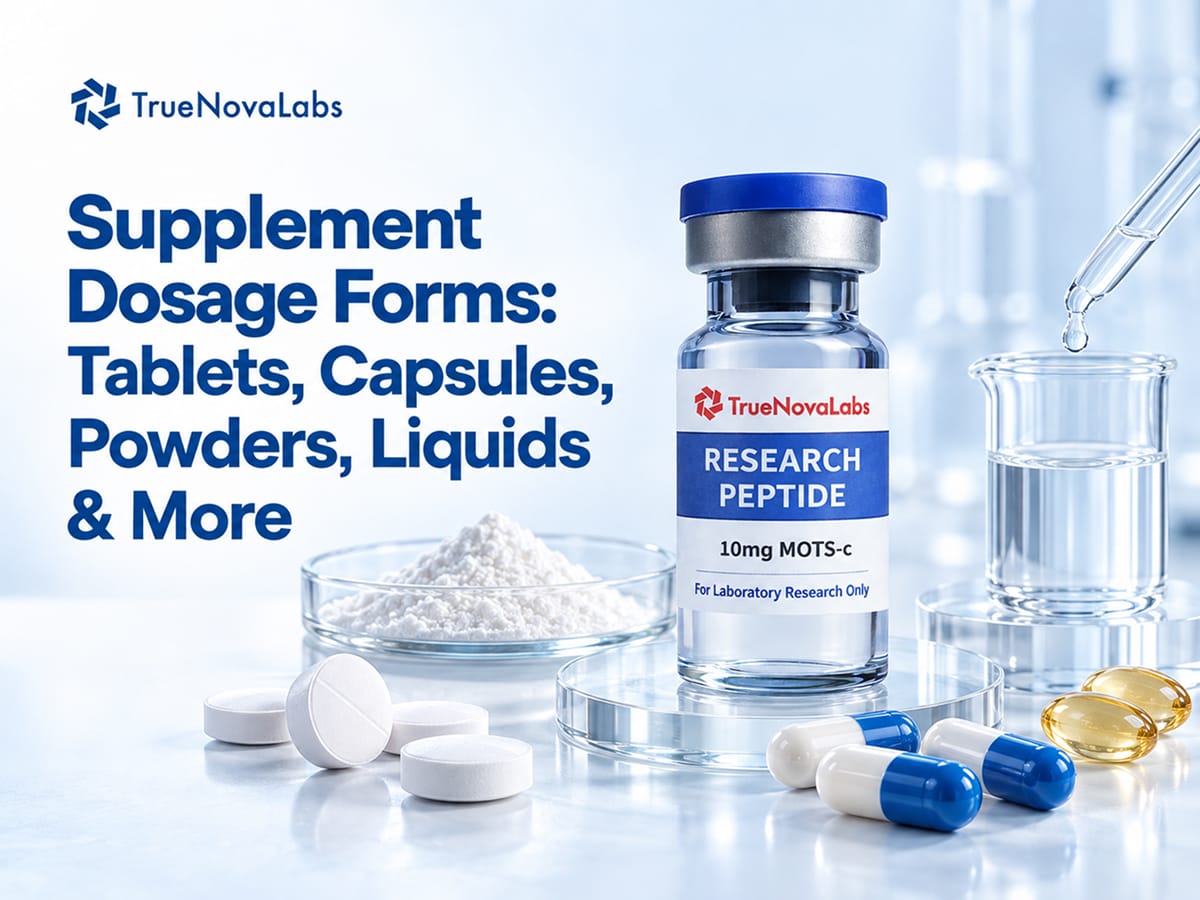
The choice of supplement dosage forms affects more than how a product looks or feels. It can influence manufacturing, quality testing, packaging, storage, and handling. In Canada, dosage form also forms part of the product information used for Natural Health Products (NHPs).
Common formats include tablets, capsules, softgels, powders, liquids, gummies, and granules. However, each format has different physical and manufacturing characteristics. For example, tablets require compression, while liquids may require additional controls for microbial quality and stability.
👉 Explore research-focused peptide resources and learn more about current peptide science at True Nova Labs
Therefore, understanding dosage forms can help researchers, manufacturers, and quality-focused buyers evaluate why a supplement uses a particular format and what quality considerations apply.
What Are Supplement Dosage Forms?
A dosage form is the physical form in which a supplement delivers its ingredients. The format affects how manufacturers produce, measure, package, test, and store the finished product.
Common supplement dosage forms include:
| Dosage Form | General Characteristics |
|---|---|
| Tablets | Compressed solid units |
| Capsules | Shells containing a formulated fill |
| Softgels | Soft-shell units containing liquid or semisolid fills |
| Powders | Non-discrete material measured before use |
| Liquids | Liquid preparations such as solutions or suspensions |
| Gummies | Chewable solid units |
| Granules | Small particles designed for measured use |
However, these formats do not require identical manufacturing controls. A tablet must maintain its physical integrity, while a liquid may require greater attention to microbial quality and container integrity.
Similarly, powders can require controls related to moisture, particle characteristics, and uniform distribution of ingredients.
As a result, dosage form plays an important role in product design and quality evaluation.
👉 Learn more about performance and recovery peptides at SHOP ALL COMPOUNDS
How Do Tablets and Capsules Differ as Supplement Formats?
Tablets and capsules are common solid dosage forms, but their structures and manufacturing processes differ.
Tablets are produced by compressing a formulated mixture into a defined shape. Depending on the formulation, manufacturers can produce coated, chewable, or other specialized tablet formats.
Capsules contain their formulation inside a shell. Hard capsules commonly contain powders or granulated materials, while softgels can contain liquid or semisolid formulations.
| Feature | Tablets | Capsules |
|---|---|---|
| Physical structure | Compressed solid | Shell containing a fill |
| Common formulation | Powder or granulated blend | Powder, liquid, or semisolid |
| Manufacturing focus | Compression and tablet characteristics | Filling and encapsulation |
| Quality considerations | Weight, uniformity, physical integrity | Fill consistency, shell integrity, uniformity |
| Packaging considerations | Moisture and physical protection | Moisture, temperature, and shell protection |
Furthermore, tablets and capsules can require quality testing related to dosage-unit uniformity, disintegration, or dissolution, depending on the product.
Therefore, manufacturers should establish quality requirements according to the specific formulation and dosage form.
What Are Powder and Liquid Supplement Formats?
Powders and liquids provide different ways to formulate and measure a supplement.
Powders are generally non-discrete dosage forms. Users may measure them with a scoop, spoon, or another specified measuring method. Consequently, manufacturers may need to consider blend uniformity, moisture exposure, particle characteristics, and measurement consistency.
Liquids, meanwhile, can include solutions or suspensions. Because of their physical characteristics, liquid products can require additional controls during manufacturing and storage.
Depending on the formulation, manufacturers may monitor:
- Microbial contamination
- pH
- Fill volume
- Physical appearance
- Container integrity
- Stability
- Preservative effectiveness, where applicable
Powders can present different challenges. For instance, moisture can cause clumping or affect the physical characteristics of certain ingredients.
Moreover, packaging can help protect both powder and liquid products from environmental factors that could affect quality.
Therefore, manufacturers select a powder or liquid format based on the formulation, intended use, manufacturing process, stability requirements, and applicable specifications.
How Do Gummies and Softgels Differ From Other Dosage Forms?
Gummies and softgels are also discrete dosage forms, but their physical characteristics differ from tablets and conventional capsules.
Gummies are chewable units produced in defined shapes and sizes. Their formulation may include ingredients that provide the desired texture, structure, and stability.
Softgels use a flexible outer shell and commonly contain liquid or semisolid formulations. This format can be useful for ingredients that are suitable for oil-based or other liquid formulations.
| Format | Key Considerations |
|---|---|
| Gummies | Texture, moisture, shape, uniformity, stability |
| Softgels | Shell integrity, fill consistency, stability |
| Tablets | Compression, physical integrity, disintegration |
| Capsules | Fill uniformity, shell integrity, disintegration |
For example, a softgel containing an oil-based formulation may require different stability considerations from a gummy formulation. Similarly, gummies may require greater attention to moisture and texture during storage.
As a result, manufacturers should evaluate the dosage form together with the ingredients, formulation, and production process.
What Factors Influence the Choice of Supplement Dosage Form?
Several technical and practical factors influence the choice of a supplement dosage form.
Ingredient characteristics
The physical and chemical properties of an ingredient can determine whether it is suitable for a tablet, capsule, powder, liquid, or another format.
Dose size
The amount of an ingredient can also affect the format. A large quantity may be difficult to fit into one capsule or tablet, while powders or liquids may provide greater flexibility.
Stability
Manufacturers need to consider how ingredients respond to moisture, oxygen, temperature, light, and other environmental conditions.
Manufacturing process
Available equipment and production capabilities can influence whether the manufacturer uses blending, compression, encapsulation, or liquid filling.
Intended use
The intended route of administration and recommended conditions of use can also affect the appropriate dosage form.
Packaging
The packaging system should provide suitable protection for the finished product during storage and handling.
For example, a dry formulation may work well in a capsule, while a formulation that requires a solution or suspension may require a liquid format.
Furthermore, the selected dosage form should remain consistent with the product’s intended use and applicable regulatory information.
Therefore, no single dosage form is automatically better than another. The appropriate format depends on the characteristics and requirements of the specific product.
👉 Learn more about performance and recovery peptides at SHOP ALL COMPOUNDS
How Can Dosage Form Affect Stability, Packaging and Handling?
Different dosage forms can respond differently to environmental conditions. Temperature, humidity, light, oxygen, and moisture can all influence product stability.
For this reason, manufacturers need stability information that reflects the characteristics of the finished product and its packaging.
| Dosage Form | Potential Stability or Handling Considerations |
|---|---|
| Tablets | Moisture, physical integrity, dissolution characteristics |
| Capsules | Humidity, shell integrity, fill stability |
| Softgels | Shell integrity, oxygen exposure, fill stability |
| Powders | Moisture, clumping, particle consistency |
| Liquids | Microbial control, pH, container integrity |
| Gummies | Moisture, texture, physical stability |
For example, a powder may require packaging that limits moisture exposure. Similarly, a liquid may require a container that protects the formulation and maintains its integrity throughout storage.
In addition, changes to a dosage form or packaging system can require further quality evaluation. Manufacturers need to determine whether the change could affect stability, physical characteristics, or other product specifications.
Consequently, dosage form, packaging, and storage conditions should be considered together when evaluating a finished supplement.
👉 Explore the science behind supplement ingredients, research methods, and quality evaluation in Supplements: Science, Ingredients, Research & Quality Standards Explained.
FAQ About Supplement Dosage Forms
What are the most common supplement dosage forms?
Common supplement dosage forms include tablets, capsules, softgels, powders, liquids, gummies, and granules. The appropriate format depends on the formulation, ingredients, manufacturing process, and intended use.
Are tablets and capsules the same?
No. Tablets are compressed solid units, while capsules contain a formulation inside a shell. Therefore, their manufacturing processes and quality considerations can differ.
Why can liquid supplements require additional quality controls?
Liquid products can present additional microbiological and physical stability considerations. Therefore, manufacturers may need controls related to microbial quality, pH, filling, packaging, and stability.
Does dosage form affect product stability?
Yes. Different dosage forms can respond differently to moisture, temperature, oxygen, light, and other environmental conditions. Consequently, manufacturers need stability controls appropriate to the finished product.
Conclusion
The choice between tablets, capsules, powders, liquids, gummies, and softgels involves more than appearance or convenience. Each format can require different manufacturing, testing, packaging, stability, and handling controls.
In Canada, dosage form is an important part of Natural Health Product information and quality evaluation. Moreover, applicable specifications and testing can vary according to the physical form and characteristics of the finished product.
Therefore, when evaluating supplement dosage forms, it is useful to consider more than the format itself. Ingredient characteristics, manufacturing processes, quality controls, packaging systems, and stability requirements all contribute to the evaluation.
Understanding these factors provides a clearer framework for comparing supplement formats and assessing the quality considerations behind a finished product.
👉 Explore educational resources and research-focused peptide information at TrueNovaLabs.
Disclaimer:
This content is provided by True Nova Labs for educational and research purposes only. It is not intended to diagnose, treat, cure, or prevent any disease, nor to provide medical or legal advice.





3 Comments
Olivia Morgan
This article gives a clear overview of the different dosage forms available for supplements. I found the comparison between capsules, tablets, powders, and liquids particularly useful when considering convenience and product characteristics.
Daniel Foster
I liked the practical explanation of why supplements come in different forms. Factors such as stability, storage, ease of use, and formulation can all influence which format is most suitable for a particular product.
Sophie Anderson
The overview of supplement dosage forms is easy to understand and useful for anyone comparing different product formats. I especially appreciate the focus on the characteristics of each form rather than suggesting that one format is universally better than another.