
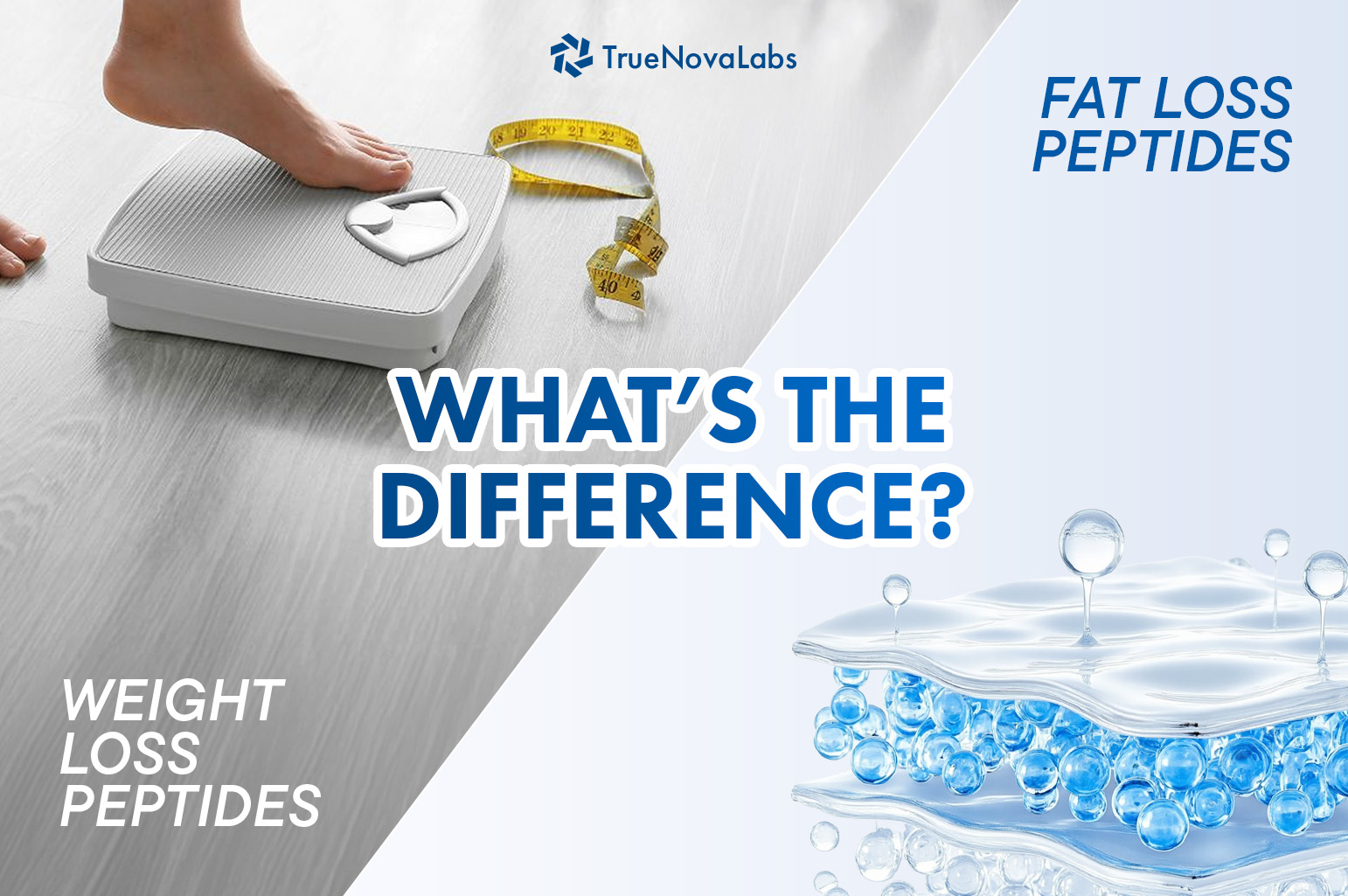
The terms weight loss peptides and fat loss peptides are often used interchangeably, but in research contexts, they describe different objectives and biological mechanisms.
Understanding this distinction is essential, because what looks like “weight loss” on the surface may not reflect what’s actually happening at the metabolic level.
In Canada, many peptides discussed in this space are supplied strictly for laboratory and educational purposes only, not as consumer-ready products. This makes it even more important to interpret these terms through a scientific lens rather than marketing language.
👉 Looking for research-grade peptides with verified purity and transparent sourcing? Explore the collection here SHOP ALL COMPOUNDS
This guide breaks down the difference between weight loss and fat loss peptides, how they work, and how to interpret results more accurately.
Understanding Weight Loss Peptides
Weight loss peptides are typically studied for how they influence overall body mass, primarily through appetite and metabolic signaling.
In research discussions, these peptides are often associated with pathways that regulate:
- hunger perception
- satiety signaling
- food intake behavior
- glucose response
Rather than directly targeting fat, they influence how much energy enters the system.
This is why weight loss peptides are often linked to compounds that interact with GLP-1 or related pathways. Their primary effect is not on fat cells directly, but on behavioral and hormonal signals that determine caloric intake.
As a result, weight loss may include changes in:
- fat mass
- water retention
- muscle mass
This broader impact is what defines “weight loss” in research.

How Fat Loss Peptides Work Differently
Fat loss peptides are typically discussed in relation to how the body stores and utilizes fat specifically, rather than total weight.
In research, these peptides are studied for their potential influence on:
- metabolic signaling
- energy utilization
- fat mobilization pathways
- hormonal regulation tied to body composition
While there is overlap between the two categories, fat loss peptides are more closely associated with how energy is used, not just how much is consumed.
However, it is important to note that even in this category, peptides do not directly “target fat” in a localized way. Instead, they may influence system-wide conditions that affect fat metabolism over time.
Main Goals: Appetite Control vs Fat Burning
At the core of the distinction is the difference in primary objective.
Weight loss peptides are generally studied for how they influence appetite and intake, while fat loss peptides are discussed in terms of energy use and metabolic efficiency.
This difference can be summarized simply:
- Weight loss peptides → influence how much you eat
- Fat loss peptides → influence how the body uses energy
In practice, these systems are deeply interconnected. Appetite affects intake, intake affects energy balance, and energy balance influences fat storage.
This is why the distinction is conceptual rather than absolute.

Comparing Results and Expectations
One of the most common misunderstandings is expecting both categories to produce the same outcomes.
Weight loss peptides may lead to:
- reduced energy intake
- gradual changes in body weight
- shifts in appetite behavior
Fat loss peptides are more often discussed in relation to:
- body composition changes
- metabolic signaling
- long-term energy utilization
However, neither category produces immediate results.
Changes typically occur gradually as:
- signaling pathways adapt
- energy balance shifts
- metabolic systems respond over time
This is why research focuses on patterns over time rather than short-term outcomes.
Risks and Side Effects Compared
From a safety perspective, the risks associated with both categories are often similar, but the context differs.
Most concerns are not tied directly to the peptide mechanism, but to:
- product purity
- contamination
- improper storage
- inconsistent handling
Because peptides are sensitive molecules, degradation or impurities can alter their biological behavior.
Some research discussions also note differences in how peptides interact with:
- appetite-related pathways
- digestive systems
- endocrine signaling
In Canada, substances are regulated based on classification and intended use by organizations such as Health Canada, reinforcing the importance of proper context.
👉 To ensure reliable research outcomes, explore peptides backed by verified testing here SHOP ALL COMPOUNDS
Which Option Fits Different Goals?
From a research perspective, the better question is not which option is “better,” but which aligns with the objective being studied.
If the focus is on:
- appetite regulation
- caloric intake behavior
- satiety signaling
then weight loss peptides are more relevant.
If the focus is on:
- metabolic efficiency
- energy utilization
- body composition
then fat loss peptides may be more aligned with that goal.
However, in practice, most research overlaps both areas because metabolism is not divided into isolated systems.
Understanding how these pathways interact is more important than choosing between categories.
Learn how appetite suppressant peptides may influence hunger, cravings, and satiety in research—explore related weight loss peptide insights at Peptides for Weight Loss: Benefits, Mechanisms & What to Expect
FAQ – Weight Loss Peptides vs Fat Loss Peptides
What is the difference between weight loss and fat loss peptides?
Weight loss peptides influence overall body mass, while fat loss peptides are associated with how the body uses and stores fat.
Do weight loss peptides reduce fat?
They may indirectly influence fat through changes in appetite and energy intake.
Are fat loss peptides more effective?
They target different mechanisms, so effectiveness depends on the research objective.
Why is the distinction important?
Because weight loss does not always equal fat loss, and understanding the difference improves interpretation of results.
Are these peptides approved in Canada?
Many are supplied as research peptides and are not approved therapeutic products unless regulated under pharmaceutical frameworks.
Conclusion
The difference between weight loss peptides vs fat loss peptides reflects two ways of looking at the same system.
One focuses on input—how much energy enters the body.
The other focuses on utilization—how that energy is processed and stored.
In reality, both are part of the same metabolic network.
Understanding this relationship is key to interpreting results accurately and avoiding oversimplified conclusions.
For researchers in Canada, reliable outcomes depend on:
- high-quality peptide sourcing
- proper handling and storage
- understanding biological pathways
- realistic expectations
Explore Research-Grade Peptides
If you’re looking for research peptides supported by verified purity, transparent sourcing, and consistent quality standards, explore the full collection here SHOP ALL COMPOUNDS
Disclaimer:
This content is provided by True Nova Labs for educational and research purposes only. It is not intended to diagnose, treat, cure, or prevent any disease, nor to provide medical or legal advice.




3 Comments
Ethan Walker
Really informative breakdown between weight loss peptides and fat loss peptides. I’ve seen a lot of confusion around these terms online, so this article made it much easier to understand how they actually work differently. Curious if you think one category is generally better for long-term body composition goals?
Olivia Bennett
I liked how clearly this article explained the science without making it overly technical. The comparison between appetite control and direct fat metabolism was especially helpful. It would be interesting to see a follow-up article about which peptides people in their 30s–40s respond to best.
Daniel Brooks
Very solid explanation overall. I’ve been researching peptide therapies for a while, and this article clarified a few things I still wasn’t fully sure about. The examples used here made the topic much easier to follow for beginners too.