
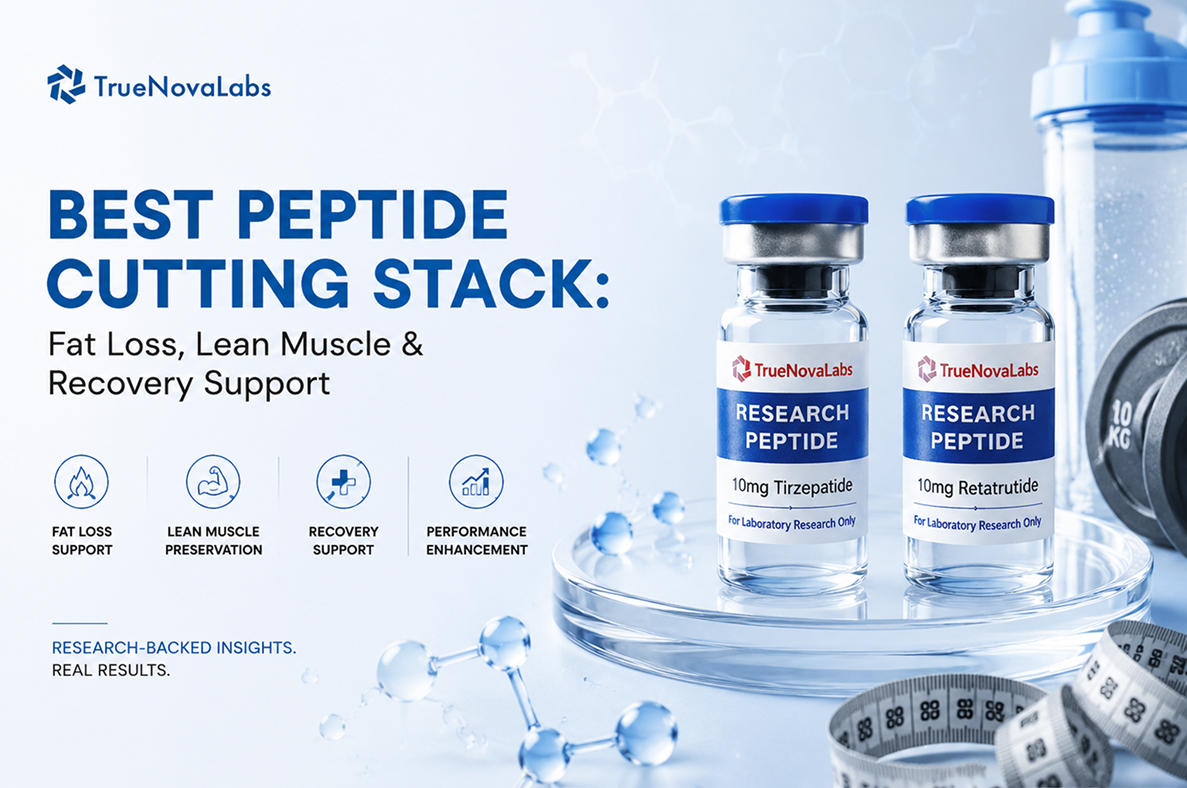
Cutting phases in bodybuilding and performance training focus on reducing body fat while maintaining lean muscle. Interest in a peptide cutting stack has grown as researchers explore how specific peptides may influence fat metabolism, recovery pathways, and lean muscle preservation. Unlike bulking stacks, cutting stacks are often designed to support metabolic efficiency and recovery during caloric restriction or high-intensity training.
In Canada, peptides referenced in this context are typically supplied for laboratory and educational research purposes only, and not approved for direct performance enhancement.
👉 Explore research-grade peptides with verified purity and transparent sourcing at True Nova Labs
This guide explains what a cutting peptide stack typically includes, the most commonly studied compounds, and considerations for optimizing fat loss while preserving muscle.
What a Cutting Peptide Stack Typically Includes
Research discussions about cutting peptide stacks often focus on combining peptides that target different physiological systems. A typical stack may include:
- Peptides that influence growth hormone (GH) and IGF-1 pathways
- Peptides studied for fat metabolism support
- Compounds that aid recovery and repair to maintain lean mass
The goal is to support fat loss while minimizing muscle catabolism, providing the biological context for effective body composition changes.
👉 Learn more about performance and recovery peptides at SHOP ALL COMPOUNDS

Popular Peptides Used During Cutting Phases
Several peptides are frequently referenced in research involving cutting or fat loss phases:
| Peptide | Research Focus | Cutting Context |
|---|---|---|
| CJC-1295 | GHRH signaling | Supports GH-related recovery |
| Ipamorelin | GH secretagogue | Pulsatile GH release and repair |
| BPC-157 | Tissue repair | Maintains connective tissue and muscle recovery |
| TB-500 | Cell regeneration | Supports recovery during caloric restriction |
| Tesamorelin | GH stimulation | Endocrine signaling for fat metabolism research |
These peptides are typically studied for how they support the biological systems required for recovery and adaptation, rather than directly causing fat loss.
Maintaining Lean Muscle While Cutting
Preserving lean muscle during fat loss requires optimizing:
- Recovery efficiency to minimize tissue breakdown
- Hormonal signaling to support anabolic pathways
- Protein intake to provide necessary amino acids
- Training consistency to maintain strength and performance
Peptides may play a supportive role by enhancing GH and recovery signaling, but training and nutrition remain primary factors.
Recovery and Energy Considerations
During cutting phases, the body is under greater metabolic stress due to reduced caloric intake. Research shows that peptides may help:
- Support tissue repair during high-frequency training
- Maintain recovery rate despite lower energy intake
- Preserve lean muscle by influencing anabolic signaling
Even in research contexts, peptides are studied as part of a broader recovery and adaptation system rather than as standalone interventions.
👉 Learn more about performance and recovery peptides at SHOP ALL COMPOUNDS
Risks and Side Effects of Cutting Stacks
Potential concerns in research discussions include:
- Hormonal variability and signaling disruptions
- Peptide degradation or instability due to improper storage
- Contamination during preparation
- Individual biological variability affecting responses
Many of these risks are tied to quality, handling, and purity, rather than the peptide mechanisms themselves.
In Canada, regulatory oversight by organizations such as Health Canada ensures that proper classification and intended use guide safe research practices.

Choosing a Cutting Strategy Based on Goals
When considering a research-based approach to a peptide cutting stack:
- Lean Muscle Preservation: Focus on recovery and GH-related peptides (CJC-1295, Ipamorelin)
- Fat Loss Support: Peptides that influence metabolic pathways indirectly (Tesamorelin)
- Recovery Emphasis: Add repair-oriented peptides like BPC-157 or TB-500
The most effective stack depends on the research goal rather than attempting to combine every peptide available.
Read Peptides for Bodybuilding: Muscle Growth, Recovery & Performance Explained to learn more about muscle growth, recovery, performance potential, and safety considerations.
FAQ – Peptide Cutting Stack
What is a peptide cutting stack?
A combination of peptides studied together to explore how multiple pathways may influence fat loss, recovery, and lean muscle preservation.
Do peptides directly burn fat?
No. They are studied for how they may support the biological systems that facilitate fat loss and maintain lean muscle during caloric restriction.
Which peptides are most commonly used for cutting?
CJC-1295, Ipamorelin, BPC-157, TB-500, and Tesamorelin.
Are cutting stacks approved in Canada?
Most are supplied as research compounds and are not approved therapeutic products unless regulated under pharmaceutical frameworks.
Conclusion
Interest in peptide cutting stacks reflects a growing understanding of body composition research. Researchers study these compounds for how they may:
- support fat metabolism
- enhance recovery
- preserve lean muscle
- facilitate adaptation during training and caloric restriction
While peptides can provide support, training, nutrition, and recovery remain the primary drivers of results.
For researchers in Canada, reliable outcomes depend on:
- verified peptide quality
- proper storage and handling
- realistic expectations
- integration with training and recovery strategies
Explore Research-Grade Peptides
If you’re looking for peptides with verified purity, transparent sourcing, and consistent quality standards, explore the full collection here SHOP ALL COMPOUNDS
Disclaimer:
This content is provided by True Nova Labs for educational and research purposes only. It is not intended to diagnose, treat, cure, or prevent any disease, nor to provide medical or legal advice.



3 Comments
Ryan Mitchell
Great breakdown of the different approaches to peptide cutting stacks. I especially liked how the article explained the role of recovery and muscle preservation during a calorie deficit, since those factors are often overlooked when people focus only on fat loss. Have you found that recovery-focused peptides are becoming more popular in cutting protocols lately?
Christopher Hall
This was a well-structured and informative article. The comparison between different peptides and their research focus made it much easier to understand that there isn’t a one-size-fits-all solution for cutting. I think many beginners would benefit from learning about the importance of choosing compounds based on specific goals rather than hype.
Andrew Collins
I appreciate the balanced perspective in this guide. Too many discussions around cutting stacks focus on quick results, while this article highlights the importance of long-term body composition, recovery, and realistic expectations. A follow-up article covering common mistakes people make when building a cutting stack would be an interesting read.